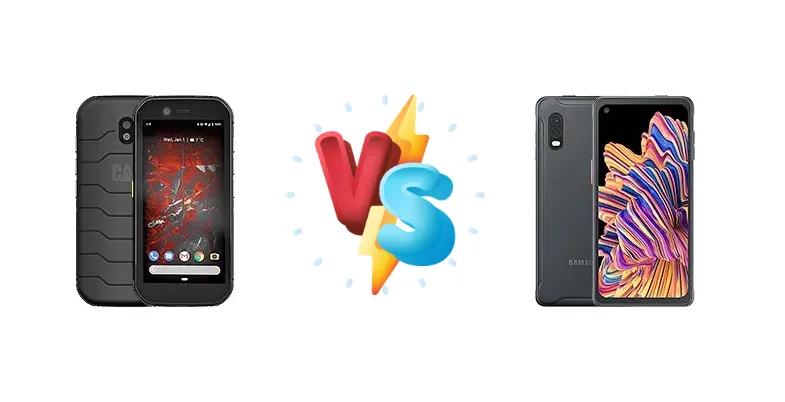
The Cat S42 and Samsung Galaxy XCover Pro both target a niche: users needing a durable, reliable smartphone for demanding environments. However, their approaches to achieving this differ significantly, particularly in processing power and overall user experience. This comparison dissects these differences to determine which device best suits your needs, from construction workers to field technicians.
🏆 Quick Verdict
For the average user prioritizing raw performance and a more modern software experience, the Samsung Galaxy XCover Pro is the clear winner. Its Exynos 9611 chipset offers a substantial performance leap over the Cat S42’s Helio A20, making it better suited for multitasking and demanding applications. However, the Cat S42 remains a viable option for basic use cases where durability is paramount and budget is a key concern.
| Network |
|---|
| 2G bands | GSM 850 / 900 / 1800 / 1900 | GSM 850 / 900 / 1800 / 1900 |
| 3G bands | HSDPA 850 / 900 / 1900 / 2100 - EU | HSDPA 850 / 900 / 1900 / 2100 - International |
| 4G bands | 1, 2, 3, 4, 5, 7, 8, 20, 28 | 1, 2, 3, 5, 7, 8, 20, 28, 38, 40, 41 - International |
| Speed | HSPA 42.2/5.76 Mbps, LTE (2CA) Cat6 300/50 Mbps | HSPA 42.2/5.76 Mbps, LTE (3CA) Cat11 600/50 Mbps |
| Technology | GSM / HSPA / LTE | GSM / HSPA / LTE |
| | HSDPA 850 / 900 / 1700(AWS) / 1900 / 2100 - USA | 1, 2, 3, 4, 5, 7, 12, 13, 14, 20, 29, 38, 40, 41, 66 - Canada |
| Launch |
|---|
| Announced | 2020, January. Released 2020, August | 2020, January |
| Status | Discontinued | Available. Released 2020, January |
| Body |
|---|
| Dimensions | 161.4 x 77.3 x 12.7 mm (6.35 x 3.04 x 0.5 in) | 159.9 x 76.7 x 10 mm (6.30 x 3.02 x 0.39 in) |
| SIM | · Nano-SIM· Nano-SIM + Nano-SIM | · Nano-SIM· Nano-SIM + Nano-SIM |
| Weight | 220 g (7.76 oz) | 218 g (7.69 oz) |
| | IP69 dust/water resistant (up to 1.5m for 35 min)
Drop-to-concrete resistance from up to 1.8m
MIL-STD-810H compliant | IP68 dust/water resistant (up to 1.5m for 35 min)
Drop-to-concrete resistance from up to 1.5m
MIL-STD-810G compliant*
*does not guarantee ruggedness or use in extreme conditions |
| Display |
|---|
| Protection | Corning Gorilla Glass 5 | Corning Gorilla Glass 5 |
| Resolution | 720 x 1440 pixels, 18:9 ratio (~293 ppi density) | 1080 x 2340 pixels, 19.5:9 ratio (~409 ppi density) |
| Size | 5.5 inches, 78.1 cm2 (~62.6% screen-to-body ratio) | 6.3 inches, 97.4 cm2 (~79.4% screen-to-body ratio) |
| Type | IPS LCD | IPS LCD |
| Platform |
|---|
| CPU | Quad-core 1.8 GHz Cortex-A53 | Octa-core (4x2.3 GHz Cortex-A73 & 4x1.7 GHz Cortex-A53) |
| Chipset | Mediatek MT6761D Helio A20 (12 nm) | Exynos 9611 (10 nm) |
| GPU | PowerVR GE8320 | Mali-G72 MP3 |
| OS | Android 10, planned upgrade to Android 11 | Android 10, upgradable to Android 13, One UI 5 |
| Memory |
|---|
| Card slot | microSDXC (dedicated slot) | microSDXC (dedicated slot) |
| Internal | 32GB 3GB RAM | 64GB 4GB RAM |
| | eMMC 5.1 | - |
| Main Camera |
|---|
| Dual | - | 25 MP, f/1.7, 26mm (wide), PDAF
8 MP, f/2.2, 123˚ (ultrawide), 1/4.0", 1.12µm |
| Features | LED flash | Dual-LED flash, HDR, panorama |
| Single | 13 MP, f/2.0, (wide), PDAF | - |
| Video | 1080p@30fps | 1080p@30fps |
| Selfie camera |
|---|
| Features | - | HDR |
| Single | 5 MP | 13 MP, f/2.0, (wide), 1/3.1", 1.12µm |
| Video | - | 1080p@30fps |
| Sound |
|---|
| 3.5mm jack | Yes | Yes |
| 35mm jack | Yes | Yes |
| Loudspeaker | Yes | Yes |
| Comms |
|---|
| Bluetooth | 5.0, A2DP, LE | 5.0, A2DP, LE |
| NFC | Yes | Yes |
| Positioning | GPS, GLONASS, BDS | GPS, GLONASS, GALILEO, BDS |
| Radio | FM radio | FM radio (market/region dependent) |
| USB | microUSB 2.0, OTG | USB Type-C 2.0 |
| WLAN | Wi-Fi 802.11 b/g/n | Wi-Fi 802.11 a/b/g/n/ac/k/v/r, dual-band, Wi-Fi Direct |
| Features |
|---|
| Sensors | Accelerometer, proximity, compass | Fingerprint (side-mounted), accelerometer, gyro, proximity, compass |
| | - | ANT+ |
| Battery |
|---|
| Charging | - | 15W wired |
| Type | Li-Ion 4200 mAh | Li-Po 4050 mAh, removable |
| Misc |
|---|
| Colors | Black | Black |
| Models | - | SM-G715FN/DS, SM-G715FN, SM-G715F, SM-G715W, SM-G715U, SM-G715U1 |
| Price | About 300 EUR | About 120 EUR |
| SAR EU | - | 0.47 W/kg (head) 1.23 W/kg (body) |
Cat S42
- Exceptional durability and ruggedness
- Potentially longer battery life due to simpler chipset
- Lower price point
- Significantly slower performance
- Outdated chipset
- Limited multitasking capabilities
Samsung Galaxy XCover Pro
- Faster and more responsive performance
- 15W fast charging
- More versatile software experience
- Higher price point
- May be slightly less durable than the Cat S42
- Battery life may be slightly shorter under heavy load
Display Comparison
Neither device boasts a cutting-edge display. Details on panel type and resolution are missing for both, but the focus is clearly on practicality over aesthetics. The lack of high refresh rates is expected in this segment. The real difference lies in processing power impacting UI smoothness, not display quality itself. Expect both to be adequate for outdoor visibility, but not exceptional color accuracy.
Camera Comparison
Camera details are sparse, but both phones likely prioritize functionality over photographic excellence. Given the target audience, image quality is less critical than durability. Expect both to offer basic image capture capabilities suitable for documentation purposes. The absence of detailed sensor information suggests neither phone will excel in low-light conditions. Any 2MP macro or depth sensors are likely to offer minimal benefit.
Performance
The performance gap is the most significant differentiator. The Samsung Galaxy XCover Pro’s Exynos 9611, built on a 10nm process, is a substantial upgrade over the Cat S42’s Mediatek Helio A20 (12nm). The Exynos utilizes an octa-core configuration (4x2.3 GHz Cortex-A73 & 4x1.7 GHz Cortex-A53) compared to the Cat S42’s quad-core 1.8 GHz Cortex-A53. This translates to significantly faster app loading times, smoother multitasking, and a more responsive overall experience. The Exynos’s more advanced architecture allows it to handle more complex tasks without significant slowdown. While neither phone is a gaming powerhouse, the XCover Pro will handle less demanding titles with greater ease.
Battery Life
Battery capacity is not specified for the Cat S42, but rugged phones typically prioritize long battery life. The Samsung Galaxy XCover Pro offers 15W wired charging, a feature absent on the Cat S42. While 15W isn’t fast by modern standards, it’s a significant advantage over slower charging solutions. The Exynos 9611’s 10nm process also contributes to better power efficiency, potentially offsetting any capacity difference between the two devices. Real-world battery life will depend heavily on usage patterns, but the XCover Pro’s charging capabilities provide a practical benefit for users who need to quickly top up their battery.
Buying Guide
Buy the Cat S42 if you need an exceptionally durable, no-frills smartphone for basic communication and limited app usage, and cost is a primary factor. It’s ideal for roles where the phone is primarily used for calls, texts, and simple data collection. Buy the Samsung Galaxy XCover Pro if you prefer a more responsive user experience, require better multitasking capabilities, and appreciate features like 15W fast charging and a more versatile software ecosystem. This phone is better suited for professionals who rely on apps for field work, data analysis, or communication.
Frequently Asked Questions
❓ Does the Exynos 9611 in the Galaxy XCover Pro tend to overheat during prolonged use, like extended navigation or video recording?
The Exynos 9611 is a relatively efficient chipset, and while it can get warm under sustained load, it’s unlikely to experience significant thermal throttling in typical usage scenarios. The phone’s ruggedized design also provides more surface area for heat dissipation compared to slimmer smartphones. However, extremely demanding tasks like prolonged 4K video recording may lead to some performance reduction.
❓ How does the Cat S42’s Helio A20 handle common work apps like Microsoft Office or basic email clients?
The Helio A20 can handle basic productivity apps like Microsoft Office and email clients, but expect slower loading times and occasional lag, especially when multitasking. It’s sufficient for light office work, but users who frequently switch between apps or work with large files may find the performance frustrating. The XCover Pro is significantly better suited for these tasks.
❓ Are the batteries on either phone user-replaceable, a common feature in older rugged devices?
Neither the Cat S42 nor the Samsung Galaxy XCover Pro feature user-replaceable batteries. This is a trend in modern smartphone design, even within the rugged category. While it reduces user convenience, it allows for more streamlined designs and improved water resistance.