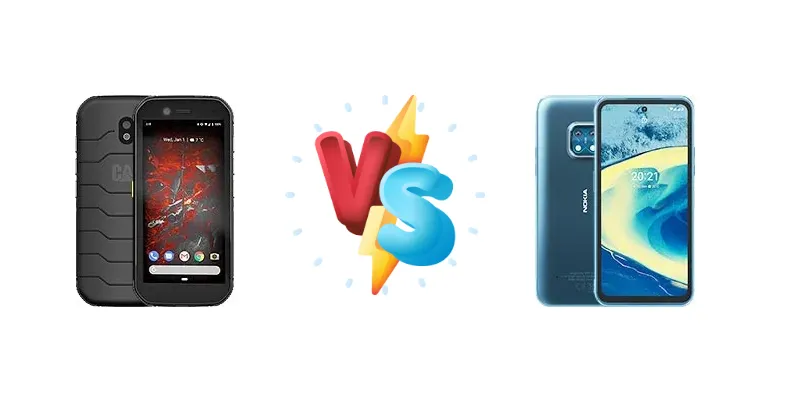
The rugged smartphone market caters to a specific need: durability. Both the Cat S42 and Nokia XR20 aim to deliver on that promise, but they approach it with vastly different internal hardware. The Cat S42 prioritizes affordability with a basic Mediatek chipset, while the Nokia XR20 steps up with a Qualcomm Snapdragon 480 5G, adding connectivity and a performance boost. This comparison dissects these differences to determine which phone best suits your needs.
🏆 Quick Verdict
For the average user needing a reliable, 5G-connected rugged phone, the Nokia XR20 is the clear winner. Its Snapdragon 480 offers significantly better performance and future-proofing than the Cat S42’s Helio A20, and the addition of wireless charging adds convenience. While the Cat S42 is cheaper, the performance gap is too large to ignore for most users.
| Network |
|---|
| 2G bands | GSM 850 / 900 / 1800 / 1900 | GSM 850 / 900 / 1800 / 1900 |
| 3G bands | HSDPA 850 / 900 / 1900 / 2100 - EU | HSDPA 850 / 900 / 1700(AWS) / 1900 / 2100 |
| 4G bands | 1, 2, 3, 4, 5, 7, 8, 20, 28 | 1, 2, 3, 4, 5, 7, 8, 12, 13, 14, 20, 25, 26, 28, 30, 38, 40, 41, 48, 66, 71 |
| 5G bands | - | 2, 5, 25, 38, 41, 48, 66, 77, 78 SA/NSA |
| Speed | HSPA 42.2/5.76 Mbps, LTE (2CA) Cat6 300/50 Mbps | HSPA, LTE, 5G |
| Technology | GSM / HSPA / LTE | GSM / CDMA / HSPA / EVDO / LTE / 5G |
| | HSDPA 850 / 900 / 1700(AWS) / 1900 / 2100 - USA | CDMA2000 1xEV-DO |
| Launch |
|---|
| Announced | 2020, January. Released 2020, August | 2021, July 27 |
| Status | Discontinued | Available. Released 2021, August 04 |
| Body |
|---|
| Dimensions | 161.4 x 77.3 x 12.7 mm (6.35 x 3.04 x 0.5 in) | 171.6 x 81.5 x 10.6 mm (6.76 x 3.21 x 0.42 in) |
| SIM | · Nano-SIM· Nano-SIM + Nano-SIM | · Nano-SIM· Nano-SIM + Nano-SIM |
| Weight | 220 g (7.76 oz) | 248 g (8.75 oz) |
| | IP69 dust/water resistant (up to 1.5m for 35 min)
Drop-to-concrete resistance from up to 1.8m
MIL-STD-810H compliant | IP68 dust/water resistant (up to 1.5m for 60 min)
Drop-to-concrete resistance from up to 1.8m
MIL-STD-810H compliant |
| Display |
|---|
| Protection | Corning Gorilla Glass 5 | Corning Gorilla Glass Victus |
| Resolution | 720 x 1440 pixels, 18:9 ratio (~293 ppi density) | 1080 x 2400 pixels, 20:9 ratio (~395 ppi density) |
| Size | 5.5 inches, 78.1 cm2 (~62.6% screen-to-body ratio) | 6.67 inches, 107.4 cm2 (~76.8% screen-to-body ratio) |
| Type | IPS LCD | IPS LCD, 550 nits |
| Platform |
|---|
| CPU | Quad-core 1.8 GHz Cortex-A53 | Octa-core (2x2.0 GHz Kryo 460 & 6x1.8 GHz Kryo 460) |
| Chipset | Mediatek MT6761D Helio A20 (12 nm) | Qualcomm SM4350 Snapdragon 480 5G (8 nm) |
| GPU | PowerVR GE8320 | Adreno 619 |
| OS | Android 10, planned upgrade to Android 11 | Android 11, upgradable to Android 13 |
| Memory |
|---|
| Card slot | microSDXC (dedicated slot) | microSDXC (uses shared SIM slot) |
| Internal | 32GB 3GB RAM | 64GB 4GB RAM, 128GB 6GB RAM |
| | eMMC 5.1 | - |
| Main Camera |
|---|
| Dual | - | 48 MP, f/1.8, (wide), 1/2.25", 0.8µm, PDAF
13 MP, f/2.4, 123˚ (ultrawide), 1/3.0", 1.12µm |
| Features | LED flash | Zeiss optics, Dual-LED dual-tone flash, second LED flash, HDR, panorama |
| Single | 13 MP, f/2.0, (wide), PDAF | 8 MP, f/2.0 (wide), 1/4.0", 1.12µm |
| Video | 1080p@30fps | 1080p@30fps |
| Selfie camera |
|---|
| Single | 5 MP | 8 MP, f/2.0 (wide), 1/4.0", 1.12µm |
| Video | - | 1080p@30fps |
| Sound |
|---|
| 3.5mm jack | Yes | Yes |
| 35mm jack | Yes | Yes |
| Loudspeaker | Yes | Yes, with stereo speakers |
| Comms |
|---|
| Bluetooth | 5.0, A2DP, LE | 5.1, A2DP, LE, aptX Adaptive |
| NFC | Yes | Yes |
| Positioning | GPS, GLONASS, BDS | GPS (L1+L5), GLONASS, BDS, GALILEO, QZSS, NavIC |
| Radio | FM radio | Unspecified |
| USB | microUSB 2.0, OTG | USB Type-C 3.0 |
| WLAN | Wi-Fi 802.11 b/g/n | Wi-Fi 802.11 a/b/g/n/ac/6, dual-band, Wi-Fi Direct |
| Features |
|---|
| Sensors | Accelerometer, proximity, compass | Fingerprint (side-mounted), accelerometer, gyro, proximity, compass, barometer |
| Battery |
|---|
| Charging | - | 18W wired
15W wireless |
| Type | Li-Ion 4200 mAh | Li-Po 4630 mAh |
| Misc |
|---|
| Colors | Black | Ultra Blue, Granite Gray |
| Models | - | TA-1368, TA-1362 |
| Price | About 300 EUR | About 270 EUR |
| SAR EU | - | 1.13 W/kg (head) 1.43 W/kg (body) |
Cat S42
- Most affordable rugged phone option
- Durable build quality (expected of the Cat brand)
- Simple and straightforward user experience
- Significantly slower performance
- Lacks 5G connectivity
- Slower charging speeds
Nokia XR20
- 5G connectivity for faster data speeds
- More powerful Snapdragon 480 processor
- Wireless charging support
- Higher price point
- May not be as exceptionally durable as the Cat S42 in extreme conditions (though still rugged)
- Software update support may be limited compared to other Nokia phones
Display Comparison
Neither device boasts a cutting-edge display. Details on panel type and resolution are missing for both, but the focus is clearly on durability, not visual fidelity. The lack of high refresh rates is expected in this segment. However, the Nokia XR20 benefits from the more modern Snapdragon chipset potentially enabling better image signal processing for display calibration. The Cat S42’s older chipset may result in less accurate color reproduction. Bezels are likely substantial on both to contribute to drop protection.
Camera Comparison
Detailed camera specs are unavailable, but the chipset difference suggests a clear advantage for the Nokia XR20. The Snapdragon 480’s image signal processor (ISP) is far more capable than the one found in the Helio A20. This means better image quality, especially in low-light conditions, and faster image processing. While both phones likely feature basic camera setups, the XR20 will likely deliver sharper, more detailed photos and videos. Expect both to have a focus on practicality over photographic excellence.
Performance
The performance disparity is the most significant difference. The Cat S42’s Mediatek MT6761D Helio A20, a quad-core Cortex-A53 processor built on a 12nm process, is designed for basic functionality. The Nokia XR20’s Qualcomm SM4350 Snapdragon 480 5G, with its octa-core configuration (2x2.0 GHz Kryo 460 & 6x1.8 GHz Kryo 460) and 8nm fabrication, offers a substantial leap in processing power. This translates to faster app loading times, smoother multitasking, and a more responsive user experience. The 8nm process also contributes to better thermal efficiency, reducing the likelihood of throttling under sustained load. The Snapdragon 480 also includes an integrated 5G modem, a feature absent in the Cat S42.
Battery Life
Battery capacity is not specified for either device. However, the Nokia XR20’s 18W wired and 15W wireless charging capabilities provide a significant convenience advantage. The Cat S42 likely relies solely on slower wired charging. While a larger battery capacity on the Cat S42 could offset the slower charging, the Snapdragon 480’s improved power efficiency means the XR20 will likely achieve comparable or better battery life despite potentially having a smaller capacity. Wireless charging is a key differentiator for users who prefer cable-free convenience.
Buying Guide
Buy the Cat S42 if you need the absolute cheapest entry point into the rugged phone market and your usage is limited to basic tasks like calls, texts, and light app use. You’re prioritizing minimal cost over performance and future features. Buy the Nokia XR20 if you prefer a more responsive experience, require 5G connectivity for faster data speeds, and value the convenience of wireless charging. This phone is for users who need a durable device that can also handle everyday smartphone tasks without frustration.
Frequently Asked Questions
❓ Will the Nokia XR20’s Snapdragon 480 handle demanding apps like navigation or offline maps without lag?
Yes, the Snapdragon 480 is significantly more capable than the Helio A20 in the Cat S42. It will handle navigation apps, offline maps, and most common smartphone applications with ease, providing a much smoother and more responsive experience. The extra cores and higher clock speeds make a noticeable difference.
❓ Is the Cat S42 a good choice for someone who primarily uses their phone for calls, texts, and basic web browsing?
Yes, the Cat S42 is perfectly adequate for those basic tasks. Its Helio A20 chipset is sufficient for calls, texts, and light web browsing. However, be prepared for slower loading times and a less responsive experience compared to the Nokia XR20. If you prioritize affordability above all else, the Cat S42 is a viable option.
❓ How does the 5G connectivity on the Nokia XR20 benefit a user in a rural area?
Even in rural areas, 5G is expanding. The Nokia XR20’s 5G capability provides future-proofing and potentially faster data speeds where available. Even if 5G isn’t immediately accessible, the phone will fall back to 4G, and the Snapdragon 480’s modem is also more efficient at managing 4G connections, potentially improving signal strength and battery life.