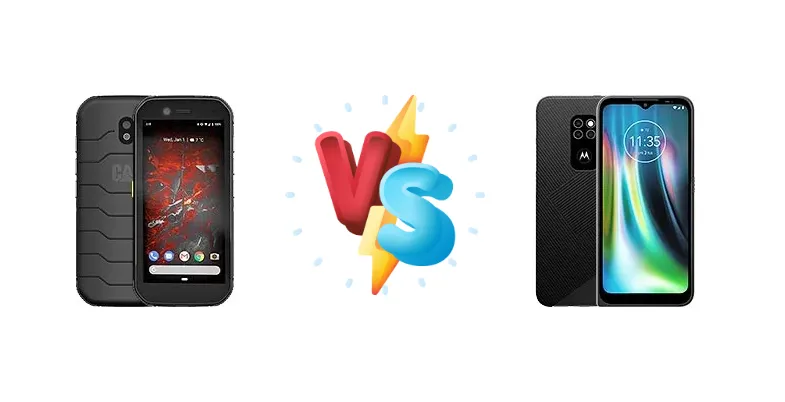
The Cat S42 and Motorola Defy (2021) both target a niche: users needing a phone that can withstand drops, dust, and water. However, their approaches to achieving this ruggedness differ significantly, particularly in internal hardware. This comparison dissects those differences, focusing on performance, battery life, and overall value to help you choose the right tool for the job.
🏆 Quick Verdict
For most users prioritizing a responsive experience and faster charging, the Motorola Defy (2021) is the better choice. Its Snapdragon 662 chipset offers a substantial performance advantage over the Cat S42’s Helio A20, despite both phones sharing an identical 129-hour endurance rating. The Cat S42 remains viable for basic tasks and extreme environments where absolute simplicity is key.
| Network |
|---|
| 2G bands | GSM 850 / 900 / 1800 / 1900 | GSM 850 / 900 / 1800 / 1900 |
| 3G bands | HSDPA 850 / 900 / 1900 / 2100 - EU | HSDPA 850 / 900 / 1700(AWS) / 1900 / 2100 - LATAM |
| 4G bands | 1, 2, 3, 4, 5, 7, 8, 20, 28 | 1, 2, 3, 5, 7, 8, 18, 19, 20, 26, 28, 38, 40, 41 - EMEA |
| Speed | HSPA 42.2/5.76 Mbps, LTE (2CA) Cat6 300/50 Mbps | HSPA 42.2/5.76 Mbps, LTE Cat4 150/50 Mbps |
| Technology | GSM / HSPA / LTE | GSM / HSPA / LTE |
| | HSDPA 850 / 900 / 1700(AWS) / 1900 / 2100 - USA | 1, 2, 3, 4, 5, 7, 8, 19, 28, 66 - LATAM |
| Launch |
|---|
| Announced | 2020, January. Released 2020, August | 2021, June 17 |
| Status | Discontinued | Available. Released 2021, July 25 |
| Body |
|---|
| Build | - | Glass front (Gorilla Glass Victus), plastic frame, plastic back |
| Dimensions | 161.4 x 77.3 x 12.7 mm (6.35 x 3.04 x 0.5 in) | 169.8 x 78.2 x 10.9 mm (6.69 x 3.08 x 0.43 in) |
| SIM | · Nano-SIM· Nano-SIM + Nano-SIM | · Nano-SIM· Nano-SIM + Nano-SIM |
| Weight | 220 g (7.76 oz) | 232 g (8.18 oz) |
| | IP69 dust/water resistant (up to 1.5m for 35 min)
Drop-to-concrete resistance from up to 1.8m
MIL-STD-810H compliant | IP68 dust/water resistant (up to 1.5m for 35 min)
Drop-to-concrete resistance from up to 1.8m
MIL-SPEC 810H compliant |
| Display |
|---|
| Protection | Corning Gorilla Glass 5 | Corning Gorilla Glass Victus |
| Resolution | 720 x 1440 pixels, 18:9 ratio (~293 ppi density) | 720 x 1600 pixels, 20:9 ratio (~270 ppi density) |
| Size | 5.5 inches, 78.1 cm2 (~62.6% screen-to-body ratio) | 6.5 inches, 102.0 cm2 (~76.8% screen-to-body ratio) |
| Type | IPS LCD | IPS LCD |
| Platform |
|---|
| CPU | Quad-core 1.8 GHz Cortex-A53 | Octa-core (4x2.0 GHz Kryo 260 Gold & 4x1.8 GHz Kryo 260 Silver) |
| Chipset | Mediatek MT6761D Helio A20 (12 nm) | Qualcomm SM6115 Snapdragon 662 (11 nm) |
| GPU | PowerVR GE8320 | Adreno 610 |
| OS | Android 10, planned upgrade to Android 11 | Android 10 |
| Memory |
|---|
| Card slot | microSDXC (dedicated slot) | microSDXC (uses shared SIM slot) |
| Internal | 32GB 3GB RAM | 64GB 4GB RAM |
| | eMMC 5.1 | - |
| Main Camera |
|---|
| Features | LED flash | LED flash, HDR, panorama |
| Single | 13 MP, f/2.0, (wide), PDAF | - |
| Triple | - | 48 MP, f/1.8, (wide), PDAF
2 MP (macro)
Auxiliary lens |
| Video | 1080p@30fps | 1080p@30fps |
| Selfie camera |
|---|
| Single | 5 MP | 8 MP, f/2.2, 1.12µm |
| Video | - | 1080p@30fps |
| Sound |
|---|
| 3.5mm jack | Yes | Yes |
| 35mm jack | Yes | Yes |
| Loudspeaker | Yes | Yes |
| Comms |
|---|
| Bluetooth | 5.0, A2DP, LE | 5.0, A2DP, LE |
| NFC | Yes | Yes |
| Positioning | GPS, GLONASS, BDS | GPS |
| Radio | FM radio | FM radio |
| USB | microUSB 2.0, OTG | USB Type-C 2.0 |
| WLAN | Wi-Fi 802.11 b/g/n | Wi-Fi 802.11 a/b/g/n/ac, dual-band, Wi-Fi Direct |
| Features |
|---|
| Sensors | Accelerometer, proximity, compass | Fingerprint (rear-mounted), accelerometer, gyro, proximity, compass |
| Battery |
|---|
| Charging | - | 20W wired |
| Type | Li-Ion 4200 mAh | Li-Po 5000 mAh |
| Misc |
|---|
| Colors | Black | Black, Green |
| Models | - | XT2083-9 |
| Price | About 300 EUR | About 280 EUR |
| Tests |
|---|
| Battery life | - |
Endurance rating 129h
|
| Camera | - |
Photo / Video |
| Display | - |
Contrast ratio: 1896:1 (nominal) |
| Loudspeaker | - |
-29.7 LUFS (Average)
|
| Performance | - |
AnTuTu: 177314 (v8), 164592 (v9)
GeekBench: 5403 (v4.4), 1511 (v5.1)
GFXBench: 13fps (ES 3.1 onscreen) |
Cat S42
- Extremely durable and rugged build quality
- Simple and easy-to-use interface
- Affordable price point
- Significantly slower performance
- Unspecified display brightness
- Slow charging speeds
Motorola Defy (2021)
- Faster and more responsive performance
- Brighter display for outdoor visibility
- 20W fast charging
- Still a budget-oriented chipset
- Ruggedness may not match the Cat S42 in extreme scenarios
- Software support may be limited
Display Comparison
Both phones feature a contrast ratio of 1896:1, suggesting similar panel characteristics. However, the Motorola Defy (2021) boasts a measured peak brightness of 436 nits, a significant advantage over the unstated brightness of the Cat S42. This higher brightness translates to better visibility in direct sunlight, crucial for outdoor use. While neither phone specifies panel technology (IPS, AMOLED), the Defy’s brightness suggests a more modern display capable of better color reproduction and viewing angles.
Camera Comparison
Both devices list 'Photo / Video' capabilities, but lack specific details. Given the target market, image quality isn’t a primary focus. However, the Snapdragon 662’s image signal processor (ISP) within the Motorola Defy (2021) is likely more advanced, offering better noise reduction and dynamic range. Without sensor size or aperture information, it’s difficult to make a definitive judgment, but the Defy’s chipset provides a foundation for superior image processing.
Performance
The performance gap is the most significant differentiator. The Cat S42’s MediaTek Helio A20, a quad-core Cortex-A53 processor built on a 12nm process, is designed for entry-level smartphones. In contrast, the Motorola Defy (2021) utilizes the Qualcomm Snapdragon 662, an octa-core chip (4x2.0 GHz Kryo 260 Gold & 4x1.8 GHz Kryo 260 Silver) fabricated on a more efficient 11nm node. This translates to substantially faster app loading times, smoother multitasking, and a more responsive user interface on the Defy. The Snapdragon 662’s architecture also provides a more capable GPU for light gaming.
Battery Life
Interestingly, both phones share an endurance rating of 129 hours, suggesting similar real-world battery life despite the performance disparity. The Motorola Defy (2021) compensates for its more powerful processor with 20W wired charging, allowing for significantly faster top-ups compared to the Cat S42’s unspecified charging speed. This faster charging is a practical advantage for users who need to quickly replenish their battery during breaks.
Buying Guide
Buy the Cat S42 if you need a truly basic, ultra-durable phone for harsh work environments where performance is secondary and simplicity is paramount. It’s ideal for construction workers or those frequently exposed to extreme conditions. Buy the Motorola Defy (2021) if you prefer a more balanced experience, needing a phone that can handle everyday tasks, media consumption, and occasional gaming alongside its rugged capabilities. It’s better suited for outdoor enthusiasts and users who want a reliable daily driver.
Frequently Asked Questions
❓ Does the Snapdragon 662 in the Motorola Defy (2021) struggle with demanding games?
While not a gaming powerhouse, the Snapdragon 662 can handle many popular mobile games at medium settings. Expect playable frame rates in titles like PUBG Mobile and Call of Duty: Mobile, but don't anticipate maxing out graphics settings. The Cat S42’s Helio A20 would struggle significantly with these titles.
❓ How does the Cat S42’s build quality compare to the Motorola Defy (2021) in terms of drop resistance?
The Cat S42 is built to meet MIL-STD-810H standards, indicating a higher level of shock resistance. While the Motorola Defy (2021) is also ruggedized, the Cat S42 is specifically engineered for harsher environments and is likely to withstand more severe drops and impacts. However, both phones offer IP68/IP69K water and dust resistance.
❓ Is the 20W charging on the Motorola Defy (2021) a significant advantage?
Yes, the 20W charging is a notable benefit. It allows you to replenish the battery much faster than the Cat S42, which lacks fast charging support. A full charge from 0-100% on the Defy will take considerably less time, making it more convenient for users who need to quickly power up their device.