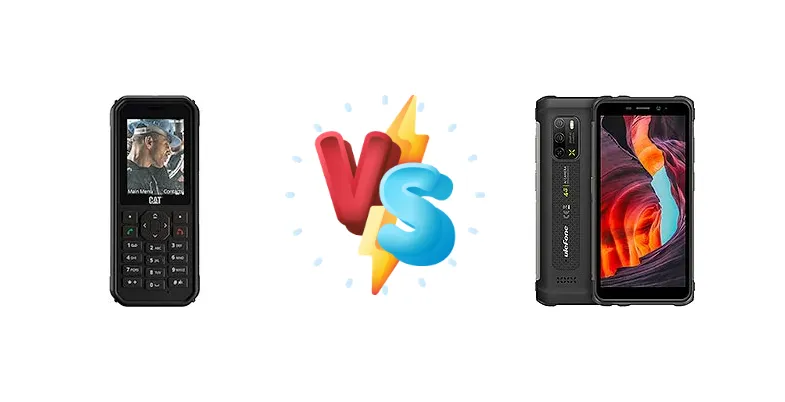
The rugged smartphone market caters to a specific user: those needing a device that can withstand drops, dust, and water. Both the Cat B40 and Ulefone Armor X10 Pro aim to deliver this durability, but they differ significantly in their internal hardware. This comparison dissects those differences, focusing on how the Unisoc T117 in the Cat B40 stacks up against the MediaTek Helio P22 in the Ulefone Armor X10 Pro.
🏆 Quick Verdict
For the average user prioritizing basic functionality and potentially longer software support (given Cat’s brand reputation), the Cat B40 is the better choice. While the Ulefone Armor X10 Pro boasts an octa-core processor, the Unisoc T117 in the B40 offers a more modern architecture and likely better efficiency for everyday tasks, despite the core count difference.
| Network |
|---|
| 2G bands | GSM 850 / 900 / 1800 / 1900 | GSM 850 / 900 / 1800 / 1900 |
| 3G bands | HSDPA 850 / 900 / 1900 / 2100 | HSDPA 850 / 900 / 1700(AWS) / 1900 / 2100 |
| 4G bands | 1, 3, 7, 8, 20, 28 | 1, 2, 3, 4, 5, 7, 8, 12, 13, 17, 18, 19, 20, 25, 26, 28 |
| Speed | HSPA 42.2/5.76 Mbps, LTE Cat4 150/50 Mbps | HSPA 21/5.76 Mbps, LTE Cat6 300/150 Mbps |
| Technology | GSM / HSPA / LTE | GSM / HSPA / LTE |
| Launch |
|---|
| Announced | 2021, April 20 | 2022, March 10 |
| Status | Available. Released 2021, April 20 | Available. Released 2022, March 10 |
| Body |
|---|
| Dimensions | 145 x 62 x 18 mm (5.71 x 2.44 x 0.71 in) | 158.2 x 76.7 x 14.6 mm (6.23 x 3.02 x 0.57 in) |
| SIM | Nano-SIM | Nano-SIM + Nano-SIM |
| Weight | 157 g (5.54 oz) | 256 g (9.03 oz) |
| | IP69 dust/water resistant (up to 1.2m for 35 min)
MIL-STD-810H compliant
Drop-to-concrete resistance from up to 1.8m
Flashlight (100+ lumens)
Antimicrobial protection (silver ion-based) | IP68/IP69K dust/water resistant (up to 1.5m for 30 min)
Drop-to-concrete resistance from up to 1.2m
MIL-STD-810G compliant |
| Display |
|---|
| Resolution | 240 x 320 pixels, 4:3 ratio (~167 ppi density) | 720 x 1440 pixels, 18:9 ratio (~295 ppi density) |
| Size | 2.4 inches, 17.8 cm2 (~19.8% screen-to-body ratio) | 5.45 inches, 76.7 cm2 (~63.2% screen-to-body ratio) |
| Type | TFT LCD | IPS LCD |
| Platform |
|---|
| CPU | - | Octa-core 2.0 GHz Cortex-A53 |
| Chipset | Unisoc T117 | Mediatek MT6762 Helio P22 (12 nm) |
| GPU | - | PowerVR GE8320 |
| OS | - | Android 11 |
| Memory |
|---|
| Call records | Yes | - |
| Card slot | microSD | microSDXC (dedicated slot) |
| Internal | Unspecified | 64GB 4GB RAM |
| Phonebook | Yes | - |
| | - | eMMC 5.1 |
| Main Camera |
|---|
| Dual | - | 20 MP, f/1.8, 26mm (wide), 1/2.78", 1.0µm, PDAF
Auxiliary lens |
| Features | - | Dual-LED flash |
| Single | 2 MP | 5 MP, f/2.2 |
| Video | Yes | 1080p@30fps |
| Selfie camera |
|---|
| Features | - | HDR |
| Single | - | 5 MP, f/2.2 |
| Video | - | 1080p@30fps |
| | No | - |
| Sound |
|---|
| 3.5mm jack | Yes | Yes |
| 35mm jack | Yes | Yes |
| Loudspeaker | Yes | Yes |
| Comms |
|---|
| Bluetooth | 5.0, A2DP, LE | 5.0, A2DP, LE |
| NFC | No | Yes |
| Positioning | No | GPS, GLONASS, GALILEO, BDS |
| Radio | FM radio | FM radio, RDS, recording |
| USB | USB Type-C 2.0 | USB Type-C 2.0, OTG |
| WLAN | No | Wi-Fi 802.11 a/b/g/n/ac, dual-band, Wi-Fi Direct |
| Features |
|---|
| Games | No | - |
| Messaging | SMS | - |
| Sensors | Accelerometer | Accelerometer, proximity, compass |
| Battery |
|---|
| Charging | - | 10W wired |
| Type | Li-Ion 1800 mAh | Li-Po 5180 mAh |
| Misc |
|---|
| Colors | Black | Black/Gray |
| Price | About 110 EUR | About 170 EUR |
Cat B40
- Likely better power efficiency due to the Unisoc T117’s modern architecture.
- Potential for longer software support from Cat, a more established brand.
- Focus on core durability and reliability.
- Limited information available on specific features.
- Potentially lower peak performance compared to an octa-core processor.
Ulefone Armor X10 Pro
- Octa-core processor may offer slightly better multitasking capabilities.
- Potentially higher resolution display (speculative).
- More readily available information due to wider marketing.
- Slow 10W charging is a major inconvenience.
- Older Helio P22 chipset is less efficient.
- Potential for shorter software support lifecycle.
Display Comparison
Neither device’s display specifications are provided, so a direct comparison is limited. However, given the price points, both likely utilize IPS LCD panels. The Ulefone Armor X10 Pro, being slightly more feature-rich, *may* have a higher resolution, but this is speculative. Users prioritizing outdoor visibility should look for independent reviews detailing peak brightness levels, as this is crucial for rugged phone usability.
Camera Comparison
Without detailed camera specifications, a meaningful comparison is difficult. Both phones likely feature basic camera setups geared towards functional photography rather than high-end image quality. The presence of a 2MP macro camera on the Ulefone Armor X10 Pro is a common marketing tactic, offering limited real-world benefit due to the small sensor size and low resolution. Users should focus on the main sensor specifications (resolution, aperture) when evaluating camera performance.
Performance
The core difference lies in the chipsets. The Ulefone Armor X10 Pro’s MediaTek Helio P22 (12nm) is an older architecture, utilizing eight Cortex-A53 cores clocked at 2.0 GHz. While the octa-core configuration sounds impressive, the Cortex-A53 is a relatively inefficient design. The Cat B40’s Unisoc T117, while lacking core count information, benefits from a more modern design and likely a more efficient manufacturing process. This translates to potentially better sustained performance and battery life under load. The Helio P22’s 12nm process node is also less efficient than newer nodes, meaning more heat generation for similar tasks.
Battery Life
Battery capacity is not specified for either device. However, the Ulefone Armor X10 Pro’s 10W wired charging is a significant drawback. This slow charging speed will result in extended charging times, making it less convenient for users who rely on their phone throughout the day. The Cat B40’s charging speed is unknown, but even a modest increase over 10W would be a substantial advantage.
Buying Guide
Buy the Cat B40 if you need a dependable, no-frills rugged phone for essential communication and occasional use. Its focus is on durability and reliability over raw processing power. Buy the Ulefone Armor X10 Pro if you prefer a phone with a more traditional octa-core processor and are willing to potentially trade off some efficiency for slightly improved multitasking capabilities, understanding that the 10W charging is a significant limitation.
Frequently Asked Questions
❓ Is the MediaTek Helio P22 in the Ulefone Armor X10 Pro likely to struggle with demanding apps?
Yes, the Helio P22 is an older chipset designed for entry-level smartphones. While it can handle basic tasks like calling, texting, and light web browsing, it will likely exhibit noticeable slowdowns and lag when running more demanding applications like modern games or resource-intensive editing software.
❓ How does the Unisoc T117 in the Cat B40 compare to the Helio P22 in terms of long-term software updates?
Cat is a more established brand in the rugged phone market and generally provides longer software support for its devices. While neither manufacturer has a stellar track record for updates, the Cat B40 is more likely to receive security patches and potentially even a major Android version update compared to the Ulefone Armor X10 Pro.
❓ Given the 10W charging on the Ulefone Armor X10 Pro, how long will it take to fully charge the battery?
Assuming a typical battery capacity of around 4000-5000mAh (common in rugged phones), a full charge from 0% with 10W charging could take upwards of 4-6 hours. This is significantly slower than the charging speeds offered by most modern smartphones.