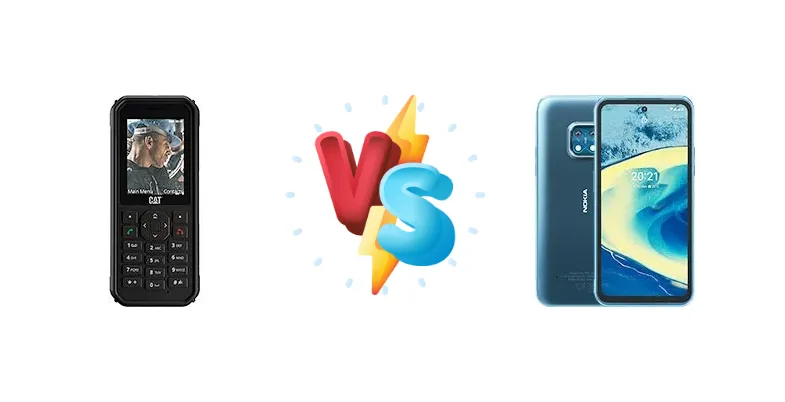
The rugged smartphone market caters to a specific need: durability. Both the Cat B40 and the Nokia XR20 aim to deliver on that promise, but they approach it with different philosophies. The Cat B40 prioritizes core ruggedness and affordability, while the Nokia XR20 adds 5G connectivity and a more modern chipset to the mix. This comparison will dissect their strengths and weaknesses to determine which phone best suits your needs.
🏆 Quick Verdict
For users prioritizing absolute affordability and core ruggedness above all else, the Cat B40 is the better choice. However, the Nokia XR20’s Qualcomm Snapdragon 480 5G chipset provides a significantly smoother user experience and future-proofs connectivity, making it the superior option for most users willing to spend a bit more.
| Network |
|---|
| 2G bands | GSM 850 / 900 / 1800 / 1900 | GSM 850 / 900 / 1800 / 1900 |
| 3G bands | HSDPA 850 / 900 / 1900 / 2100 | HSDPA 850 / 900 / 1700(AWS) / 1900 / 2100 |
| 4G bands | 1, 3, 7, 8, 20, 28 | 1, 2, 3, 4, 5, 7, 8, 12, 13, 14, 20, 25, 26, 28, 30, 38, 40, 41, 48, 66, 71 |
| 5G bands | - | 2, 5, 25, 38, 41, 48, 66, 77, 78 SA/NSA |
| Speed | HSPA 42.2/5.76 Mbps, LTE Cat4 150/50 Mbps | HSPA, LTE, 5G |
| Technology | GSM / HSPA / LTE | GSM / CDMA / HSPA / EVDO / LTE / 5G |
| | - | CDMA2000 1xEV-DO |
| Launch |
|---|
| Announced | 2021, April 20 | 2021, July 27 |
| Status | Available. Released 2021, April 20 | Available. Released 2021, August 04 |
| Body |
|---|
| Dimensions | 145 x 62 x 18 mm (5.71 x 2.44 x 0.71 in) | 171.6 x 81.5 x 10.6 mm (6.76 x 3.21 x 0.42 in) |
| SIM | Nano-SIM | · Nano-SIM· Nano-SIM + Nano-SIM |
| Weight | 157 g (5.54 oz) | 248 g (8.75 oz) |
| | IP69 dust/water resistant (up to 1.2m for 35 min)
MIL-STD-810H compliant
Drop-to-concrete resistance from up to 1.8m
Flashlight (100+ lumens)
Antimicrobial protection (silver ion-based) | IP68 dust/water resistant (up to 1.5m for 60 min)
Drop-to-concrete resistance from up to 1.8m
MIL-STD-810H compliant |
| Display |
|---|
| Protection | - | Corning Gorilla Glass Victus |
| Resolution | 240 x 320 pixels, 4:3 ratio (~167 ppi density) | 1080 x 2400 pixels, 20:9 ratio (~395 ppi density) |
| Size | 2.4 inches, 17.8 cm2 (~19.8% screen-to-body ratio) | 6.67 inches, 107.4 cm2 (~76.8% screen-to-body ratio) |
| Type | TFT LCD | IPS LCD, 550 nits |
| Platform |
|---|
| CPU | - | Octa-core (2x2.0 GHz Kryo 460 & 6x1.8 GHz Kryo 460) |
| Chipset | Unisoc T117 | Qualcomm SM4350 Snapdragon 480 5G (8 nm) |
| GPU | - | Adreno 619 |
| OS | - | Android 11, upgradable to Android 13 |
| Memory |
|---|
| Call records | Yes | - |
| Card slot | microSD | microSDXC (uses shared SIM slot) |
| Internal | Unspecified | 64GB 4GB RAM, 128GB 6GB RAM |
| Phonebook | Yes | - |
| Main Camera |
|---|
| Dual | - | 48 MP, f/1.8, (wide), 1/2.25", 0.8µm, PDAF
13 MP, f/2.4, 123˚ (ultrawide), 1/3.0", 1.12µm |
| Features | - | Zeiss optics, Dual-LED dual-tone flash, second LED flash, HDR, panorama |
| Single | 2 MP | 8 MP, f/2.0 (wide), 1/4.0", 1.12µm |
| Video | Yes | 1080p@30fps |
| Selfie camera |
|---|
| Single | - | 8 MP, f/2.0 (wide), 1/4.0", 1.12µm |
| Video | - | 1080p@30fps |
| | No | - |
| Sound |
|---|
| 3.5mm jack | Yes | Yes |
| 35mm jack | Yes | Yes |
| Loudspeaker | Yes | Yes, with stereo speakers |
| Comms |
|---|
| Bluetooth | 5.0, A2DP, LE | 5.1, A2DP, LE, aptX Adaptive |
| NFC | No | Yes |
| Positioning | No | GPS (L1+L5), GLONASS, BDS, GALILEO, QZSS, NavIC |
| Radio | FM radio | Unspecified |
| USB | USB Type-C 2.0 | USB Type-C 3.0 |
| WLAN | No | Wi-Fi 802.11 a/b/g/n/ac/6, dual-band, Wi-Fi Direct |
| Features |
|---|
| Games | No | - |
| Messaging | SMS | - |
| Sensors | Accelerometer | Fingerprint (side-mounted), accelerometer, gyro, proximity, compass, barometer |
| Battery |
|---|
| Charging | - | 18W wired
15W wireless |
| Type | Li-Ion 1800 mAh | Li-Po 4630 mAh |
| Misc |
|---|
| Colors | Black | Ultra Blue, Granite Gray |
| Models | - | TA-1368, TA-1362 |
| Price | About 110 EUR | About 270 EUR |
| SAR EU | - | 1.13 W/kg (head) 1.43 W/kg (body) |
Cat B40
- Extremely durable and rugged design
- Highly affordable price point
- Simple and straightforward user experience
- Weak processor performance
- Limited features and connectivity
- Basic camera capabilities
Nokia XR20
- 5G connectivity for faster data speeds
- More powerful Snapdragon 480 processor
- Wireless charging support
- Higher price compared to the Cat B40
- Still not a flagship-level performer
- Ruggedness may not be as extreme as the Cat B40
Display Comparison
Neither device boasts a cutting-edge display. Details on the Cat B40’s display are scarce, suggesting a basic LCD panel. The Nokia XR20, while also utilizing an LCD, benefits from a larger 6.67-inch screen. The absence of high refresh rates or advanced features like LTPO on both devices indicates a focus on durability and power efficiency over visual fidelity. The XR20’s larger size will be preferable for media consumption, but both will likely suffer in direct sunlight without significant brightness.
Camera Comparison
Camera details for the Cat B40 are limited, suggesting a basic imaging experience. The Nokia XR20 features a more capable dual-camera system, though details on sensor sizes are lacking. The XR20’s image processing capabilities, powered by the Snapdragon 480’s ISP, will likely deliver superior image quality, particularly in challenging lighting conditions. While neither phone is expected to compete with flagship camera phones, the XR20 offers a more versatile and reliable camera experience.
Performance
The performance gap is the most significant differentiator. The Cat B40’s Unisoc T117 is an entry-level chipset designed for basic tasks. In contrast, the Nokia XR20’s Qualcomm Snapdragon 480 5G (built on an 8nm process) offers a substantial performance uplift with its octa-core configuration (2x2.0 GHz Kryo 460 & 6x1.8 GHz Kryo 460). This translates to smoother multitasking, faster app loading times, and a more responsive user interface on the XR20. The 8nm fabrication process of the Snapdragon also contributes to better thermal efficiency, reducing the likelihood of throttling during sustained use. The XR20 is the clear winner for users who demand more than basic functionality.
Battery Life
Battery capacity details for the Cat B40 are unavailable, but given its focus on affordability, a smaller capacity is likely. The Nokia XR20 packs a 5000mAh battery, providing ample power for all-day use. Furthermore, the XR20 supports both 18W wired charging and 15W wireless charging, offering greater convenience. While the Cat B40 may offer comparable battery life due to its less demanding chipset, the XR20’s faster and more versatile charging options give it a distinct advantage.
Buying Guide
Buy the Cat B40 if you need an incredibly durable, no-frills phone for demanding work environments where connectivity is secondary and budget is a primary concern. It’s ideal for construction workers, field technicians, or anyone needing a phone that can withstand extreme conditions without breaking the bank. Buy the Nokia XR20 if you prefer a more balanced experience, offering 5G connectivity, a more responsive processor for everyday tasks, and the convenience of wireless charging, all within a ruggedized package. This is the better choice for users who need a reliable phone for both work and personal use.
Frequently Asked Questions
❓ Is the Nokia XR20’s Snapdragon 480 5G chipset powerful enough for gaming?
While the Snapdragon 480 5G isn’t a gaming powerhouse, it can handle casual gaming and less demanding titles. Expect to play games at lower settings to maintain a smooth frame rate. The Cat B40’s Unisoc T117 is significantly less capable and will struggle with even basic games.
❓ How does the Cat B40’s ruggedness compare to the Nokia XR20?
The Cat B40 is likely built to a higher degree of ruggedness, prioritizing drop resistance and water/dust ingress protection. While the Nokia XR20 is also ruggedized, it aims for a balance between durability and everyday usability. The Cat B40 is designed for harsher environments.
❓ Does the Nokia XR20 receive regular software updates?
Nokia is known for providing relatively timely software updates and security patches, even for its more affordable devices. This is a significant advantage over the Cat B40, which likely receives minimal software support.
❓ What type of charging port does each phone use?
Both the Cat B40 and Nokia XR20 utilize USB-C ports for wired charging. However, the Nokia XR20 adds the convenience of 15W wireless charging, a feature absent on the Cat B40.