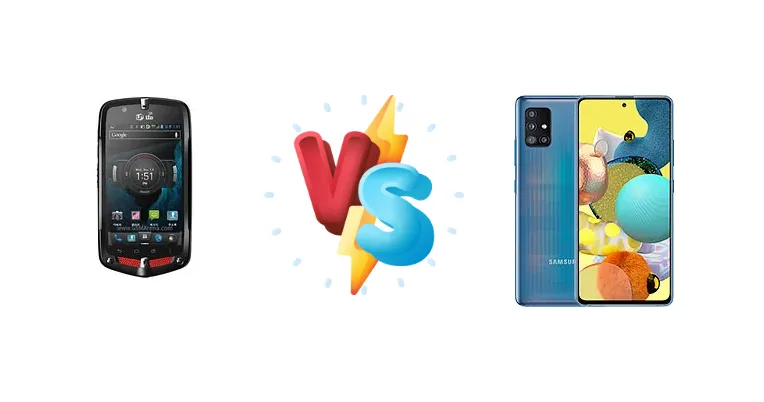
The Casio G'zOne CA-201L represents a bygone era of ultra-rugged phones, prioritizing durability above all else. The Samsung Galaxy A51 5G UW, on the other hand, embodies modern smartphone design and features, including 5G connectivity. Let's see how these two vastly different devices stack up against each other.
🏆 Quick Verdict
The Samsung Galaxy A51 5G UW is the clear winner for most users. Its superior performance, camera, display, and 5G capabilities far outweigh the G'zOne's ruggedness. However, if your priority is absolute durability and you don't need modern features, the G'zOne remains a niche option.
| Network |
|---|
| 2G bands | CDMA 800 / 1900 | GSM 850 / 900 / 1800 / 1900 |
| 3G bands | CDMA2000 1xEV-DO | HSDPA 850 / 900 / 1900 / 2100 |
| 4G bands | 13 | 2, 4, 5, 13, 66 |
| 5G bands | - | 260, 261 mmWave |
| Speed | EV-DO Rev.A 3.1 Mbps, HSPA, LTE | HSPA, LTE, 5G |
| Technology | GSM / CDMA / HSPA / EVDO / LTE | GSM / HSPA / LTE / 5G |
| | HSDPA 850 / 900 / 1900 / 2100 | - |
| Launch |
|---|
| Announced | 2013, March. Released 2013, May | 2020, August 14 |
| Status | Discontinued | Available. Released 2020, August 14 |
| Body |
|---|
| Build | - | Glass front (Gorilla Glass 3), plastic back, aluminum frame |
| Dimensions | 129.9 x 68.1 x 13.7 mm (5.11 x 2.68 x 0.54 in) | 158.8 x 73.4 x 8.6 mm (6.25 x 2.89 x 0.34 in) |
| SIM | Micro-SIM | Nano-SIM (pre-installed) |
| Weight | 173.8 g (6.10 oz) | 188.8 g (6.67 oz) |
| | IP67 dust/water resistant (up to 1m for 30 min)
MIL-STD-810G compliant | - |
| Display |
|---|
| Protection | Corning Gorilla Glass 2 | Corning Gorilla Glass 3 |
| Resolution | 480 x 800 pixels, 5:3 ratio (~233 ppi density) | 1080 x 2400 pixels, 20:9 ratio (~405 ppi density) |
| Size | 4.0 inches, 45.5 cm2 (~51.5% screen-to-body ratio) | 6.5 inches, 102.0 cm2 (~87.5% screen-to-body ratio) |
| Type | IPS LCD | Super AMOLED |
| Platform |
|---|
| CPU | Dual-core 1.5 GHz Krait | Octa-core (1x2.4 GHz Kryo 475 Prime & 1x2.2 GHz Kryo 475 Gold & 6x1.8 GHz Kryo 475 Silver) |
| Chipset | Qualcomm MSM8960 Snapdragon S4 Plus | Qualcomm SM7250 Snapdragon 765G 5G (7 nm) |
| GPU | Adreno 225 | Adreno 620 |
| OS | Android 4.0 (Ice Cream Sandwich) | Android 10, One UI 2 |
| Memory |
|---|
| Card slot | microSDHC (dedicated slot) | microSDXC (uses shared SIM slot) |
| Internal | 16GB 1GB RAM | 128GB 6GB RAM |
| | - | UFS 2.1 |
| Main Camera |
|---|
| Features | LED flash | LED flash, panorama, HDR |
| Quad | - | 48 MP, f/2.0, 26mm (wide), 1/2.0", 0.8µm, PDAF
12 MP, f/2.2, 123˚ (ultrawide)
5 MP (macro)
Auxiliary lens |
| Single | 8 MP, AF | 5 MP, AF |
| Video | Yes | 4K@30fps, 1080p@30/120fps; gyro-EIS |
| Selfie camera |
|---|
| Features | - | HDR |
| Single | 1.3 MP | 32 MP, f/2.2, 26mm (wide), 1/2.8", 0.8µm |
| Video | - | 4K@30fps, 1080p@30fps |
| Sound |
|---|
| 3.5mm jack | Yes | Yes |
| 35mm jack | Yes | Yes |
| Loudspeaker | Yes | Yes |
| Comms |
|---|
| Bluetooth | 4.0, A2DP | 5.0, A2DP, LE |
| Infrared port | Yes | - |
| NFC | Yes | Yes |
| Positioning | GPS | GPS, GLONASS, GALILEO, BDS |
| Radio | No | FM radio, RDS, recording |
| USB | microUSB 2.0 | USB Type-C 2.0, OTG |
| WLAN | Wi-Fi 802.11 a/b/g/n, dual-band, Wi-Fi Direct, hotspot | Wi-Fi 802.11 a/b/g/n/ac, dual-band, Wi-Fi Direct |
| Features |
|---|
| Sensors | Accelerometer, proximity, compass, thermometer, barometer | Fingerprint (under display, optical), accelerometer, gyro, proximity, compass |
| | - | ANT+ |
| Battery |
|---|
| Charging | - | 15W wired |
| Stand-by | - | Up to 672 h |
| Talk time | - | Up to 5 h |
| Type | Li-Ion 1800 mAh, removable | Li-Po 4500 mAh |
| Misc |
|---|
| Colors | Black, Red | Prism Bricks Blue |
| Models | - | SM-A516V |
| Price | About 270 EUR | About 470 EUR |
| SAR | - | 0.70 W/kg (head) 1.25 W/kg (body) |
| SAR EU | - | 0.59 W/kg (head) 1.32 W/kg (body) |
Casio G'zOne CA-201L
- Extremely durable
- Waterproof
- Dustproof
- Shockproof
- Outdated performance
- Low-resolution display
- Poor camera
- Limited app support
Samsung Galaxy A51 5G UW
- Modern performance (Snapdragon 765G)
- Excellent display (Super AMOLED, 120Hz)
- Versatile camera system
- 5G connectivity
- Large battery
- Less rugged than G'zOne
- 15W charging is relatively slow
Display Comparison
The Galaxy A51 5G UW boasts a large 6.5-inch Super AMOLED display with a 120Hz refresh rate, offering vibrant colors and smooth scrolling. The G'zOne CA-201L has a much smaller, lower-resolution LCD screen, prioritizing visibility over visual fidelity. The A51's display is significantly better for media consumption and general use.
Camera Comparison
The Galaxy A51 5G UW features a versatile quad-camera system with a 48MP main sensor, offering excellent image quality and various shooting modes. The G'zOne's camera is basic and produces noticeably inferior results. The A51 is the clear winner in camera performance.
Performance
The Snapdragon 765G in the Galaxy A51 5G UW provides a substantial performance advantage over the G'zOne's Snapdragon S4 Plus. The A51 handles multitasking, gaming, and demanding apps with ease, while the G'zOne can feel sluggish by today's standards. The A51's octa-core processor is a significant upgrade.
Battery Life
While the G'zOne likely has decent battery life due to its less demanding hardware, the Galaxy A51 5G UW's 4500mAh battery provides ample power for a full day of use, and supports 15W fast charging. The G'zOne's charging capabilities are likely slower and less convenient.
Buying Guide
Buy the Casio G'zOne CA-201L if you work in harsh environments (construction, military, outdoor adventures) and need a phone that can withstand extreme drops, water, and dust. Buy the Samsung Galaxy A51 5G UW if you want a modern smartphone with a great camera, fast performance, and 5G connectivity for everyday use.
Frequently Asked Questions
❓ Is the G'zOne CA-201L still worth buying?
Only if extreme durability is your absolute top priority and you don't need modern smartphone features. Otherwise, there are better options available.
❓ Does the Galaxy A51 5G UW have a good camera?
Yes, the Galaxy A51 5G UW offers a versatile and capable camera system that produces excellent photos and videos in various conditions.