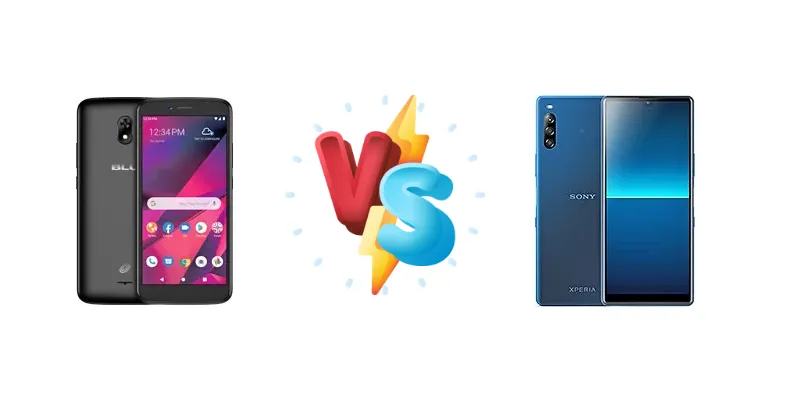
The BLU View Mega and Sony Xperia L4 represent distinct approaches to the ultra-budget smartphone market. The BLU prioritizes a large screen at the lowest possible price, while the Sony Xperia L4 aims for a more refined experience with features like USB Power Delivery, despite operating in the same price bracket. This comparison dissects their core differences to determine which device delivers the best value.
🏆 Quick Verdict
For the average user prioritizing basic functionality and a large display, the BLU View Mega offers a compelling value proposition. However, the Sony Xperia L4’s more powerful Helio P22 chipset and USB Power Delivery charging provide a smoother experience and greater convenience, making it the better choice for those willing to spend slightly more.
| Network |
|---|
| 2G bands | GSM 850 / 900 / 1800 / 1900 | GSM 850 / 900 / 1800 / 1900 |
| 3G bands | HSDPA 850 / 1700(AWS) / 1900 | HSDPA 850 / 900 / 1900 / 2100 |
| 4G bands | 2, 4, 5, 12, 13, 25, 26, 41, 66, 71 | 1, 2, 3, 5, 7, 8, 20, 40 |
| Speed | HSPA 42.2/5.76 Mbps, LTE Cat6 300/50 Mbps | HSPA 42.2/5.76 Mbps, LTE (2CA) Cat6 300/50 Mbps |
| Technology | GSM / HSPA / LTE | GSM / HSPA / LTE |
| Launch |
|---|
| Announced | 2020, April. Released 2020, April | 2020, February 20. Released 2020, April 28 |
| Status | Discontinued | Discontinued |
| Body |
|---|
| Build | - | Glass front, plastic back, plastic frame |
| Dimensions | 167.5 x 78 x 9.4 mm (6.59 x 3.07 x 0.37 in) | 159 x 71 x 8.7 mm (6.26 x 2.80 x 0.34 in) |
| SIM | Nano-SIM | · Nano-SIM· Nano-SIM + Nano-SIM |
| Weight | 189 g (6.67 oz) | 178 g (6.28 oz) |
| Display |
|---|
| Resolution | 720 x 1440 pixels, 18:9 ratio (~268 ppi density) | 720 x 1680 pixels, 21:9 ratio (~295 ppi density) |
| Size | 6.0 inches, 92.9 cm2 (~71.1% screen-to-body ratio) | 6.2 inches, 89.8 cm2 (~79.5% screen-to-body ratio) |
| Type | IPS LCD | IPS LCD |
| Platform |
|---|
| CPU | Quad-core 2.0 GHz Cortex-A53 | Octa-core 2.0 GHz Cortex-A53 |
| Chipset | Mediatek MT6761 Helio A22 (12 nm) | Mediatek MT6762 Helio P22 (12 nm) |
| GPU | PowerVR GE6300 | PowerVR GE8320 |
| OS | Android 9.0 (Pie) | Android 9.0 (Pie) |
| Memory |
|---|
| Card slot | microSDXC | microSDXC (uses shared SIM slot) |
| Internal | 32GB 2GB RAM | 64GB 3GB RAM |
| | eMMC 5.1 | eMMC 5.1 |
| Main Camera |
|---|
| Features | LED flash | LED flash, HDR, panorama |
| Single | 13 MP | - |
| Triple | - | 13 MP, f/2.0, 26mm (wide), 1/3.0", PDAF
5 MP, f/2.2, 17mm (ultrawide), 1/5.0", 1.12µm
Auxiliary lens |
| Video | 1080p@30fps | 1080p@30fps |
| Selfie camera |
|---|
| Single | 8 MP | 8 MP, f/2.0, 27mm (wide), 1/4.0", 1.12µm |
| Video | 720p@30fps | 1080p@30fps |
| Sound |
|---|
| 3.5mm jack | Yes | Yes |
| 35mm jack | Yes | Yes |
| Loudspeaker | Yes | Yes |
| Comms |
|---|
| Bluetooth | 4.1, A2DP, LE | 5.0, A2DP, LE |
| NFC | No | Yes |
| Positioning | GPS | GPS, GLONASS |
| Radio | FM radio | FM radio |
| USB | microUSB 2.0 | USB Type-C 2.0 |
| WLAN | Wi-Fi 802.11 b/g/n, Wi-Fi Direct | Wi-Fi 802.11 a/b/g/n, dual-band, Wi-Fi Direct |
| Features |
|---|
| Sensors | Accelerometer, proximity | Fingerprint (side-mounted), accelerometer, proximity, compass |
| Battery |
|---|
| Charging | 0 | USB Power Delivery |
| Type | Li-Po 3000 mAh, removable | Li-Ion 3580 mAh |
| Misc |
|---|
| Colors | Black | Black, Blue |
| Models | - | XQ-AD52, XQ-AD51 |
| Price | - | About 200 EUR |
BLU View Mega
- Larger display likely offers a more immersive media experience.
- Lower price point makes it accessible to a wider range of buyers.
- Simpler chipset may result in slightly better battery life (speculative).
- Significantly weaker performance compared to the Xperia L4.
- Lacks USB Power Delivery for faster charging.
- Potentially lower build quality and software support.
Sony Xperia L4
- More powerful Helio P22 chipset delivers a smoother user experience.
- USB Power Delivery enables faster and more efficient charging.
- Benefit from Sony’s brand reputation and potential software updates.
- Higher price point compared to the BLU View Mega.
- May have a smaller display size.
- Performance still limited for demanding games and applications.
Display Comparison
Both devices utilize 12nm chipsets, suggesting similar power efficiency considerations impacting display choices. While specific display specs (resolution, panel type) are missing for the BLU View Mega, its focus is clearly on size. The Sony Xperia L4, while also lacking detailed display specs, benefits from Sony’s display expertise, likely resulting in better color accuracy and viewing angles compared to the BLU. The absence of fast refresh rates on either device indicates a focus on maximizing battery life rather than visual fluidity.
Camera Comparison
Without detailed camera specifications, a direct comparison is challenging. However, given the budget nature of both devices, expectations should be tempered. It’s highly probable that both phones feature basic camera setups with limited low-light performance. The Sony Xperia L4, benefiting from Sony’s imaging technology, likely offers slightly better image processing and color reproduction. The presence of a 2MP macro camera on either device is largely a marketing gimmick, offering minimal practical benefit due to the low resolution and lack of optical image stabilization.
Performance
The core difference lies in the chipset: the BLU View Mega features the Mediatek MT6761 Helio A22 with a quad-core 2.0 GHz Cortex-A53 CPU, while the Sony Xperia L4 boasts the Mediatek MT6762 Helio P22 with an octa-core 2.0 GHz Cortex-A53 CPU. This doubling of cores in the P22 translates to significantly improved multitasking and app loading speeds. While both CPUs are based on the Cortex-A53 architecture, the P22’s additional cores provide a noticeable performance advantage, particularly in demanding applications. The Xperia L4’s chipset is better suited for light gaming and smoother operation of social media apps.
Battery Life
Battery capacity data is missing for both devices. However, the Sony Xperia L4’s inclusion of USB Power Delivery is a significant advantage. USB PD allows for faster and more efficient charging compared to standard USB charging, reducing the time spent tethered to a wall outlet. While the BLU View Mega lacks this feature, its simpler chipset and potentially larger battery (speculation based on its size-focused design) might offer comparable battery life in real-world usage, but at the cost of charging speed.
Buying Guide
Buy the BLU View Mega if you need a large screen for media consumption and prioritize absolute affordability above all else. It’s ideal for first-time smartphone users or as a secondary device. Buy the Sony Xperia L4 if you prefer a more responsive user experience, faster charging, and a brand with a longer track record of software support, even if it means a slightly higher upfront cost.
Frequently Asked Questions
❓ Will the Sony Xperia L4 struggle with demanding games like PUBG Mobile?
While the Helio P22 is an improvement over the Helio A22, the Xperia L4 is not a gaming powerhouse. PUBG Mobile will likely be playable at low to medium settings with reduced frame rates. Expect some lag and stuttering during intense moments. It's best suited for casual gaming rather than competitive play.
❓ Is the lack of USB Power Delivery on the BLU View Mega a dealbreaker?
If charging speed is a priority, then yes, the lack of USB Power Delivery is a significant drawback. Charging will be considerably slower compared to the Xperia L4. However, if you typically charge your phone overnight or don't mind longer charging times, it may not be a major issue.
❓ How does the software experience differ between these two phones?
The BLU View Mega likely runs a near-stock version of Android, potentially with minimal bloatware. The Sony Xperia L4 offers a more refined software experience with Sony’s customizations, which include features like a dedicated camera app and potentially longer software support. Sony generally provides more consistent updates than BLU.
❓ Can I expect good low-light performance from either of these cameras?
Low-light performance will be limited on both devices. The sensors are likely small and lack optical image stabilization. Expect noisy images with limited detail in challenging lighting conditions. Using the flash will be necessary in most low-light scenarios.