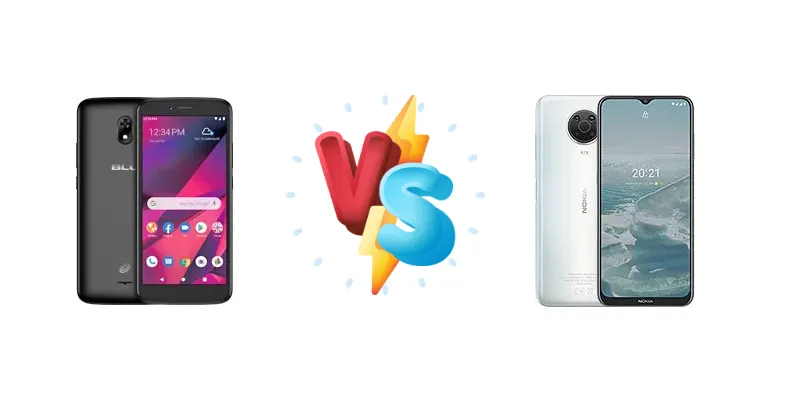
The BLU View Mega and Nokia G20 represent the lower end of the smartphone spectrum, targeting users prioritizing affordability. However, even within this segment, key differences emerge. The Nokia G20 boasts a more modern chipset and faster processing speeds, while the BLU View Mega focuses on a minimalist approach. This comparison dissects these differences to determine which device delivers the best value.
🏆 Quick Verdict
For most users, the Nokia G20 is the superior choice. Its Mediatek Helio G35 chipset, featuring an octa-core CPU, provides a noticeably smoother experience than the BLU View Mega’s quad-core Helio A22. While neither phone excels in any single area, the G20’s performance advantage justifies its slightly higher price.
| Network |
|---|
| 2G bands | GSM 850 / 900 / 1800 / 1900 | GSM 850 / 900 / 1800 / 1900 |
| 3G bands | HSDPA 850 / 1700(AWS) / 1900 | HSDPA 850 / 900 / 1900 / 2100 - International |
| 4G bands | 2, 4, 5, 12, 13, 25, 26, 41, 66, 71 | 1, 3, 5, 7, 8, 20, 28, 38, 40, 41 - International |
| Speed | HSPA 42.2/5.76 Mbps, LTE Cat6 300/50 Mbps | HSPA 42.2/5.76 Mbps, LTE Cat4 150/50 Mbps |
| Technology | GSM / HSPA / LTE | GSM / HSPA / LTE |
| | - | 1, 2, 3, 4, 5, 7, 8, 12, 17, 28, 66 - LATAM |
| Launch |
|---|
| Announced | 2020, April. Released 2020, April | 2021, April 08 |
| Status | Discontinued | Available. Released 2021, May 17 |
| Body |
|---|
| Dimensions | 167.5 x 78 x 9.4 mm (6.59 x 3.07 x 0.37 in) | 164.9 x 76 x 9.2 mm (6.49 x 2.99 x 0.36 in) |
| SIM | Nano-SIM | · Nano-SIM· Nano-SIM + Nano-SIM |
| Weight | 189 g (6.67 oz) | 197 g (6.95 oz) |
| | - | Splash protection |
| Display |
|---|
| Resolution | 720 x 1440 pixels, 18:9 ratio (~268 ppi density) | 720 x 1600 pixels, 20:9 ratio (~269 ppi density) |
| Size | 6.0 inches, 92.9 cm2 (~71.1% screen-to-body ratio) | 6.52 inches, 102.6 cm2 (~81.9% screen-to-body ratio) |
| Type | IPS LCD | IPS LCD |
| Platform |
|---|
| CPU | Quad-core 2.0 GHz Cortex-A53 | Octa-core (4x2.3 GHz Cortex-A53 & 4x1.8 GHz Cortex-A53) |
| Chipset | Mediatek MT6761 Helio A22 (12 nm) | Mediatek MT6765G Helio G35 (12 nm) |
| GPU | PowerVR GE6300 | PowerVR GE8320 |
| OS | Android 9.0 (Pie) | Android 11, upgradable to Android 13 |
| Memory |
|---|
| Card slot | microSDXC | microSDXC (dedicated slot) |
| Internal | 32GB 2GB RAM | 64GB 4GB RAM, 128GB 4GB RAM |
| | eMMC 5.1 | - |
| Main Camera |
|---|
| Features | LED flash | LED flash, HDR, panorama |
| Quad | - | 48 MP, f/1.8, (wide), PDAF
5 MP, (ultrawide)
2 MP (macro)
Auxiliary lens |
| Single | 13 MP | 8 MP, (wide) |
| Video | 1080p@30fps | 1080p@30fps |
| Selfie camera |
|---|
| Single | 8 MP | 8 MP, (wide) |
| Video | 720p@30fps | 1080p@30fps |
| Sound |
|---|
| 3.5mm jack | Yes | Yes |
| 35mm jack | Yes | Yes |
| Loudspeaker | Yes | Yes |
| Comms |
|---|
| Bluetooth | 4.1, A2DP, LE | 5.0, A2DP, LE |
| NFC | No | Yes (market/region dependent) |
| Positioning | GPS | GPS, GLONASS, BDS |
| Radio | FM radio | FM radio |
| USB | microUSB 2.0 | USB Type-C 2.0, OTG |
| WLAN | Wi-Fi 802.11 b/g/n, Wi-Fi Direct | Wi-Fi 802.11 b/g/n |
| Features |
|---|
| Sensors | Accelerometer, proximity | Fingerprint (side-mounted), accelerometer, gyro, proximity |
| Battery |
|---|
| Charging | 0 | 10W wired |
| Type | Li-Po 3000 mAh, removable | Li-Po 5050 mAh |
| Misc |
|---|
| Colors | Black | Glacier, Night |
| Models | - | TA-1336, TA-1343, TA-1347, TA-1372, TA-1365 |
| Price | - | About 90 EUR |
| SAR | - | 1.01 W/kg (head) 1.02 W/kg (body) |
| SAR EU | - | 0.49 W/kg (head) 1.13 W/kg (body) |
BLU View Mega
- Lowest possible price point
- Simple and straightforward user experience
- Potentially longer battery life due to less demanding processor (speculative)
- Significantly slower performance
- No wired charging support
- Likely outdated software
Nokia G20
- Faster and more responsive performance
- 10W wired charging for convenience
- More modern chipset architecture
- Slightly higher price
- Still limited in terms of overall features
- May not receive frequent software updates
Display Comparison
Neither BLU nor Nokia provide display specifications beyond size. Given the price point, both likely utilize IPS LCD panels. The absence of detailed specs suggests neither phone will deliver exceptional color accuracy or brightness. The focus here is purely functional, prioritizing visibility over visual fidelity. Bezels are expected to be substantial on both devices, maximizing screen real estate within a budget-friendly design.
Camera Comparison
Without detailed camera specifications, a direct comparison is difficult. However, it’s safe to assume both phones feature basic camera setups geared towards casual photography. The absence of Optical Image Stabilization (OIS) on either device suggests image quality will be heavily reliant on software processing. Given the market segment, expect limited low-light performance and a focus on capturing usable images in well-lit conditions. The inclusion of a 2MP macro lens on either device is likely a marketing tactic, offering minimal practical benefit due to the low resolution.
Performance
The Nokia G20’s Mediatek Helio G35 is the clear winner in this category. Its octa-core configuration (4x2.3 GHz Cortex-A53 & 4x1.8 GHz Cortex-A53) significantly outperforms the BLU View Mega’s quad-core 2.0 GHz Cortex-A53 processor. The G35’s higher clock speeds and additional cores translate to faster app loading times, smoother multitasking, and a more responsive overall experience. While both chipsets are built on a 12nm process, the architectural improvements in the G35 provide a tangible performance boost. The G20 will handle everyday tasks and light gaming with greater ease.
Battery Life
Battery capacity is not specified for either device. However, the Nokia G20 benefits from 10W wired charging, a feature entirely absent on the BLU View Mega. This means the G20 can be topped up more conveniently, reducing downtime. While a larger battery capacity would be ideal, the G20’s charging capability provides a practical advantage for users who rely on their phones throughout the day. The lack of charging information for the BLU View Mega suggests a slower, potentially less reliable charging experience.
Buying Guide
Buy the BLU View Mega if you absolutely need the lowest possible price and your smartphone usage is limited to basic tasks like calls, texts, and light social media. Buy the Nokia G20 if you prioritize a more responsive user experience, occasional gaming, and appreciate the convenience of 10W wired charging for extended use.
Frequently Asked Questions
❓ Is the Mediatek Helio G35 in the Nokia G20 capable of playing popular mobile games like PUBG or Call of Duty?
The Helio G35 can run PUBG and Call of Duty Mobile, but expect to play at lower graphics settings and frame rates to maintain a smooth experience. It's not a gaming powerhouse, but it's significantly more capable than the Helio A22 in the BLU View Mega.
❓ How long will it take to fully charge the Nokia G20 with the 10W charger?
With 10W charging, a full charge from 0% will likely take between 3 to 4 hours. While not fast charging, it's a substantial improvement over the BLU View Mega, which lacks any specified charging capability and will likely take considerably longer.
❓ Will either phone receive Android version updates in the future?
Nokia generally provides more consistent software updates than BLU. While the G20 likely launched with an older version of Android, it has a higher chance of receiving at least one major update compared to the BLU View Mega.