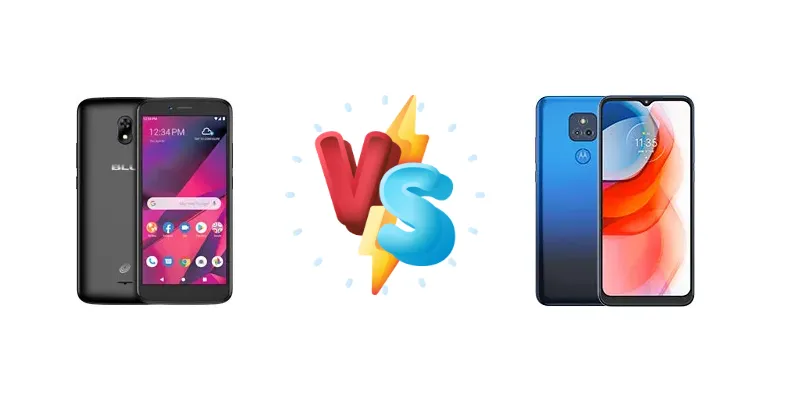
The sub-$150 smartphone market is fiercely competitive. The BLU View Mega and Motorola Moto G Play (2021) represent two distinct approaches to delivering value. The View Mega prioritizes a large screen at a minimal cost, while the Moto G Play aims for a more balanced experience with a more modern chipset. This comparison dissects their key differences to help you choose the right device.
🏆 Quick Verdict
For most users, the Motorola Moto G Play (2021) is the superior choice. Its Qualcomm Snapdragon 460 chipset provides a significantly smoother and more responsive experience than the BLU View Mega’s MediaTek Helio A22, despite the lack of fast charging. The G Play’s octa-core CPU offers a noticeable advantage in multitasking and app loading.
| Network |
|---|
| 2G bands | GSM 850 / 900 / 1800 / 1900 | GSM 850 / 900 / 1800 / 1900 |
| 3G bands | HSDPA 850 / 1700(AWS) / 1900 | HSDPA 850 / 900 / 1700(AWS) / 1900 / 2100 |
| 4G bands | 2, 4, 5, 12, 13, 25, 26, 41, 66, 71 | 1, 2, 3, 4, 5, 7, 8, 12, 13, 17, 25, 26, 38, 41, 66, 71 |
| Speed | HSPA 42.2/5.76 Mbps, LTE Cat6 300/50 Mbps | HSPA, LTE |
| Technology | GSM / HSPA / LTE | GSM / CDMA / HSPA / LTE |
| | - | 2, 4, 5, 12, 14, 30, 66 |
| Launch |
|---|
| Announced | 2020, April. Released 2020, April | 2021, January 08 |
| Status | Discontinued | Available. Released 2021, January 14 |
| Body |
|---|
| Build | - | Plastic frame, plastic back |
| Dimensions | 167.5 x 78 x 9.4 mm (6.59 x 3.07 x 0.37 in) | 166.6 x 76 x 9.4 mm (6.56 x 2.99 x 0.37 in) |
| SIM | Nano-SIM | Nano-SIM |
| Weight | 189 g (6.67 oz) | 204 g (7.20 oz) |
| | - | Water-repellent coating |
| Display |
|---|
| Resolution | 720 x 1440 pixels, 18:9 ratio (~268 ppi density) | 720 x 1600 pixels, 20:9 ratio (~270 ppi density) |
| Size | 6.0 inches, 92.9 cm2 (~71.1% screen-to-body ratio) | 6.5 inches, 102.0 cm2 (~80.6% screen-to-body ratio) |
| Type | IPS LCD | IPS LCD |
| Platform |
|---|
| CPU | Quad-core 2.0 GHz Cortex-A53 | Octa-core (4x1.8 GHz Kryo 240 & 4x1.6 GHz Kryo 240) |
| Chipset | Mediatek MT6761 Helio A22 (12 nm) | Qualcomm SM4250 Snapdragon 460 (11 nm) |
| GPU | PowerVR GE6300 | Adreno 610 |
| OS | Android 9.0 (Pie) | Android 10 |
| Memory |
|---|
| Card slot | microSDXC | microSDXC (dedicated slot) |
| Internal | 32GB 2GB RAM | 32GB 3GB RAM |
| | eMMC 5.1 | eMMC 5.1 |
| Main Camera |
|---|
| Dual | - | 13 MP, f/2.0, (wide), 1/3.1", 1.12µm, PDAF
Auxiliary lens |
| Features | LED flash | LED flash, HDR, panorama |
| Single | 13 MP | - |
| Video | 1080p@30fps | 1080p@30/60fps |
| Selfie camera |
|---|
| Features | - | HDR |
| Single | 8 MP | 5 MP, f/2.2, (wide), 1.12µm |
| Video | 720p@30fps | 1080p@30fps |
| Sound |
|---|
| 3.5mm jack | Yes | Yes |
| 35mm jack | Yes | Yes |
| Loudspeaker | Yes | Yes |
| Comms |
|---|
| Bluetooth | 4.1, A2DP, LE | 5.0, A2DP, LE |
| NFC | No | No |
| Positioning | GPS | GPS, GLONASS, GALILEO |
| Radio | FM radio | Unspecified |
| USB | microUSB 2.0 | USB Type-C 2.0 |
| WLAN | Wi-Fi 802.11 b/g/n, Wi-Fi Direct | Wi-Fi 802.11 a/b/g/n/ac, dual-band, Wi-Fi Direct |
| Features |
|---|
| Sensors | Accelerometer, proximity | Fingerprint (rear-mounted), accelerometer, proximity |
| Battery |
|---|
| Charging | 0 | 10W wired |
| Type | Li-Po 3000 mAh, removable | Li-Po 5000 mAh |
| Misc |
|---|
| Colors | Black | Misty Blue |
| Models | - | XT2093-3, XT2093-7, XT2093-DL, XT2093DL |
| Price | - | About 60 EUR |
BLU View Mega
- Potentially larger display size (unconfirmed)
- Extremely low price point
- May offer longer standby time due to less powerful processor
- Significantly weaker performance
- Outdated chipset
- No charging information available
- Likely limited software support
Motorola Moto G Play (2021)
- More powerful Snapdragon 460 chipset
- Octa-core CPU for smoother multitasking
- 10W wired charging support
- Larger 5000mAh battery
- Likely better software support
- 720p+ display resolution
- Basic camera system
- May be slightly more expensive than the BLU View Mega
Display Comparison
Neither device boasts a standout display. The BLU View Mega’s screen size is not specified, but its focus is clearly on maximizing screen real estate at the lowest possible cost. The Moto G Play (2021) features a 6.5-inch 720p+ display. While resolution is modest on both, the G Play benefits from a more modern panel and likely better color accuracy. Neither device is expected to offer high brightness or wide color gamut support, making them best suited for indoor use. The lack of display specifications for the View Mega makes a direct comparison difficult, but the G Play’s more recent manufacturing likely results in a better viewing experience.
Camera Comparison
Camera performance is likely to be similar – basic. Both devices target the ultra-budget segment, meaning image sensors and processing are not priorities. The Moto G Play (2021) features a 13MP main camera, which is likely a more capable sensor than anything found in the View Mega, given the latter’s focus on cost reduction. While neither phone will deliver flagship-level image quality, the G Play’s image processing and sensor size will likely result in more detailed and usable photos in good lighting conditions. The presence of a 13MP sensor on the G Play suggests a more functional camera experience than the View Mega, which likely relies on a lower-resolution sensor.
Performance
The performance gap is the most significant differentiator. The Motorola Moto G Play (2021) utilizes the Qualcomm Snapdragon 460, an octa-core processor built on an 11nm process. This contrasts sharply with the BLU View Mega’s MediaTek Helio A22, a quad-core chip fabricated on a 12nm node. The Snapdragon 460’s eight Kryo 240 cores (split between 1.8GHz and 1.6GHz) offer substantially more processing power and multi-tasking capability than the Helio A22’s four Cortex-A53 cores clocked at 2.0 GHz. The 11nm process also contributes to better power efficiency, potentially offsetting the G Play’s slightly smaller battery (spec not provided for View Mega). Users will notice a significant difference in app loading times, scrolling smoothness, and overall responsiveness on the Moto G Play.
Battery Life
Battery life is a complex equation. The BLU View Mega’s battery capacity is not specified, making a direct comparison challenging. The Motorola Moto G Play (2021) features a 5000mAh battery. While the Helio A22 in the View Mega might be more power-efficient at idle, the Snapdragon 460’s efficiency gains under load, combined with the G Play’s larger battery, likely translate to comparable or even better real-world battery life. The Moto G Play also supports 10W wired charging, a feature absent on the BLU View Mega, allowing for some level of quick top-ups when needed.
Buying Guide
Buy the BLU View Mega if your primary need is a very large display for media consumption and basic tasks, and you are operating on an extremely tight budget where every dollar counts. Buy the Motorola Moto G Play (2021) if you prioritize a more fluid user experience, better performance for everyday apps, and a chipset that will likely receive longer software support, even if it means sacrificing a slightly larger screen.
Frequently Asked Questions
❓ Will the Motorola Moto G Play (2021) struggle with demanding games like PUBG Mobile?
While the Snapdragon 460 isn't a gaming powerhouse, it can handle PUBG Mobile at lower settings. Expect to play at balanced graphics and medium frame rates for a playable experience. The BLU View Mega’s Helio A22 will likely struggle significantly, even at the lowest settings.
❓ Does the lack of charging information for the BLU View Mega mean it charges very slowly?
The absence of any charging specifications for the BLU View Mega is concerning. It likely uses a very slow, older charging standard, potentially taking several hours to fully charge the device. The Moto G Play’s 10W charging, while not fast, is a significant improvement.
❓ How will software updates affect the longevity of these phones?
Motorola generally provides at least one major Android update and a few security patches for the Moto G Play (2021). BLU devices historically have limited software support, meaning the View Mega is unlikely to receive updates beyond its initial Android version, potentially leaving it vulnerable to security risks over time.