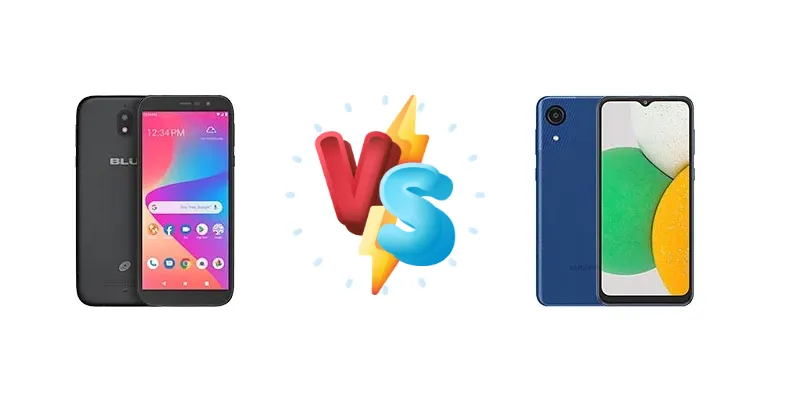
The BLU View 2 and Samsung Galaxy A03 Core represent the extreme end of the smartphone price spectrum. Both aim to deliver basic smartphone functionality at an incredibly low cost, but they achieve this with vastly different hardware approaches. This comparison dissects those differences to determine which device offers the best value for users prioritizing affordability.
🏆 Quick Verdict
For the average user needing a functional, if basic, smartphone, the BLU View 2 emerges as the slightly better choice. Its newer, 12nm Mediatek Helio A22 chipset offers a more efficient architecture than the Samsung’s older 28nm Unisoc SC9863A, translating to potentially better sustained performance and battery life.
| Network |
|---|
| 2G bands | GSM 850 / 900 / 1800 / 1900 | GSM 850 / 900 / 1800 / 1900 |
| 3G bands | HSDPA 850 / 1700(AWS) / 1900 | HSDPA 850 / 900 / 2100 |
| 4G bands | 2, 4, 5, 12, 13, 25, 26, 41, 66, 71 | 1, 3, 5, 7, 8, 20, 28, 38, 40, 41 |
| Speed | HSPA 42.2/5.76 Mbps, LTE Cat6 300/50 Mbps | HSPA 21.1/5.76 Mbps, LTE |
| Technology | GSM / HSPA / LTE | GSM / HSPA / LTE |
| Launch |
|---|
| Announced | 2020, November. Released 2020, November | 2021, November 15 |
| Status | Discontinued | Available. Released 2021, December 06 |
| Body |
|---|
| Build | - | Plastic back, plastic frame |
| Dimensions | 153.7 x 71 x 9.5 mm (6.05 x 2.80 x 0.37 in) | 164.2 x 75.9 x 9.1 mm (6.46 x 2.99 x 0.36 in) |
| SIM | Nano-SIM | · Nano-SIM· Nano-SIM + Nano-SIM |
| Weight | 162 g (5.71 oz) | 211 g (7.44 oz) |
| Display |
|---|
| Resolution | 720 x 1440 pixels, 18:9 ratio (~293 ppi density) | 720 x 1600 pixels, 20:9 ratio (~270 ppi density) |
| Size | 5.5 inches, 78.1 cm2 (~71.5% screen-to-body ratio) | 6.5 inches, 102.0 cm2 (~81.8% screen-to-body ratio) |
| Type | IPS LCD | PLS LCD |
| Platform |
|---|
| CPU | Octa-core 2.0 GHz Cortex-A53 | Octa-core (4x1.6 GHz Cortex-A55 & 4x1.2 GHz Cortex-A55) |
| Chipset | Mediatek MT6761 Helio A22 (12 nm) | Unisoc SC9863A (28 nm) |
| GPU | PowerVR GE8320 | IMG8322 |
| OS | Android 10 | Android 11 (Go edition) |
| Memory |
|---|
| Card slot | microSDXC | microSDXC (dedicated slot) |
| Internal | 32GB 2GB RAM | 32GB 2GB RAM |
| | eMMC 5.1 | eMMC 5.1 |
| Main Camera |
|---|
| Features | LED flash | LED flash |
| Single | 13 MP | 8 MP, f/2.0, AF |
| Video | 1080p@30fps | 1080p@30fps |
| Selfie camera |
|---|
| Single | 8 MP | 5 MP, f/2.2 |
| Video | 720p@30fps | - |
| Sound |
|---|
| 3.5mm jack | Yes | Yes |
| 35mm jack | Yes | Yes |
| Loudspeaker | Yes | Yes |
| Comms |
|---|
| Bluetooth | 4.1, A2DP, LE | 4.2, A2DP |
| NFC | No | No |
| Positioning | GPS | GPS, GLONASS |
| Radio | FM radio | Unspecified |
| USB | USB Type-C 2.0 | microUSB 2.0, OTG |
| WLAN | Wi-Fi 802.11 b/g/n, Wi-Fi Direct | Wi-Fi 802.11 b/g/n, Wi-Fi Direct |
| Features |
|---|
| Sensors | Accelerometer, proximity | Accelerometer, proximity |
| Battery |
|---|
| Type | Li-Po 3000 mAh, removable | Li-Ion 5000 mAh |
| Misc |
|---|
| Colors | Black | Black, Blue |
| Models | B130DL, B131DL | SM-A032F, SM-A032F/DS, SM-A032M |
| Price | - | £ 74.99 |
| SAR | - | 0.30 W/kg (head) |
| SAR EU | - | 0.24 W/kg (head) 1.39 W/kg (body) |
BLU View 2
- More efficient 12nm chipset
- Potentially better sustained performance
- Likely longer battery life
- Less brand recognition
- Potentially lower build quality
Samsung Galaxy A03 Core
- Samsung brand reputation
- Familiar Samsung UI
- Potentially better software support (though limited)
- Less efficient 28nm chipset
- Lower performance
- Potentially shorter battery life
Display Comparison
Neither device boasts a standout display. Specifications are unavailable for the BLU View 2's panel, but given its price point, it's likely a basic IPS LCD. The Samsung Galaxy A03 Core also utilizes an IPS LCD. The key difference lies under the hood: the Unisoc SC9863A’s older 28nm process likely contributes to lower power efficiency even when displaying static content. Both will likely suffer from limited viewing angles and color accuracy, but the A03 Core’s panel may exhibit slightly more power draw.
Camera Comparison
Camera performance on both devices will be limited. Details on sensor sizes are unavailable, but both likely feature low-resolution primary sensors paired with basic image processing. The Samsung Galaxy A03 Core may benefit from Samsung’s software optimizations, but the underlying hardware limitations will be substantial. Expect washed-out colors, limited dynamic range, and poor low-light performance from both. Any 2MP macro or depth sensors on either device are largely marketing fluff and offer minimal practical benefit.
Performance
The performance gap is the most significant differentiator. The BLU View 2’s Mediatek Helio A22, built on a 12nm process, features eight Cortex-A53 cores clocked at 2.0 GHz. This contrasts sharply with the Samsung Galaxy A03 Core’s Unisoc SC9863A, which employs a big.LITTLE architecture with four Cortex-A55 cores at 1.6 GHz and four at 1.2 GHz, fabricated on a much older 28nm node. While both are octa-core, the A22’s newer architecture and smaller process node provide a clear advantage in both single-core and multi-core performance, and crucially, power efficiency. The A03 Core’s slower, less efficient cores will struggle more with multitasking and demanding apps. The 28nm process will also generate more heat, potentially leading to thermal throttling during prolonged use.
Battery Life
Battery capacity is not specified for either device, but both will likely feature batteries in the 3000-4000 mAh range. However, the Unisoc SC9863A’s 28nm process is significantly less power-efficient than the Helio A22’s 12nm process. This means the BLU View 2 will likely deliver longer battery life on a single charge, despite potentially having a similar capacity battery. Charging wattage is also unknown for both, but expect slow charging speeds given the budget nature of these devices.
Buying Guide
Buy the BLU View 2 if you prioritize a slightly more responsive user experience and potentially longer battery life, even if it means sacrificing brand recognition. It’s ideal for users who primarily need calling, texting, and light social media use. Buy the Samsung Galaxy A03 Core if you strongly prefer the Samsung brand ecosystem and user interface, and are willing to accept a potentially less fluid experience and shorter battery life in exchange for that familiarity.
Frequently Asked Questions
❓ Will the Unisoc SC9863A in the Galaxy A03 Core overheat during extended use?
The Unisoc SC9863A, being fabricated on a 28nm process, is prone to generating more heat than the BLU View 2’s Helio A22. While it won’t likely reach critical temperatures, expect performance throttling during prolonged gaming or demanding tasks. The larger process node simply isn’t as thermally efficient.
❓ Is the BLU View 2 a good choice for playing mobile games like PUBG Mobile or Call of Duty Mobile?
The BLU View 2, while better than the A03 Core, is still an entry-level device. PUBG Mobile and Call of Duty Mobile will be playable at the lowest settings, but expect significant frame rate drops and stuttering, even on minimal graphics settings. It’s not designed for serious gaming.
❓ How does Samsung's software optimization affect the A03 Core's performance?
Samsung's One UI can offer some software optimizations, but these are limited by the underlying hardware. While the software experience might be smoother than a stock Android implementation on the BLU View 2, it cannot overcome the performance limitations of the older Unisoc chipset and its inefficient 28nm process.
❓ What kind of storage options are available on these phones, and can it be expanded?
Storage details are not provided in the context data. However, given the price point, both devices likely offer limited internal storage (16GB or 32GB) and will almost certainly include a microSD card slot for expandable storage. This is crucial for users planning to store photos, videos, or apps.