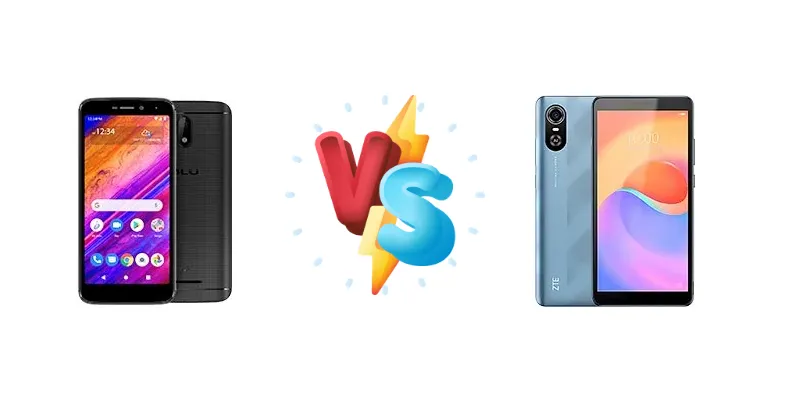
The BLU View 1 and ZTE Blade A31 Plus represent the extreme end of the smartphone price spectrum. Both aim to deliver basic smartphone functionality at an incredibly low cost. However, their internal components differ significantly, particularly in the processor department. This comparison dissects those differences to determine which device offers the best experience for the price-conscious consumer.
🏆 Quick Verdict
For the average user prioritizing multitasking and smoother app operation, the ZTE Blade A31 Plus is the better choice. Its octa-core Unisoc SC9863A processor, utilizing Cortex-A55 cores, provides a noticeable performance advantage over the BLU View 1’s quad-core Mediatek MT6739, despite both being fabricated on a 28nm process.
| Network |
|---|
| 2G bands | GSM 850 / 900 / 1800 / 1900 | GSM 850 / 900 / 1800 / 1900 |
| 3G bands | HSDPA 850 / 1700(AWS) / 1900 | HSDPA 850 / 900 / 2100 |
| 4G bands | 2, 4, 5, 12, 13, 66, 71 | 1, 2, 3, 5, 7, 8, 20, 28, 38, 40, 41 |
| Speed | HSPA 42.2/5.76 Mbps, LTE Cat4 150/50 Mbps | HSPA, LTE |
| Technology | GSM / HSPA / LTE | GSM / HSPA / LTE |
| Launch |
|---|
| Announced | 2019, November. Released 2019, November | 2021, October 31 |
| Status | Discontinued | Available. Released 2021, October 31 |
| Body |
|---|
| Dimensions | 142.2 x 71.1 x 10.1 mm (5.60 x 2.80 x 0.40 in) | 159.2 x 77.5 x 9.6 mm (6.27 x 3.05 x 0.38 in) |
| SIM | Nano-SIM + Nano-SIM | Nano-SIM + Nano-SIM |
| Weight | 153 g (5.40 oz) | - |
| Display |
|---|
| Resolution | 480 x 960 pixels, 18:9 ratio (~195 ppi density) | 480 x 960 pixels, 18:9 ratio (~179 ppi density) |
| Size | 5.5 inches, 78.1 cm2 (~77.2% screen-to-body ratio) | 6.0 inches, 92.9 cm2 (~75.3% screen-to-body ratio) |
| Type | IPS LCD | IPS LCD |
| Platform |
|---|
| CPU | Quad-core 1.5 GHz Cortex-A53 | Octa-core (4x1.6 GHz Cortex-A55 & 4x1.2 GHz Cortex-A55) |
| Chipset | Mediatek MT6739 (28 nm) | Unisoc SC9863A (28 nm) |
| GPU | PowerVR GE8100 | IMG8322 |
| OS | Android 9.0 (Pie) | Android 11 (Go edition) |
| Memory |
|---|
| Card slot | microSDXC | microSDXC |
| Internal | 16GB 2GB RAM | 32GB 1GB RAM |
| | eMMC 5.1 | eMMC 5.1 |
| Main Camera |
|---|
| Features | LED flash | LED flash, HDR |
| Single | 8 MP | 5 MP (up-scaled to 8 MP) |
| Video | 1080p@30fps | 720p@30fps |
| Selfie camera |
|---|
| Single | 5 MP | 2 MP (up-scaled to 5 MP) |
| Video | 720p@30fps | - |
| Sound |
|---|
| 3.5mm jack | Yes | Yes |
| 35mm jack | Yes | Yes |
| Loudspeaker | Yes | Yes |
| Comms |
|---|
| Bluetooth | 4.1, A2DP, LE | 4.2, A2DP, LE |
| NFC | No | Yes |
| Positioning | GPS | GPS, GLONASS |
| Radio | FM radio | FM radio |
| USB | microUSB 2.0 | microUSB 2.0 |
| WLAN | Wi-Fi 802.11 b/g/n, Wi-Fi Direct | Wi-Fi 802.11 b/g/n |
| Features |
|---|
| Sensors | Accelerometer, proximity | Accelerometer |
| Battery |
|---|
| Type | Li-Po 2500 mAh, removable | Li-Ion 3000 mAh |
| Misc |
|---|
| Colors | Black | Blue, Gray |
BLU View 1
- Potentially lower price point
- Simple and straightforward user experience
- Compact form factor (likely)
- Slower processor performance
- Less efficient CPU architecture
- Likely limited multitasking capabilities
ZTE Blade A31 Plus
- Faster octa-core processor
- More efficient CPU architecture (Cortex-A55)
- Improved multitasking performance
- Potentially slightly higher price
- May not offer significantly better camera performance
- Still a budget device with inherent limitations
Display Comparison
Neither device is expected to boast a high-quality display. Given the price point, both likely utilize LCD panels with modest resolutions. Without specific display specs, it's reasonable to assume both offer similar viewing experiences – adequate for basic tasks but lacking in vibrancy and sharpness. Bezels are likely to be substantial on both devices, maximizing screen real estate within a compact form factor.
Camera Comparison
Both devices likely feature basic camera setups geared towards casual photography. Without detailed sensor information, it’s safe to assume both will struggle in low-light conditions. The focus should be on the image processing capabilities of the respective chipsets. The Unisoc SC9863A in the ZTE Blade A31 Plus may offer slightly better image processing due to its more modern architecture, but expectations should remain low. Any 2MP macro or depth sensors on either device are likely to be of limited utility.
Performance
The core difference lies in the processors. The ZTE Blade A31 Plus’s Unisoc SC9863A is an octa-core chip featuring four Cortex-A55 cores clocked at 1.6 GHz and another four at 1.2 GHz. This configuration provides a significant advantage over the BLU View 1’s Mediatek MT6739, which utilizes a quad-core Cortex-A53 setup clocked at 1.5 GHz. While both are 28nm chips, the A55 architecture is more efficient and offers improved performance per clock cycle compared to the older A53. This translates to faster app loading times and smoother multitasking on the ZTE device. The A31 Plus’s octa-core design also allows for better handling of background processes.
Battery Life
Battery life will heavily depend on usage patterns. Without knowing the battery capacities of each device, it’s difficult to make a definitive statement. However, the more efficient Unisoc SC9863A in the ZTE Blade A31 Plus could potentially lead to slightly longer battery life, even with a similar capacity battery, due to its lower power consumption during typical tasks. Charging speeds are also unknown, but likely to be slow on both devices given their budget nature.
Buying Guide
Buy the BLU View 1 if you need a bare-bones smartphone for essential tasks like calls, texts, and light web browsing, and are operating under a very strict budget. Buy the ZTE Blade A31 Plus if you prefer a more responsive experience for social media, basic gaming, and running multiple apps simultaneously, even if it means spending slightly more.
Frequently Asked Questions
❓ Will the ZTE Blade A31 Plus handle popular social media apps like Facebook and Instagram smoothly?
Yes, the ZTE Blade A31 Plus’s octa-core Unisoc SC9863A processor should provide a noticeably smoother experience with social media apps compared to the BLU View 1. The Cortex-A55 cores are more efficient at handling the demands of these applications, resulting in faster loading times and less lag.
❓ Is the BLU View 1 suitable for playing mobile games?
The BLU View 1 is only suitable for very basic, less demanding mobile games. The Mediatek MT6739 processor will struggle with graphically intensive titles, resulting in low frame rates and a poor gaming experience. The ZTE Blade A31 Plus will offer a slightly better experience, but still isn't ideal for serious gaming.
❓ How much storage do these phones typically offer, and can it be expanded?
While specific storage configurations vary, both phones typically ship with 16GB or 32GB of internal storage. Crucially, both devices *do* support microSD card expansion, allowing users to add up to 128GB or 256GB of additional storage for photos, videos, and apps. This is essential given the limited internal storage.