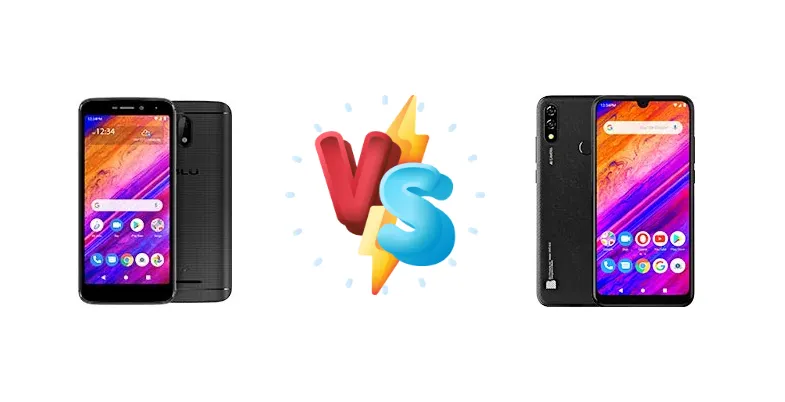
The BLU View 1 and Vivo XL5 represent the ultra-budget end of the smartphone spectrum. While both aim to deliver essential smartphone functionality at a low price, they differ significantly in their core processing power. This comparison dissects those differences, focusing on how the chipset choices impact real-world performance and user experience.
🏆 Quick Verdict
For the average user prioritizing basic tasks like calling, texting, and light social media, the BLU Vivo XL5 is the better choice. Its octa-core Cortex-A55 CPU offers a noticeable performance uplift over the View 1’s quad-core MT6739, resulting in smoother multitasking and a more responsive user interface.
| Network |
|---|
| 2G bands | GSM 850 / 900 / 1800 / 1900 | GSM 850 / 900 / 1800 / 1900 |
| 3G bands | HSDPA 850 / 1700(AWS) / 1900 | HSDPA 850 / 1700(AWS) / 1900 |
| 4G bands | 2, 4, 5, 12, 13, 66, 71 | 2, 4, 5, 12, 17 |
| Speed | HSPA 42.2/5.76 Mbps, LTE Cat4 150/50 Mbps | HSPA 42.2/11.5 Mbps, LTE Cat4 150/50 Mbps |
| Technology | GSM / HSPA / LTE | GSM / HSPA / LTE |
| Launch |
|---|
| Announced | 2019, November. Released 2019, November | 2019, July. Released 2019, July |
| Status | Discontinued | Discontinued |
| Body |
|---|
| Dimensions | 142.2 x 71.1 x 10.1 mm (5.60 x 2.80 x 0.40 in) | 161.4 x 78 x 9.6 mm (6.35 x 3.07 x 0.38 in) |
| SIM | Nano-SIM + Nano-SIM | Nano-SIM + Nano-SIM |
| Weight | 153 g (5.40 oz) | 181 g (6.38 oz) |
| Display |
|---|
| Resolution | 480 x 960 pixels, 18:9 ratio (~195 ppi density) | 720 x 1520 pixels, 19:9 ratio (~267 ppi density) |
| Size | 5.5 inches, 78.1 cm2 (~77.2% screen-to-body ratio) | 6.3 inches, 99.1 cm2 (~78.7% screen-to-body ratio) |
| Type | IPS LCD | IPS LCD |
| Platform |
|---|
| CPU | Quad-core 1.5 GHz Cortex-A53 | Octa-core 1.6 GHz Cortex-A55 |
| Chipset | Mediatek MT6739 (28 nm) | - |
| GPU | PowerVR GE8100 | IMG8322 |
| OS | Android 9.0 (Pie) | Android 9.0 (Pie) |
| Memory |
|---|
| Card slot | microSDXC | microSDXC |
| Internal | 16GB 2GB RAM | 64GB 3GB RAM |
| | eMMC 5.1 | - |
| Main Camera |
|---|
| Dual | - | 13 MP, AF
Auxiliary lens |
| Features | LED flash | LED flash |
| Single | 8 MP | - |
| Video | 1080p@30fps | 1080p@30fps |
| Selfie camera |
|---|
| Features | - | LED flash |
| Single | 5 MP | 13 MP |
| Video | 720p@30fps | 1080p@30fps |
| Sound |
|---|
| 3.5mm jack | Yes | Yes |
| 35mm jack | Yes | Yes |
| Loudspeaker | Yes | Yes |
| Comms |
|---|
| Bluetooth | 4.1, A2DP, LE | 4.1, A2DP |
| NFC | No | No |
| Positioning | GPS | GPS |
| Radio | FM radio | FM radio |
| USB | microUSB 2.0 | microUSB 2.0 |
| WLAN | Wi-Fi 802.11 b/g/n, Wi-Fi Direct | Wi-Fi 802.11 b/g/n, Wi-Fi Direct |
| Features |
|---|
| Sensors | Accelerometer, proximity | Fingerprint (rear-mounted), accelerometer, proximity |
| Battery |
|---|
| Stand-by | - | Up to 750 h (2G) / Up to 650 h (3G) |
| Talk time | - | Up to 30 h (2G) / Up to 24 h (3G) |
| Type | Li-Po 2500 mAh, removable | Li-Po 4000 mAh, non-removable |
BLU View 1
- Potentially lower price point
- May offer slightly longer battery life due to less demanding CPU
- Simple and straightforward user experience
- Significantly slower performance compared to the Vivo XL5
- Older CPU architecture (Cortex-A53)
- Likely to struggle with multitasking
BLU Vivo XL5
- Faster and more responsive performance thanks to the octa-core Cortex-A55 CPU
- More efficient CPU architecture
- Better multitasking capabilities
- May have slightly shorter battery life due to more powerful CPU
- Potentially slightly higher price
- Still an entry-level device with limitations
Display Comparison
Unfortunately, detailed display specifications are unavailable for either device. However, given their price points, it's safe to assume both utilize IPS LCD panels with 720p resolutions. Bezels are likely to be substantial on both models. Color accuracy and brightness will likely be average, prioritizing cost savings over premium display features.
Camera Comparison
Camera details are sparse. Given the market segment, both phones likely feature basic camera setups. Without sensor size or aperture information, it’s difficult to make a definitive statement. However, the image signal processor (ISP) within the Vivo XL5’s chipset is likely more advanced, potentially leading to slightly better image processing and noise reduction. Any 2MP macro or depth sensors on either device should be considered marketing features rather than significant photographic assets.
Performance
The core difference lies in the CPUs. The BLU View 1’s Mediatek MT6739, built on a 28nm process, features a quad-core Cortex-A53 configuration clocked at 1.5 GHz. This is an older architecture designed for basic smartphone tasks. The BLU Vivo XL5, conversely, boasts an octa-core Cortex-A55 CPU clocked slightly higher at 1.6 GHz. The Cortex-A55 is a more efficient and capable architecture, offering improved performance per clock cycle. The move to eight cores also allows for better multitasking. While both are entry-level, the Vivo XL5 will handle more apps simultaneously without significant slowdown. The 28nm process of the MT6739 will also likely result in higher heat generation under load compared to the potentially more efficient Cortex-A55.
Battery Life
Battery capacity is not specified for either device. However, given the lower processing demands of the View 1, it may achieve slightly longer battery life on a single charge, despite potentially having a smaller capacity. Charging wattage is also unknown, but both are likely to utilize standard 5W or 10W charging, resulting in relatively slow 0-100% charge times.
Buying Guide
Buy the BLU View 1 if you absolutely need the lowest possible price and your smartphone usage is extremely limited to essential communication. Buy the BLU Vivo XL5 if you want a more fluid experience, even with basic apps, and anticipate occasional multitasking or slightly more demanding applications. The Vivo XL5 offers a better long-term user experience for a minimal price increase.
Frequently Asked Questions
❓ Will the BLU Vivo XL5 handle popular social media apps like Facebook and Instagram smoothly?
Yes, the octa-core Cortex-A55 CPU in the Vivo XL5 is sufficiently powerful to run Facebook, Instagram, and similar social media apps without significant lag. While it won't offer a flagship-level experience, it will provide a much smoother experience than the View 1's older processor.
❓ Is the difference in CPU cores (quad-core vs. octa-core) really noticeable in everyday use?
Yes, the difference is noticeable, especially when multitasking. The BLU View 1’s quad-core processor will struggle with more than a couple of apps open simultaneously, leading to slowdowns. The Vivo XL5’s eight cores allow it to handle more apps in the background without impacting performance as severely.
❓ Can either of these phones play modern mobile games?
Both phones will struggle with graphically demanding games. They may be able to run simpler 2D games or older 3D titles at low settings, but don't expect a playable experience with popular, modern games like PUBG or Call of Duty Mobile.