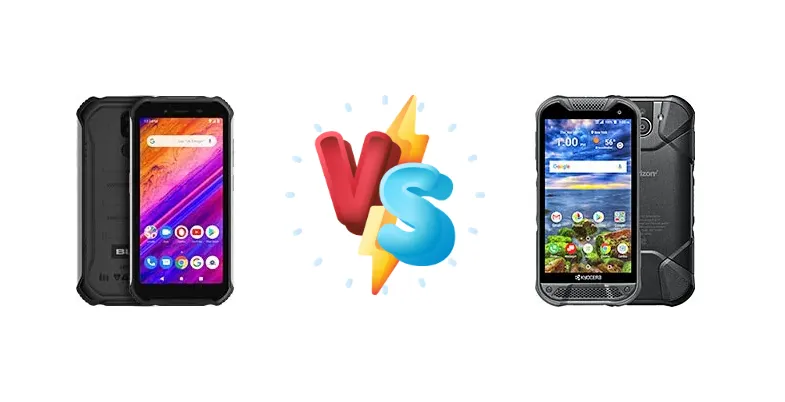
The rugged smartphone market caters to a specific need: devices that can withstand harsh conditions. Both the BLU Tank Xtreme and the Kyocera DuraForce Pro 2 aim to fulfill this requirement, but they approach it with vastly different internal hardware. This comparison dissects their strengths and weaknesses, focusing on performance, battery, and overall value.
🏆 Quick Verdict
For the average user prioritizing performance and future-proofing, the Kyocera DuraForce Pro 2 is the clear winner. Its Snapdragon 630 chipset offers a significant performance leap over the BLU Tank Xtreme’s quad-core Cortex-A53, alongside the convenience of wireless charging. However, the Tank Xtreme remains a viable option for those on a very tight budget.
| Network |
|---|
| 2G bands | GSM 850 / 900 / 1800 / 1900 | GSM 850 / 900 / 1800 / 1900 |
| 3G bands | HSDPA 850 / 900 / 1700(AWS) / 1900 / 2100 | HSDPA 850 / 900 / 1900 / 2100 |
| 4G bands | 1, 2, 3, 4, 5, 7, 12, 17, 28 | 1, 2, 3, 4, 5, 7, 13, 66 |
| Speed | HSPA 42.2/11.5 Mbps, LTE Cat4 150/50 Mbps | HSPA 42.2/5.76 Mbps, LTE (3CA) Cat9 450/50 Mbps |
| Technology | GSM / HSPA / LTE | GSM / HSPA / LTE |
| Launch |
|---|
| Announced | 2020, January. Released 2020, January | 2018, November. Released 2018, November |
| Status | Discontinued | Discontinued |
| Body |
|---|
| Dimensions | 153.6 x 71.8 x 10.2 mm (6.05 x 2.83 x 0.40 in) | 150.2 x 73.4 x 13.5 mm (5.91 x 2.89 x 0.53 in) |
| SIM | Nano-SIM + Nano-SIM | Nano-SIM |
| Weight | 178 g (6.28 oz) | 243 g (8.25 oz) |
| | IP68 dust/water resistant (up to 1.5m for 30 mins) | IP68 dust/water resistant (up to 2m for 30 mins)
MIL-STD-810G compliant
Push-to-talk button |
| Display |
|---|
| Protection | - | Sapphire crystal glass |
| Resolution | 480 x 960 pixels, 18:9 ratio (~195 ppi density) | 1080 x 1920 pixels, 16:9 ratio (~441 ppi density) |
| Size | 5.5 inches, 78.1 cm2 (~70.8% screen-to-body ratio) | 5.0 inches, 68.9 cm2 (~62.5% screen-to-body ratio) |
| Type | IPS LCD | IPS LCD |
| Platform |
|---|
| CPU | Quad-core 1.3 GHz Cortex-A53 | Octa-core 2.2 GHz Cortex-A53 |
| Chipset | - | Qualcomm SDM630 Snapdragon 630 (14 nm) |
| GPU | Mali-T720 | Adreno 508 |
| OS | Android 9.0 (Pie) | Android 8.0 (Oreo) |
| Memory |
|---|
| Card slot | microSDXC (uses shared SIM slot) | microSDXC (dedicated slot) |
| Internal | 32GB 2GB RAM | 64GB 4GB RAM |
| | eMMC 5.1 | - |
| Main Camera |
|---|
| Dual | 13 MP, AF
Auxiliary lens | - |
| Features | LED flash | LED flash, HDR, panorama |
| Single | - | 13 MP, AF
8 MP (ultra wide; dedicated video camera) |
| Video | 1080p@30fps | 4K@30fps, 1080p@30fps |
| Selfie camera |
|---|
| Single | 8 MP | 5 MP |
| Video | 720p@30fps | - |
| Sound |
|---|
| 3.5mm jack | Yes | Yes |
| 35mm jack | Yes | Yes |
| Loudspeaker | Yes | Yes, with stereo speakers |
| Comms |
|---|
| Bluetooth | 4.0, A2DP | 5.0, A2DP, LE |
| NFC | No | Yes |
| Positioning | GPS | GPS |
| Radio | FM radio | No |
| USB | microUSB 2.0 | USB Type-C 3.1 |
| WLAN | Wi-Fi 802.11 b/g/n | Wi-Fi 802.11 a/b/g/n/ac/i/r/k, dual-band, Wi-Fi Direct |
| Features |
|---|
| Sensors | Fingerprint (rear-mounted), accelerometer, proximity | Fingerprint (side-mounted), accelerometer, gyro, proximity, compass, barometer |
| Battery |
|---|
| Charging | - | 10W wired
Wireless (Qi) |
| Stand-by | - | Up to 312 h (3G) |
| Talk time | - | Up to 21 h (3G) |
| Type | Li-Po 4200 mAh | Li-Ion 3240 mAh, non-removable |
| Misc |
|---|
| Colors | Black | Black |
| Price | About 120 EUR | About 400 EUR |
BLU Tank Xtreme
- Extremely affordable price point
- Ruggedized design for durability
- Simple and easy-to-use interface
- Outdated processor and limited performance
- Likely lower-quality camera
- No wireless charging
Kyocera DuraForce Pro 2
- Significantly faster Snapdragon 630 processor
- Wireless charging (Qi standard)
- Potentially better camera system
- Higher price compared to the BLU Tank Xtreme
- May still lack high-end camera features
- Rugged design may add bulk
Display Comparison
Neither device’s display specifications are provided, so we must infer. Given the market segment, both likely utilize LCD panels. The Kyocera, being a slightly higher-tier device, may have a higher resolution and potentially better viewing angles. The BLU Tank Xtreme, focusing on cost reduction, likely uses a simpler panel. The absence of any mention of refresh rates suggests both operate at the standard 60Hz. Bezels are likely substantial on both to contribute to shock absorption.
Camera Comparison
Without detailed camera specifications, a direct comparison is difficult. However, the Kyocera’s higher-tier positioning suggests a more capable camera system. While both likely feature a primary rear camera, the Kyocera may include features like optical image stabilization (OIS) or a larger sensor, resulting in better low-light performance and image quality. The BLU Tank Xtreme likely prioritizes affordability over camera capabilities, potentially resulting in a less detailed and dynamic image. We can assume both will have a front-facing camera for video calls.
Performance
The performance disparity is significant. The BLU Tank Xtreme’s quad-core 1.3 GHz Cortex-A53 CPU is a relatively old architecture, designed for basic smartphone tasks. In contrast, the Kyocera DuraForce Pro 2 boasts the Qualcomm Snapdragon 630, an octa-core 2.2 GHz Cortex-A53 chipset fabricated on a 14nm process. This means the Kyocera offers substantially more processing power, enabling smoother multitasking, faster app loading times, and a better overall user experience. The 14nm process also contributes to improved thermal efficiency, reducing the likelihood of throttling under sustained load. The Kyocera’s Adreno 508 GPU will also provide a far superior graphics experience.
Battery Life
Battery capacity isn’t specified for either device. However, the Kyocera DuraForce Pro 2 gains a significant advantage with its support for 10W wired charging *and* Qi wireless charging. This provides flexibility and convenience, especially for users who frequently work in environments where access to power outlets is limited. The BLU Tank Xtreme, lacking wireless charging, relies solely on wired charging, which is likely slower. While a larger mAh capacity on the Tank Xtreme could offset the slower charging, the Snapdragon 630’s improved power efficiency in the Kyocera could result in comparable real-world battery life.
Buying Guide
Buy the BLU Tank Xtreme if you need a basic, extremely affordable rugged phone for essential communication and minimal app usage. It’s ideal for users who prioritize cost above all else and don’t require demanding performance. Buy the Kyocera DuraForce Pro 2 if you prefer a more capable device that can handle multitasking, moderate gaming, and benefit from features like wireless charging and a more powerful processor, making it suitable for field work or demanding outdoor activities.
Frequently Asked Questions
❓ Is the Snapdragon 630 in the Kyocera DuraForce Pro 2 still capable of running modern apps smoothly?
Yes, the Snapdragon 630 is a capable mid-range processor that can handle most modern apps without significant issues. While it won't deliver flagship-level performance, it provides a smooth and responsive experience for everyday tasks, social media, and moderate gaming.
❓ How does the ruggedization of the Kyocera DuraForce Pro 2 compare to other rugged phones?
The Kyocera DuraForce Pro 2 is built to meet MIL-STD-810G standards, meaning it's tested against drops, shock, vibration, temperature extremes, and dust/water ingress. While specific testing details aren't available, this certification indicates a high level of durability suitable for demanding work environments.
❓ Will the BLU Tank Xtreme struggle with common tasks like web browsing and email?
The BLU Tank Xtreme's quad-core processor is relatively slow, so you may experience some lag when browsing the web or using multiple apps simultaneously. It's best suited for basic communication and simple tasks, rather than demanding applications.
❓ Does the Kyocera DuraForce Pro 2 support software updates?
Kyocera's software update track record is not as consistent as some other manufacturers. While it initially launched with Android 8.0 Oreo, updates have been limited. Users should not expect frequent or long-term software support.