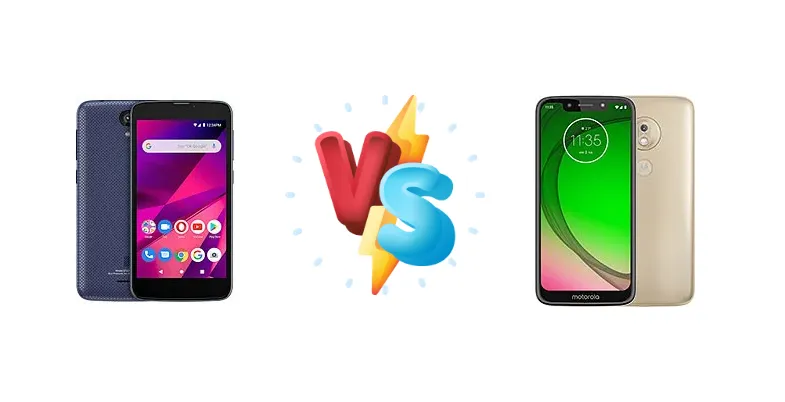
Both the BLU Studio X9 HD and Motorola Moto G7 Play target the ultra-budget smartphone market, but they approach it with vastly different hardware. This comparison dissects the core differences – particularly the chipset – to determine which device offers the best experience for the money.
🏆 Quick Verdict
For the vast majority of users, the Motorola Moto G7 Play is the clear winner. Its Qualcomm Snapdragon 632 chipset provides a substantial performance advantage over the BLU Studio X9 HD’s Mediatek MT6580, translating to smoother multitasking and a more responsive user experience, despite both phones offering similar battery endurance.
| Network |
|---|
| 2G bands | GSM 850 / 900 / 1800 / 1900 | GSM 850 / 900 / 1800 / 1900 |
| 3G bands | HSDPA 850 / 900 / 1900 / 2100 | HSDPA 850 / 900 / 1700(AWS) / 1900 / 2100 |
| 4G bands | - | 1, 2, 3, 4, 5, 7, 8, 20, 28, 38, 40, 41 - Europe |
| Speed | HSPA 21.1/5.76 Mbps | HSPA 42.2/5.76 Mbps, LTE (2CA) Cat7 300/50 Mbps |
| Technology | GSM / HSPA | GSM / HSPA / LTE |
| | - | 1, 2, 3, 4, 5, 7, 8, 12, 13, 14, 17, 20, 25, 26, 29, 30, 38, 39, 40, 41, 41, 66, 71 - USA |
| Launch |
|---|
| Announced | 2020, March 25. Released 2020, March 25 | 2019, February. Released 2019, March |
| Status | Discontinued | Discontinued |
| Body |
|---|
| Build | - | Glass front (Gorilla Glass 3), plastic back, plastic frame |
| Dimensions | 143 x 73 x 10.1 mm (5.63 x 2.87 x 0.40 in) | 147.3 x 71.5 x 8 mm (5.80 x 2.81 x 0.31 in) |
| SIM | Nano-SIM + Nano-SIM | · Nano-SIM· Nano-SIM + Nano-SIM |
| Weight | 144 g (5.08 oz) | 149 g (5.26 oz) |
| | - | Splash resistant (market dependent) |
| Display |
|---|
| Protection | - | Corning Gorilla Glass 3 (market dependent) |
| Resolution | 720 x 1280 pixels, 16:9 ratio (~294 ppi density) | 720 x 1512 pixels, 19:9 ratio (~294 ppi density) |
| Size | 5.0 inches, 68.9 cm2 (~66.0% screen-to-body ratio) | 5.7 inches, 81.4 cm2 (~77.3% screen-to-body ratio) |
| Type | IPS LCD | IPS LCD |
| Platform |
|---|
| CPU | Quad-core 1.3 GHz Cortex-A7 | Octa-core (4x1.8 GHz Kryo 250 Gold & 4x1.8 GHz Kryo 250 Silver) |
| Chipset | Mediatek MT6580 (28 nm) | Qualcomm SDM632 Snapdragon 632 (14 nm) |
| GPU | Mali-400MP2 | Adreno 506 |
| OS | Android 8.1 Oreo (Go edition) | Android 9.0 (Pie), upgradable to Android 10 |
| Memory |
|---|
| Card slot | microSDXC | microSDXC (dedicated slot) |
| Internal | 8GB 1GB RAM | 32GB 2GB RAM, 32GB 3GB RAM |
| | - | eMMC 5.1 |
| Main Camera |
|---|
| Features | LED flash | LED flash, panorama, HDR |
| Single | 8 MP | 13 MP, f/2.0, 1/3.1", 1.12µm, PDAF |
| Video | 1080p@30fps | 4K@30fps, 1080p@30fps |
| Selfie camera |
|---|
| Features | - | LED flash |
| Single | 5 MP | 8 MP, f/2.2, 1/4.0", 1.12µm |
| Video | 720p@30fps | 1080p@30fps |
| Sound |
|---|
| 3.5mm jack | Yes | Yes |
| 35mm jack | Yes | Yes |
| Loudspeaker | Yes | Yes |
| Comms |
|---|
| Bluetooth | 4.0, A2DP | 4.2, A2DP, LE |
| NFC | No | No |
| Positioning | GPS | GPS, GLONASS |
| Radio | FM radio | FM radio |
| USB | microUSB 2.0 | USB Type-C 2.0, OTG |
| WLAN | Wi-Fi 802.11 b/g/n, Wi-Fi Direct | Wi-Fi 802.11 b/g/n |
| Features |
|---|
| Sensors | Accelerometer | Fingerprint (rear-mounted), accelerometer, gyro, proximity, compass |
| Battery |
|---|
| Charging | - | 10W wired |
| Stand-by | Up to 500 h (3G) | - |
| Talk time | Up to 15 h (3G) | - |
| Type | Li-Ion 2000 mAh battery | Li-Ion 3000 mAh, non-removable |
| Misc |
|---|
| Colors | Black, White, Blue | Deep indigo, Fine Gold, Starry Black |
| Models | - | XT1952-4, XT1952-5 |
| Price | About 50 EUR | About 160 EUR |
| SAR | - | 0.74 W/kg (head) 1.40 W/kg (body) |
| SAR EU | - | 0.84 W/kg (head) 0.85 W/kg (body) |
| Tests |
|---|
| Audio quality | - |
Noise -90.0dB / Crosstalk -92.9dB |
| Battery life | - | Endurance rating 103h |
| Camera | - |
Photo / Video |
| Display | - |
Contrast ratio: 1468:1 (nominal), 3.180 (sunlight) |
| Loudspeaker | - |
Voice 66dB / Noise 74dB / Ring 81dB |
| Performance | - |
AnTuTu: 97230 (v7)
GeekBench: 4154 (v4.4)
GFXBench: 7.7fps (ES 3.1 onscreen) |
BLU Studio X9 HD
- Potentially lower price point
- Acceptable battery life for basic use
- Functional for essential communication
- Significantly slower performance
- Outdated chipset architecture
- Likely limited software support
Motorola Moto G7 Play
- Much faster and more responsive performance
- More efficient chipset for sustained usage
- Better image processing capabilities
- Likely better software support from Motorola
- May be slightly more expensive
- 10W charging is relatively slow
- Display specs are not significantly better
Display Comparison
Both devices share a contrast ratio of 1468:1 (nominal) and 3180:1 (sunlight), suggesting similar outdoor visibility. However, the context data lacks specifics on panel type, resolution, or brightness. Given the price point, both likely utilize IPS LCD panels. The G7 Play’s display quality will likely be superior due to Motorola’s generally better display calibration, even if the raw specs are comparable.
Camera Comparison
Both phones are listed as having 'Photo / Video' capabilities, but lack specific details. In this segment, the Moto G7 Play likely holds an advantage due to Qualcomm’s image signal processor (ISP) within the Snapdragon 632, which generally offers better image processing and noise reduction compared to Mediatek’s ISP in the MT6580. Without sensor size or aperture information, it’s difficult to make a definitive statement, but the G7 Play’s chipset provides a foundation for better image quality.
Performance
The performance gap is the most significant differentiator. The Motorola Moto G7 Play’s Qualcomm Snapdragon 632, built on a 14nm process, is a substantial upgrade over the BLU Studio X9 HD’s Mediatek MT6580 (28nm). The Snapdragon 632’s octa-core configuration (4x1.8 GHz Kryo 250 Gold & 4x1.8 GHz Kryo 250 Silver) provides significantly more processing power than the MT6580’s quad-core 1.3 GHz Cortex-A7. This translates to faster app loading times, smoother multitasking, and a more responsive user interface. The 14nm process also contributes to better power efficiency, meaning the G7 Play can sustain performance for longer periods without throttling.
Battery Life
Both devices boast an endurance rating of 103 hours, indicating similar battery life under typical usage. However, the Snapdragon 632’s superior power efficiency means the Moto G7 Play can achieve this endurance with a potentially smaller battery capacity. The G7 Play also supports 10W wired charging, while the Studio X9 HD’s charging speed is unknown, but likely similar or slower.
Buying Guide
Buy the BLU Studio X9 HD if your absolute priority is the lowest possible price and you only need a phone for basic tasks like calls and light messaging. Buy the Motorola Moto G7 Play if you value a smoother, more responsive experience, even for everyday tasks, and anticipate using your phone for more than just the bare minimum – including occasional social media browsing or light gaming.
Frequently Asked Questions
❓ Is the Mediatek MT6580 in the BLU Studio X9 HD sufficient for running popular apps like WhatsApp and Facebook?
While the MT6580 can technically run these apps, expect noticeable lag and slow loading times, especially with multiple apps open. The chipset struggles with multitasking and is best suited for very basic usage.
❓ Will the Motorola Moto G7 Play be able to handle light gaming, such as casual puzzle games?
Yes, the Snapdragon 632 is capable of handling light gaming without significant issues. While it won’t run demanding titles at high settings, it provides a much smoother gaming experience than the MT6580.
❓ How does the Snapdragon 632's efficiency impact the long-term usability of the Moto G7 Play?
The 14nm process of the Snapdragon 632 results in lower power consumption and less heat generation. This means the Moto G7 Play is less likely to experience performance throttling during extended use and may have a longer lifespan due to reduced stress on the components.
❓ Given the similar battery endurance ratings, does the Moto G7 Play have a larger battery capacity than the BLU Studio X9 HD?
Not necessarily. The Snapdragon 632's efficiency allows it to achieve the same endurance with a potentially smaller battery. The exact battery capacities are not provided, but the G7 Play's chipset is the key factor in its efficient power usage.