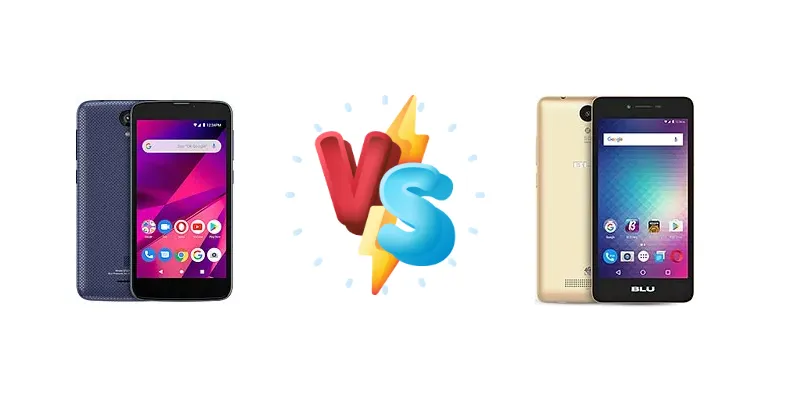
The BLU Studio X9 HD and G HD LTE represent two distinct approaches to the ultra-budget smartphone market. While both aim to deliver essential smartphone functionality at a low price point, they differ significantly in their core processing power, impacting everything from app responsiveness to network connectivity. This comparison dissects those differences to help you choose the right BLU device.
🏆 Quick Verdict
For most users, the BLU Studio G HD LTE is the better choice. Its Mediatek MT6737 chipset, featuring Cortex-A53 cores and LTE support, provides a noticeably smoother experience and future-proofed connectivity compared to the older Cortex-A7 based X9 HD, despite a slightly lower clock speed.
| Network |
|---|
| 2G bands | GSM 850 / 900 / 1800 / 1900 | GSM 850 / 900 / 1800 / 1900 - SIM 1 & SIM 2 |
| 3G bands | HSDPA 850 / 900 / 1900 / 2100 | HSDPA 850 / 1700(AWS) / 1900 / 2100 |
| 4G bands | - | 2, 4, 7, 12, 17 |
| Speed | HSPA 21.1/5.76 Mbps | HSPA 42.2/5.76 Mbps, LTE Cat4 150/50 Mbps |
| Technology | GSM / HSPA | GSM / HSPA / LTE |
| Launch |
|---|
| Announced | 2020, March 25. Released 2020, March 25 | 2016, August. Released 2016, August |
| Status | Discontinued | Discontinued |
| Body |
|---|
| Dimensions | 143 x 73 x 10.1 mm (5.63 x 2.87 x 0.40 in) | 145 x 72 x 9.4 mm (5.71 x 2.83 x 0.37 in) |
| SIM | Nano-SIM + Nano-SIM | Dual SIM (Micro-SIM, dual stand-by) |
| Weight | 144 g (5.08 oz) | 145 g (5.11 oz) |
| Display |
|---|
| Resolution | 720 x 1280 pixels, 16:9 ratio (~294 ppi density) | 720 x 1280 pixels, 16:9 ratio (~294 ppi density) |
| Size | 5.0 inches, 68.9 cm2 (~66.0% screen-to-body ratio) | 5.0 inches, 68.9 cm2 (~66.0% screen-to-body ratio) |
| Type | IPS LCD | IPS LCD |
| Platform |
|---|
| CPU | Quad-core 1.3 GHz Cortex-A7 | Quad-core 1.1 GHz Cortex-A53 |
| Chipset | Mediatek MT6580 (28 nm) | Mediatek MT6737 (28 nm) |
| GPU | Mali-400MP2 | Mali-T720 |
| OS | Android 8.1 Oreo (Go edition) | Android 6.0 (Marshmallow) |
| Memory |
|---|
| Card slot | microSDXC | microSDXC |
| Internal | 8GB 1GB RAM | 8GB 1GB RAM |
| | - | eMMC 5.0 |
| Main Camera |
|---|
| Features | LED flash | LED flash |
| Single | 8 MP | 5 MP, f/2.2, AF |
| Video | 1080p@30fps | 720p@30fps |
| Selfie camera |
|---|
| Single | 5 MP | 2 MP |
| Video | 720p@30fps | - |
| Sound |
|---|
| 3.5mm jack | Yes | Yes |
| 35mm jack | Yes | Yes |
| Loudspeaker | Yes | Yes |
| Comms |
|---|
| Bluetooth | 4.0, A2DP | 4.0, A2DP |
| NFC | No | No |
| Positioning | GPS | GPS |
| Radio | FM radio | FM radio |
| USB | microUSB 2.0 | microUSB 2.0, OTG |
| WLAN | Wi-Fi 802.11 b/g/n, Wi-Fi Direct | Wi-Fi 802.11 b/g/n, Wi-Fi Direct |
| Features |
|---|
| Sensors | Accelerometer | Accelerometer, proximity |
| Battery |
|---|
| Stand-by | Up to 500 h (3G) | Up to 550 h (2G) / Up to 400 h (3G) |
| Talk time | Up to 15 h (3G) | Up to 22 h (2G) / Up to 14 h (3G) |
| Type | Li-Ion 2000 mAh battery | Li-Po 2200 mAh, removable |
| Misc |
|---|
| Colors | Black, White, Blue | Black, Gold |
| Price | About 50 EUR | - |
BLU Studio X9 HD
- Potentially lower price point
- Simple and straightforward user experience
- May be easier to find replacement batteries (speculation)
- Outdated Cortex-A7 processor
- No LTE connectivity
- Slower app loading and multitasking
BLU Studio G HD LTE
- More efficient Cortex-A53 processor
- LTE connectivity for faster data speeds
- Improved GPU performance for gaming
- May be slightly more expensive
- Potentially slightly shorter battery life under heavy load
- Still a budget device with limited features
Display Comparison
Neither BLU provides detailed display specifications. However, given the price point, both likely utilize IPS LCD panels with 720p resolution. The lack of information prevents a detailed comparison of brightness or color accuracy. The X9 HD's omission of LTE suggests a potentially older panel technology. Bezels are expected to be substantial on both devices, typical of this market segment.
Camera Comparison
Both phones likely feature basic camera setups. Without specific sensor details, it's safe to assume both rely on low-resolution sensors (likely 5MP or 8MP main cameras). Image quality will be heavily reliant on software processing, and neither phone is expected to excel in low-light conditions. Any secondary cameras (likely 2MP) are primarily for depth sensing and offer limited practical benefit. The MT6737’s ISP (Image Signal Processor) is likely more advanced, potentially leading to slightly better image processing on the G HD LTE.
Performance
The core difference lies in the chipsets. The BLU Studio X9 HD’s Mediatek MT6580, built on a 28nm process, utilizes four Cortex-A7 cores clocked at 1.3 GHz. The G HD LTE steps up to the Mediatek MT6737, also 28nm, but with four Cortex-A53 cores at 1.1 GHz. While the clock speed is lower, the Cortex-A53 architecture is significantly more efficient and offers a substantial IPC (Instructions Per Clock) improvement over the Cortex-A7. This translates to faster app loading times and smoother multitasking on the G HD LTE. The MT6737 also includes a more capable Mali-T720 GPU, offering a better gaming experience than the MT6580’s Mali-400 MP2. The inclusion of LTE support in the MT6737 is a major advantage for data connectivity.
Battery Life
Battery capacity is not specified for either device. Given the similar chipsets (both 28nm) and likely similar screen sizes, battery life should be comparable. However, the MT6737’s more efficient Cortex-A53 cores may result in slightly longer standby times. Charging wattage is also unknown, but both are likely to ship with basic 5W chargers, resulting in relatively slow charging times (likely 3-4 hours for a full charge).
Buying Guide
Buy the BLU Studio X9 HD if your primary needs are basic communication – calls, texts, and light app usage – and you prioritize the absolute lowest possible price. You'll be trading performance for savings. Buy the BLU Studio G HD LTE if you want a more responsive experience, faster data speeds with LTE connectivity, and a phone that can handle a wider range of apps without significant lag. The G HD LTE offers a better long-term user experience.
Frequently Asked Questions
❓ Will the BLU Studio G HD LTE be able to handle popular social media apps like Facebook and Instagram without significant lag?
Yes, the Mediatek MT6737 and Cortex-A53 cores in the G HD LTE are sufficiently powerful to run Facebook, Instagram, and other common social media apps smoothly. While it won't offer a flagship-level experience, it will provide a usable and responsive experience for these applications, unlike the X9 HD which may struggle.
❓ Is the lack of LTE on the BLU Studio X9 HD a major drawback in 2024?
Absolutely. In 2024, LTE is essential for a modern smartphone experience. The X9 HD's reliance on 3G networks will result in significantly slower data speeds and limited compatibility as 3G networks are phased out. This severely limits its usefulness for browsing, streaming, and using data-intensive apps.
❓ Can I expect to play demanding games like PUBG Mobile on either of these phones?
While both phones can *launch* PUBG Mobile, the experience will be far from ideal. The Mali-400 MP2 in the X9 HD will struggle significantly, even at the lowest settings. The Mali-T720 in the G HD LTE will offer a slightly better experience, but you'll still need to play at the lowest settings and expect frame rate drops.