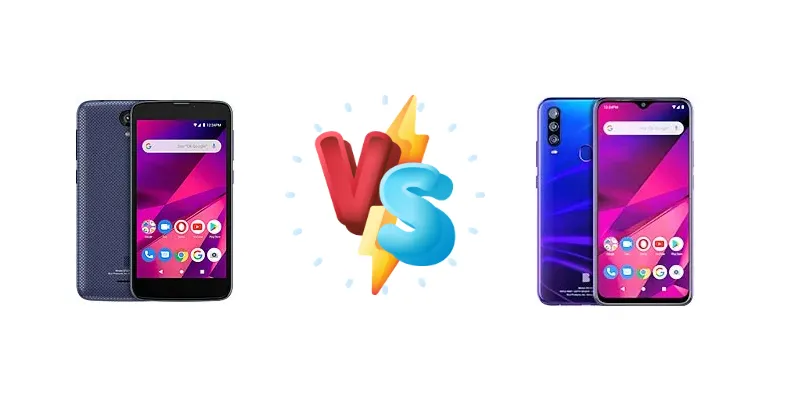
BLU offers compelling options in the ultra-budget smartphone space, but the Studio X9 HD and G9 Pro represent very different approaches. The X9 HD prioritizes affordability, while the G9 Pro aims for a more modern feature set. This comparison dissects the core differences to determine which device best suits your needs.
🏆 Quick Verdict
For most users, the BLU G9 Pro is the superior choice. Its Helio P60 chipset delivers significantly faster performance and supports modern features like wireless charging, justifying the price premium over the aging Mediatek MT6580 in the Studio X9 HD. However, the X9 HD remains a viable option for extremely budget-conscious users.
| Network |
|---|
| 2G bands | GSM 850 / 900 / 1800 / 1900 | GSM 850 / 900 / 1800 / 1900 |
| 3G bands | HSDPA 850 / 900 / 1900 / 2100 | HSDPA 850 / 900 / 1700(AWS) / 1900 / 2100 |
| 4G bands | - | 1, 2, 3, 4, 5, 7, 8, 12, 13, 17, 28 |
| Speed | HSPA 21.1/5.76 Mbps | HSPA 42.2/5.76 Mbps, LTE (2CA) Cat6 300/50 Mbps |
| Technology | GSM / HSPA | GSM / HSPA / LTE |
| Launch |
|---|
| Announced | 2020, March 25. Released 2020, March 25 | 2019, August. Released 2019, August |
| Status | Discontinued | Discontinued |
| Body |
|---|
| Dimensions | 143 x 73 x 10.1 mm (5.63 x 2.87 x 0.40 in) | 157 x 75.1 x 8.6 mm (6.18 x 2.96 x 0.34 in) |
| SIM | Nano-SIM + Nano-SIM | Nano-SIM + Nano-SIM |
| Weight | 144 g (5.08 oz) | 183 g (6.46 oz) |
| Display |
|---|
| Resolution | 720 x 1280 pixels, 16:9 ratio (~294 ppi density) | 1080 x 2340 pixels, 19.5:9 ratio (~409 ppi density) |
| Size | 5.0 inches, 68.9 cm2 (~66.0% screen-to-body ratio) | 6.3 inches, 97.4 cm2 (~82.6% screen-to-body ratio) |
| Type | IPS LCD | IPS LCD |
| Platform |
|---|
| CPU | Quad-core 1.3 GHz Cortex-A7 | Octa-core (4x2.0 GHz Cortex-A73 & 4x2.0 GHz Cortex-A53) |
| Chipset | Mediatek MT6580 (28 nm) | Mediatek MT6771 Helio P60 (12 nm) |
| GPU | Mali-400MP2 | Mali-G72 MP3 |
| OS | Android 8.1 Oreo (Go edition) | Android 9.0 (Pie), planned upgrade to Android 10 |
| Memory |
|---|
| Card slot | microSDXC | microSDXC |
| Internal | 8GB 1GB RAM | 128GB 4GB RAM |
| | - | eMMC 5.1 |
| Main Camera |
|---|
| Features | LED flash | LED flash, HDR, panorama |
| Single | 8 MP | - |
| Triple | - | 48 MP, f/1.8, 1/2.0", 0.8µm, PDAF
8 MP, f/2.2, (ultrawide)
Auxiliary lens |
| Video | 1080p@30fps | 1080p@30fps |
| Selfie camera |
|---|
| Single | 5 MP | 16 MP, f/2.0 |
| Video | 720p@30fps | 1080p@30fps |
| Sound |
|---|
| 3.5mm jack | Yes | Yes |
| 35mm jack | Yes | Yes |
| Loudspeaker | Yes | Yes |
| Comms |
|---|
| Bluetooth | 4.0, A2DP | 4.1, A2DP, LE |
| NFC | No | No |
| Positioning | GPS | GPS |
| Radio | FM radio | FM radio |
| USB | microUSB 2.0 | USB Type-C 2.0, OTG |
| WLAN | Wi-Fi 802.11 b/g/n, Wi-Fi Direct | Wi-Fi 802.11 a/b/g/n, Wi-Fi Direct |
| Features |
|---|
| Sensors | Accelerometer | Fingerprint (rear-mounted), accelerometer, gyro, proximity, compass |
| Battery |
|---|
| Charging | - | 18W wired
10W wireless (Qi) |
| Stand-by | Up to 500 h (3G) | Up to 625 h (3G) |
| Talk time | Up to 15 h (3G) | Up to 21 h (3G) |
| Type | Li-Ion 2000 mAh battery | Li-Po 4000 mAh, non-removable |
| Misc |
|---|
| Colors | Black, White, Blue | Nightfall, Black |
| Price | About 50 EUR | - |
BLU Studio X9 HD
- Lowest possible price point
- Functional for basic smartphone tasks
- Potentially longer battery life if capacity is higher than G9 Pro
- Significantly slower performance
- Outdated chipset and architecture
- Slow charging speeds
- Limited feature set
BLU G9 Pro
- Much faster performance with Helio P60
- 18W wired and 10W wireless charging
- More modern feature set
- Improved image processing capabilities
- Higher price than Studio X9 HD
- Battery life may be slightly shorter than X9 HD (depending on capacity)
- Still a budget device with potential compromises in build quality
Display Comparison
Neither BLU provides detailed display specifications. However, given the price points, both likely utilize IPS LCD panels. The G9 Pro’s more powerful chipset suggests a potentially higher resolution and better color calibration. The X9 HD, with its older processor, likely has a lower resolution display, impacting sharpness. Bezels are expected to be substantial on both devices, typical of this market segment. Without specific nit ratings, it's safe to assume neither will excel in direct sunlight.
Camera Comparison
Detailed camera specs are unavailable for both devices. However, given the market segment, expectations should be tempered. The G9 Pro likely benefits from the Helio P60’s integrated image signal processor (ISP), offering better image processing capabilities than the MT6580. While both may include a primary camera, the G9 Pro’s ISP could deliver improved dynamic range and noise reduction. Any secondary cameras (often 2MP macro lenses) on either device are unlikely to provide significant image quality improvements and should be considered a marketing feature rather than a practical benefit.
Performance
The performance gap is the most significant differentiator. The BLU G9 Pro’s Mediatek Helio P60, built on a 12nm process, features an octa-core CPU (4x2.0 GHz Cortex-A73 & 4x2.0 GHz Cortex-A53) offering a substantial leap in processing power compared to the BLU Studio X9 HD’s quad-core 1.3 GHz Cortex-A7 based Mediatek MT6580 (28nm). The Helio P60’s architecture, with its Cortex-A73 cores, provides significantly better single-core performance, crucial for app responsiveness. The 12nm process also translates to improved thermal efficiency, reducing throttling during sustained workloads. Users will experience noticeably faster app loading times, smoother multitasking, and the ability to run more demanding applications on the G9 Pro.
Battery Life
Battery capacity is not specified for either device. However, the G9 Pro’s 18W wired and 10W wireless (Qi) charging capabilities are a major advantage. The X9 HD likely relies on slower, traditional charging methods. While a larger battery capacity on the X9 HD *could* offset the G9 Pro’s faster charging, the convenience of wireless charging and quicker top-ups offered by the G9 Pro are significant benefits for many users. The Helio P60’s improved power efficiency also contributes to potentially longer real-world battery life on the G9 Pro, despite any potential capacity differences.
Buying Guide
Buy the BLU Studio X9 HD if you need a functional smartphone for basic tasks like calls, texts, and light web browsing, and your budget is under $100. Buy the BLU G9 Pro if you prioritize smoother multitasking, occasional gaming, faster charging, and the convenience of wireless charging, and are willing to spend a bit more for a more modern experience.
Frequently Asked Questions
❓ Will the BLU G9 Pro handle popular social media apps like TikTok and Instagram smoothly?
Yes, the Helio P60 chipset in the G9 Pro is significantly more capable of handling the demands of social media apps compared to the MT6580 in the X9 HD. You should experience smoother scrolling, faster loading times, and fewer instances of lag when using these apps on the G9 Pro.
❓ Is the wireless charging on the BLU G9 Pro truly useful, or is it just a gimmick?
The 10W wireless charging on the G9 Pro is a genuine convenience feature. While not as fast as wired charging, it eliminates the need for cables and allows for easy top-ups throughout the day. It's particularly useful for users who frequently use wireless charging pads at home or in the office.
❓ Can the BLU Studio X9 HD run basic games like Candy Crush or Subway Surfers without significant lag?
The BLU Studio X9 HD can handle very simple games like Candy Crush or Subway Surfers, but performance will be limited. Expect longer loading times and occasional stuttering, especially during more visually demanding sections of the game. It's not suitable for more graphically intensive games.
❓ What type of SIM card does the BLU G9 Pro support, and does it have 4G LTE connectivity?
The BLU G9 Pro supports Nano-SIM cards and *does* feature 4G LTE connectivity. This allows for faster data speeds and a better overall mobile internet experience compared to the older 3G connectivity often found in devices with the MT6580 chipset.