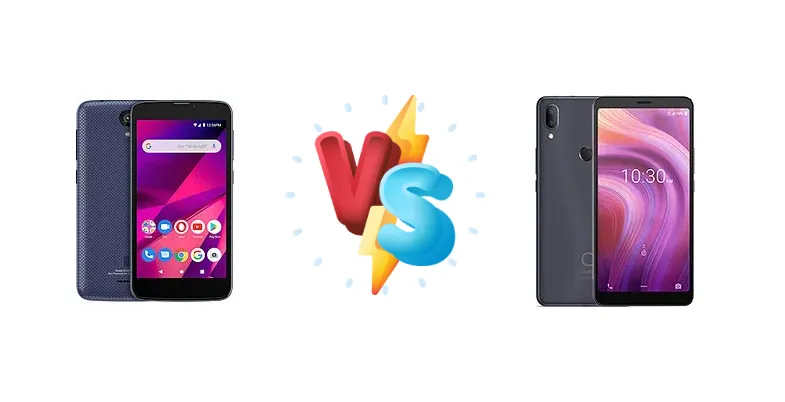
The BLU Studio X9 HD and the alcatel 3v (2019) represent the extreme end of the smartphone price spectrum. Both aim to deliver essential smartphone functionality at a minimal cost, but they take drastically different approaches to achieving this. This comparison dissects their core components to determine which device offers the best value for users prioritizing affordability.
🏆 Quick Verdict
For the average user, the alcatel 3v (2019) is the clear winner. Its Helio P22 chipset, built on a more efficient 12nm process, provides a significantly faster and more responsive experience than the BLU Studio X9 HD’s aging MT6580. While neither phone excels in any single area, the alcatel 3v offers a more modern and usable platform.
| Network |
|---|
| 2G bands | GSM 850 / 900 / 1800 / 1900 | GSM 850 / 900 / 1800 / 1900 |
| 3G bands | HSDPA 850 / 900 / 1900 / 2100 | HSDPA 850 / 900 / 1700(AWS) / 1900 / 2100 |
| 4G bands | - | 1, 2, 3, 4, 5, 7, 12, 13, 17, 20, 25, 26, 41, 66, 71 |
| Speed | HSPA 21.1/5.76 Mbps | HSPA 42.2/11.5 Mbps, LTE Cat4 150/50 Mbps |
| Technology | GSM / HSPA | GSM / HSPA / LTE |
| Launch |
|---|
| Announced | 2020, March 25. Released 2020, March 25 | 2019, Q2. Released 2019, Q4 |
| Status | Discontinued | Discontinued |
| Body |
|---|
| Build | - | Glass front (DragonTrail Pro glass), plastic back, plastic frame |
| Dimensions | 143 x 73 x 10.1 mm (5.63 x 2.87 x 0.40 in) | 174.5 x 83.3 x 8.4 mm (6.87 x 3.28 x 0.33 in) |
| SIM | Nano-SIM + Nano-SIM | Nano-SIM |
| Weight | 144 g (5.08 oz) | 197.9 g (6.98 oz) |
| Display |
|---|
| Protection | - | DragonTrail Pro |
| Resolution | 720 x 1280 pixels, 16:9 ratio (~294 ppi density) | 720 x 1440 pixels, 18:9 ratio (~240 ppi density) |
| Size | 5.0 inches, 68.9 cm2 (~66.0% screen-to-body ratio) | 6.7 inches, 115.8 cm2 (~79.7% screen-to-body ratio) |
| Type | IPS LCD | IPS LCD |
| Platform |
|---|
| CPU | Quad-core 1.3 GHz Cortex-A7 | Octa-core 2.0 GHz Cortex-A53 |
| Chipset | Mediatek MT6580 (28 nm) | Mediatek MT6762 Helio P22 (12 nm) |
| GPU | Mali-400MP2 | PowerVR GE8320 |
| OS | Android 8.1 Oreo (Go edition) | Android 9.0 (Pie) |
| Memory |
|---|
| Card slot | microSDXC | microSDXC (dedicated slot) |
| Internal | 8GB 1GB RAM | 32GB 3GB RAM |
| | - | eMMC 5.1 |
| Main Camera |
|---|
| Dual | - | 16 MP, PDAF
Auxiliary lens |
| Features | LED flash | LED flash, HDR, panorama |
| Single | 8 MP | - |
| Video | 1080p@30fps | 1080p@30fps |
| Selfie camera |
|---|
| Single | 5 MP | 8 MP |
| Video | 720p@30fps | 720p@30fps |
| Sound |
|---|
| 3.5mm jack | Yes | Yes |
| 35mm jack | Yes | Yes |
| Loudspeaker | Yes | Yes, with stereo speakers |
| Comms |
|---|
| Bluetooth | 4.0, A2DP | 4.2, A2DP, LE |
| NFC | No | No |
| Positioning | GPS | GPS |
| Radio | FM radio | FM radio |
| USB | microUSB 2.0 | USB Type-C 2.0 |
| WLAN | Wi-Fi 802.11 b/g/n, Wi-Fi Direct | Wi-Fi 802.11 a/b/g/n, dual-band, Wi-Fi Direct |
| Features |
|---|
| Sensors | Accelerometer | Fingerprint (rear-mounted), accelerometer, proximity, compass |
| Battery |
|---|
| Charging | - | 15W wired |
| Stand-by | Up to 500 h (3G) | - |
| Talk time | Up to 15 h (3G) | - |
| Type | Li-Ion 2000 mAh battery | Li-Po 4000 mAh |
| Misc |
|---|
| Colors | Black, White, Blue | Elegant Black |
| Models | - | 5032W |
| Price | About 50 EUR | About 170 EUR |
BLU Studio X9 HD
- Potentially lower price point
- Basic smartphone functionality
- Simple user interface (likely)
- Outdated processor (MT6580)
- Poor performance for multitasking
- Likely lower quality display
- Slow charging (estimated)
alcatel 3v (2019)
- Faster processor (Helio P22)
- More efficient 12nm process
- 15W fast charging
- Smoother user experience
- Still a budget device with limitations
- 2MP macro camera is largely ineffective
- May be slightly more expensive
Display Comparison
Neither device boasts a standout display. Both likely utilize IPS LCD panels, common in this price bracket. However, details like resolution and brightness are missing for the BLU Studio X9 HD. The alcatel 3v, while not specified, benefits from a more modern chipset capable of driving a higher resolution display if implemented. The lack of information on the X9 HD’s panel suggests a lower quality experience, potentially with poorer viewing angles and color reproduction. Bezels are expected to be substantial on both devices, reflecting their budget nature.
Camera Comparison
Camera performance on both devices is expected to be basic. Details are scarce, but it’s safe to assume both rely on low-resolution sensors. The presence of a 15W charger on the alcatel 3v suggests a slightly more modern design philosophy, potentially extending to image processing capabilities. However, without sensor size or aperture information, a definitive comparison is impossible. The inclusion of a 2MP macro camera on the alcatel 3v is largely a marketing gimmick, offering minimal practical benefit due to the low resolution.
Performance
The performance gap is the most significant differentiator. The alcatel 3v’s Mediatek Helio P22 (MT6762) is an octa-core processor clocked at 2.0 GHz, built on a 12nm process. This contrasts sharply with the BLU Studio X9 HD’s Mediatek MT6580, a quad-core 1.3 GHz processor fabricated on a larger, less efficient 28nm node. The 12nm process of the Helio P22 translates to better power efficiency and reduced thermal throttling, allowing for sustained performance. The Cortex-A53 cores in the P22 also represent a generational leap over the Cortex-A7 cores in the MT6580, resulting in noticeably faster application loading and smoother multitasking. The alcatel 3v will handle basic social media and web browsing with far less lag.
Battery Life
Battery capacity is not specified for the BLU Studio X9 HD. The alcatel 3v (2019) supports 15W wired charging, a significant advantage over the likely 5W or 10W charging of the BLU device. While battery life will depend on usage patterns, the faster charging of the alcatel 3v will provide a more convenient user experience, allowing for quicker top-ups throughout the day. The more efficient Helio P22 chipset will also contribute to longer battery life on the alcatel 3v, even with a similar capacity battery.
Buying Guide
Buy the BLU Studio X9 HD if you absolutely need the lowest possible price and are willing to tolerate significant performance limitations for basic tasks like calls and messaging. Buy the alcatel 3v (2019) if you prioritize a smoother user experience, even for light multitasking, and appreciate the benefit of faster charging for a more convenient daily routine. The alcatel 3v is the better choice for anyone using apps beyond basic communication.
Frequently Asked Questions
❓ Will the alcatel 3v (2019) be able to run popular apps like WhatsApp and Facebook smoothly?
Yes, the Mediatek Helio P22 chipset in the alcatel 3v (2019) is capable of running apps like WhatsApp and Facebook without significant lag. While it won't offer a high-end experience, it provides a usable and responsive platform for these common applications, unlike the BLU Studio X9 HD which will struggle with even basic app performance.
❓ Is the BLU Studio X9 HD suitable for someone who primarily uses their phone for calls and texts?
The BLU Studio X9 HD *can* function for calls and texts, but it's a bare minimum experience. The outdated processor may still introduce noticeable delays even in these basic functions. If you only need a phone for essential communication and are on an extremely tight budget, it's an option, but the alcatel 3v offers a far more pleasant experience for a small price increase.
❓ How long will it take to fully charge the alcatel 3v (2019) with the 15W charger?
While the exact 0-100% charge time isn't specified, the 15W charging will likely take around 2-3 hours, depending on battery capacity and usage during charging. This is significantly faster than the estimated 4-6 hours it would take to charge the BLU Studio X9 HD with a standard 5W charger.