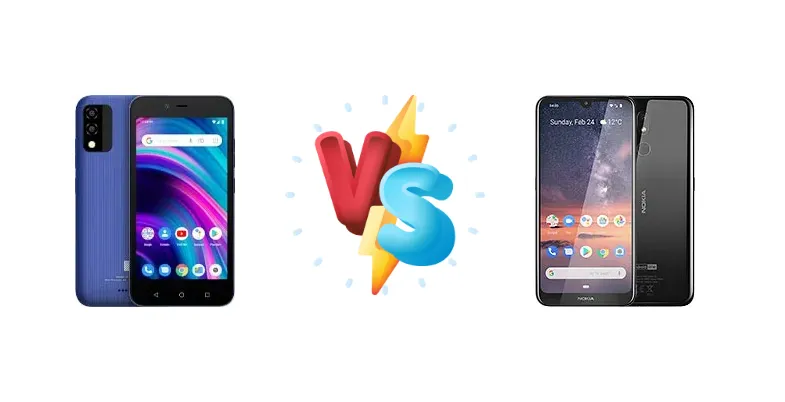
The BLU Studio X5 and Nokia 3.2 represent the lower end of the Android smartphone market, targeting users prioritizing affordability. However, despite similar price points, they diverge significantly in their internal hardware. This comparison dissects those differences, focusing on the impact of the Nokia 3.2’s Qualcomm Snapdragon 429 chipset versus the BLU Studio X5’s simpler Cortex-A53 processor.
🏆 Quick Verdict
For the average user, the Nokia 3.2 is the superior choice. Its Snapdragon 429 chipset, built on a more efficient 12nm process, delivers noticeably better performance and responsiveness than the BLU Studio X5’s older Cortex-A53. While both phones are entry-level, the Nokia 3.2 offers a smoother user experience for everyday tasks.
| Network |
|---|
| 2G bands | GSM 850 / 900 / 1800 / 1900 | GSM 850 / 900 / 1800 / 1900 |
| 3G bands | HSDPA 850 / 900 / 1700(AWS) / 1900 / 2100 | HSDPA 850 / 900 / 2100 |
| 4G bands | 2, 3, 5, 7, 12, 17, 28, 66 | 1, 3, 5, 7, 8, 20, 28, 38, 40 - EMEA, APAC, MENA |
| Speed | HSPA 21.1/5.76 Mbps | HSPA 42.2/5.76 Mbps, LTE Cat4 150/50 Mbps |
| Technology | GSM / HSPA / LTE | GSM / HSPA / LTE |
| | - | 1, 3, 5, 8, 40, 41 - India |
| Launch |
|---|
| Announced | 2022, July | 2019, February 24. Released 2019, May 22 |
| Status | Available. Released 2022, July | Discontinued |
| Body |
|---|
| Build | - | Glass front, plastic back, plastic frame |
| Dimensions | 145 x 72.4 x 10.1 mm (5.71 x 2.85 x 0.40 in) | 159.4 x 76.2 x 8.6 mm (6.28 x 3.00 x 0.34 in) |
| SIM | Nano-SIM + Nano-SIM | Nano-SIM + Nano-SIM |
| Weight | 149 g (5.26 oz) | 181 g (6.38 oz) |
| Display |
|---|
| Resolution | 480 x 854 pixels, 16:9 ratio (~196 ppi density) | 720 x 1520 pixels, 19:9 ratio (~269 ppi density) |
| Size | 5.0 inches, 68.9 cm2 (~65.6% screen-to-body ratio) | 6.26 inches, 97.8 cm2 (~80.5% screen-to-body ratio) |
| Type | IPS LCD | IPS LCD |
| Platform |
|---|
| CPU | Quad-core 1.3 GHz Cortex-A53 | Quad-core 1.8 GHz Cortex-A53 |
| Chipset | - | Qualcomm SDM429 Snapdragon 429 (12 nm) |
| GPU | - | Adreno 504 |
| OS | Android 11 (Go edition) | Android 9.0 (Pie), upgradable to Android 11, Android One |
| Memory |
|---|
| Card slot | microSDXC | microSDXC (dedicated slot) |
| Internal | 32GB 1GB RAM | 16GB 2GB RAM, 32GB 3GB RAM, 64GB 3GB RAM |
| | eMMC 5.1 | eMMC 5.1 |
| Main Camera |
|---|
| Dual | 5 MP
Secondary unspecified camera | - |
| Features | LED flash | LED flash |
| Single | 2 MP | 13 MP, f/2.2, 1/3.1", 1.12µm, AF |
| Video | 720p@30fps | 1080p@30fps |
| Selfie camera |
|---|
| Single | 2 MP | 5 MP, f/2.2, 27mm (wide), 1/5.0", 1.12µm |
| Video | 720p@30fps | - |
| Sound |
|---|
| 3.5mm jack | Yes | Yes |
| 35mm jack | Yes | Yes |
| Loudspeaker | Yes | Yes |
| Comms |
|---|
| Bluetooth | 4.2, A2DP | 4.2, A2DP, LE, aptX |
| NFC | No | No |
| Positioning | GPS | GPS, GLONASS, BDS |
| Radio | FM radio | FM radio |
| USB | microUSB 2.0 | microUSB 2.0, OTG |
| WLAN | Wi-Fi 802.11 b/g/n, Wi-Fi Direct | Wi-Fi 802.11 b/g/n |
| Features |
|---|
| Sensors | Accelerometer | Fingerprint (rear-mounted, 32/3GB only), accelerometer, proximity |
| Battery |
|---|
| Charging | - | 10W wired |
| Type | Li-Ion 2000 mAh, removable | Li-Ion 4000 mAh, non-removable |
| Misc |
|---|
| Colors | Green, Bronze, Black, Blue | Black, Steel |
| Models | - | TA-1156, TA-1159, TA-1164 |
| Price | About 50 EUR | About 140 EUR |
| SAR EU | - | 0.24 W/kg (head) 1.63 W/kg (body) |
BLU Studio X5
- Potentially lower price point
- Simple and straightforward Android experience
- May offer expandable storage (spec not confirmed)
- Significantly slower performance
- Less efficient processor
- Likely limited software updates
- Lower quality display (assumed)
Nokia 3.2
- More powerful Snapdragon 429 chipset
- Better power efficiency
- More reliable software support from Nokia
- 10W charging support
- Slightly higher price
- Still an entry-level device with limited features
- Slow charging speed
Display Comparison
Neither device boasts a standout display. Specifics regarding panel type, resolution, and brightness are unavailable for the BLU Studio X5, suggesting a basic LCD. The Nokia 3.2 also utilizes an LCD, but its focus is on efficiency rather than visual fidelity. The lack of detailed display specs on the BLU Studio X5 implies a lower-quality panel compared to what Nokia typically offers, even at this price point. Bezels are likely substantial on both devices, reflecting their budget nature.
Camera Comparison
Camera performance is likely to be similar on both devices, leaning towards basic functionality. Without detailed sensor information, it’s safe to assume both phones feature low-resolution primary sensors. The inclusion of a 2MP macro camera on either device is largely a marketing tactic, offering minimal practical benefit due to the low resolution and lack of optical image stabilization. Image processing will likely be basic on both, resulting in acceptable photos in good lighting conditions but struggling in low-light scenarios.
Performance
The core difference lies in the chipsets. The Nokia 3.2’s Qualcomm Snapdragon 429 (12nm) is a significant upgrade over the BLU Studio X5’s Quad-core 1.3 GHz Cortex-A53. The 12nm fabrication process of the Snapdragon 429 translates to improved power efficiency and reduced heat generation, allowing for sustained performance. While both CPUs feature Cortex-A53 cores, the Snapdragon 429’s higher clock speed (1.8 GHz) and optimized architecture provide a tangible performance boost in app loading times, multitasking, and overall system responsiveness. The Snapdragon 429 also benefits from a more modern GPU, offering a better gaming experience, albeit still limited to less demanding titles.
Battery Life
Battery capacity is not specified for the BLU Studio X5, but given its price point, it’s likely comparable to or slightly smaller than the Nokia 3.2’s. The Nokia 3.2 supports 10W wired charging, which is slow by modern standards but adequate for its battery size. The Snapdragon 429’s power efficiency gives the Nokia 3.2 an advantage in battery life, allowing it to potentially last longer on a single charge despite a similar capacity. The BLU Studio X5’s less efficient Cortex-A53 processor will likely result in shorter battery life, especially under load.
Buying Guide
Buy the BLU Studio X5 if you absolutely need the lowest possible price and are willing to accept significantly slower performance and potentially limited software support. It’s a viable option for basic communication and minimal app usage. Buy the Nokia 3.2 if you prioritize a more responsive user experience, better app compatibility, and the reliability of Qualcomm’s Snapdragon platform, even if it means spending a little more.
Frequently Asked Questions
❓ Will the Nokia 3.2 struggle with popular apps like Facebook or WhatsApp?
While the Nokia 3.2 is an entry-level device, the Snapdragon 429 is generally capable of running apps like Facebook and WhatsApp smoothly. However, expect some loading times and potential lag when multitasking with other applications. The BLU Studio X5’s Cortex-A53 processor will likely exhibit more noticeable performance issues with these apps.
❓ Is the Nokia 3.2 a good choice for mobile gaming?
The Nokia 3.2 is not ideal for demanding mobile games. The Snapdragon 429 can handle less graphically intensive titles at lower settings, but you’ll likely experience frame rate drops and lag in more demanding games. The BLU Studio X5 will struggle even more with gaming due to its weaker processor.
❓ How long will software updates be supported on the Nokia 3.2?
Nokia generally provides a reasonable level of software support for its budget devices. While not guaranteed for an extended period, the Nokia 3.2 is likely to receive at least one major Android version update and regular security patches for a couple of years. The BLU Studio X5’s software support is likely to be limited and less frequent.