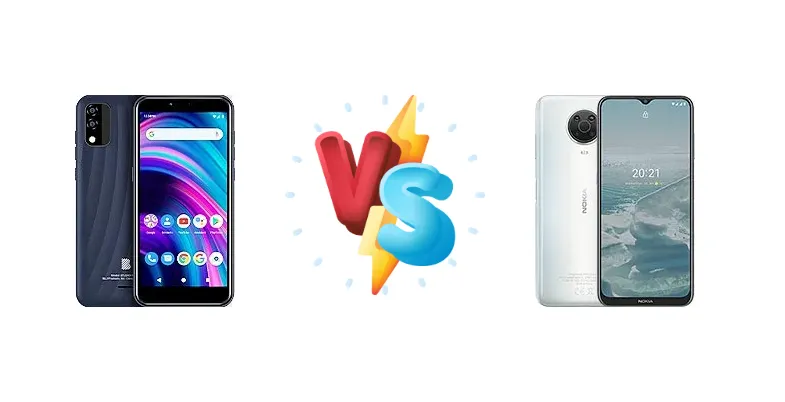
The BLU Studio X5 Max and Nokia G20 represent the ultra-budget end of the smartphone spectrum. While neither aims for flagship performance, they cater to users prioritizing affordability. This comparison dissects their key differences, focusing on how the Nokia G20’s more modern chipset impacts real-world usability compared to the BLU Studio X5 Max’s older architecture.
🏆 Quick Verdict
For most users, the Nokia G20 is the better choice. Its Mediatek Helio G35 chipset, featuring an octa-core configuration, provides a significantly more responsive experience than the BLU Studio X5 Max’s quad-core Cortex-A53. While charging is slow at 10W, the overall performance uplift justifies the slight trade-off.
| Network |
|---|
| 2G bands | GSM 850 / 900 / 1800 / 1900 | GSM 850 / 900 / 1800 / 1900 |
| 3G bands | HSDPA 850 / 900 / 1700(AWS) / 1900 / 2100 | HSDPA 850 / 900 / 1900 / 2100 - International |
| 4G bands | 2, 3, 5, 7, 12, 17, 28, 66 | 1, 3, 5, 7, 8, 20, 28, 38, 40, 41 - International |
| Speed | HSPA 21.1/5.76 Mbps | HSPA 42.2/5.76 Mbps, LTE Cat4 150/50 Mbps |
| Technology | GSM / HSPA / LTE | GSM / HSPA / LTE |
| | - | 1, 2, 3, 4, 5, 7, 8, 12, 17, 28, 66 - LATAM |
| Launch |
|---|
| Announced | 2022, July | 2021, April 08 |
| Status | Available. Released 2022, July | Available. Released 2021, May 17 |
| Body |
|---|
| Dimensions | 164.7 x 76 x 8.9 mm (6.48 x 2.99 x 0.35 in) | 164.9 x 76 x 9.2 mm (6.49 x 2.99 x 0.36 in) |
| SIM | Nano-SIM + Nano-SIM | · Nano-SIM· Nano-SIM + Nano-SIM |
| Weight | 202 g (7.13 oz) | 197 g (6.95 oz) |
| | - | Splash protection |
| Display |
|---|
| Resolution | 480 x 960 pixels, 18:9 ratio (~188 ppi density) | 720 x 1600 pixels, 20:9 ratio (~269 ppi density) |
| Size | 5.7 inches, 83.8 cm2 (~67.0% screen-to-body ratio) | 6.52 inches, 102.6 cm2 (~81.9% screen-to-body ratio) |
| Type | IPS LCD | IPS LCD |
| Platform |
|---|
| CPU | Quad-core 1.3 GHz Cortex-A53 | Octa-core (4x2.3 GHz Cortex-A53 & 4x1.8 GHz Cortex-A53) |
| Chipset | - | Mediatek MT6765G Helio G35 (12 nm) |
| GPU | - | PowerVR GE8320 |
| OS | Android 11 (Go edition) | Android 11, upgradable to Android 13 |
| Memory |
|---|
| Card slot | microSDXC | microSDXC (dedicated slot) |
| Internal | 32GB 2GB RAM | 64GB 4GB RAM, 128GB 4GB RAM |
| | eMMC 5.1 | - |
| Main Camera |
|---|
| Dual | 5 MP
Secondary unspecified camera | - |
| Features | LED flash | LED flash, HDR, panorama |
| Quad | - | 48 MP, f/1.8, (wide), PDAF
5 MP, (ultrawide)
2 MP (macro)
Auxiliary lens |
| Single | 2 MP | 8 MP, (wide) |
| Video | 720p@30fps | 1080p@30fps |
| Selfie camera |
|---|
| Single | 2 MP | 8 MP, (wide) |
| Video | 720p@30fps | 1080p@30fps |
| Sound |
|---|
| 3.5mm jack | Yes | Yes |
| 35mm jack | Yes | Yes |
| Loudspeaker | Yes | Yes |
| Comms |
|---|
| Bluetooth | 4.2, A2DP | 5.0, A2DP, LE |
| NFC | No | Yes (market/region dependent) |
| Positioning | GPS | GPS, GLONASS, BDS |
| Radio | FM radio | FM radio |
| USB | microUSB 2.0 | USB Type-C 2.0, OTG |
| WLAN | Wi-Fi 802.11 b/g/n, Wi-Fi Direct | Wi-Fi 802.11 b/g/n |
| Features |
|---|
| Sensors | Accelerometer | Fingerprint (side-mounted), accelerometer, gyro, proximity |
| Battery |
|---|
| Charging | - | 10W wired |
| Type | Li-Ion 2700 mAh, removable | Li-Po 5050 mAh |
| Misc |
|---|
| Colors | Green, Bronze, Black, Blue | Glacier, Night |
| Models | - | TA-1336, TA-1343, TA-1347, TA-1372, TA-1365 |
| Price | About 50 EUR | About 90 EUR |
| SAR | - | 1.01 W/kg (head) 1.02 W/kg (body) |
| SAR EU | - | 0.49 W/kg (head) 1.13 W/kg (body) |
BLU Studio X5 Max
- Potentially lower price point
- May have a more compact form factor (specifications unavailable)
- Basic functionality for essential tasks
- Significantly weaker processor
- Likely limited multitasking capabilities
- Outdated architecture
Nokia G20
- More powerful octa-core processor
- Larger battery capacity
- More responsive user experience
- Slow 10W charging
- Basic camera system
- Larger form factor
Display Comparison
Neither device boasts a standout display. Specifics regarding panel type, resolution, and brightness are unavailable for the BLU Studio X5 Max, suggesting a basic LCD. The Nokia G20 also utilizes an LCD, but its larger 6.5-inch size offers more screen real estate. Without detailed specs on the BLU Studio X5 Max, it's difficult to assess color accuracy or viewing angles, but we can assume it will be comparable to other phones in this price bracket. The Nokia G20's larger display will be more immersive for video consumption, even if it lacks advanced features like high refresh rates.
Camera Comparison
Camera performance is likely to be similar on both devices, leaning towards basic functionality. Details on sensor sizes and apertures are unavailable for both, but given the price point, expectations should be tempered. The Nokia G20 likely benefits from Mediatek’s image signal processor (ISP) within the Helio G35, potentially offering slightly better image processing. The presence of a dedicated macro lens on either device is largely irrelevant, as 2MP macro cameras typically produce low-quality results. Real-world image quality will depend heavily on software optimization, but the Nokia G20 has a slight edge due to its more modern chipset.
Performance
The Nokia G20’s Mediatek Helio G35 is the clear winner here. Its octa-core configuration (4x2.3 GHz Cortex-A53 & 4x1.8 GHz Cortex-A53) provides a substantial performance advantage over the BLU Studio X5 Max’s quad-core 1.3 GHz Cortex-A53. The Helio G35’s 12nm process also contributes to better power efficiency. While both utilize the Cortex-A53 architecture, the increased core count and higher clock speeds on the Nokia G20 translate to smoother multitasking, faster app loading times, and a more responsive overall experience. The BLU Studio X5 Max will likely struggle with demanding applications or multiple apps running simultaneously.
Battery Life
Battery capacity is not specified for the BLU Studio X5 Max, but given its market segment, it's likely around 4000-5000mAh. The Nokia G20 features a larger 5050mAh battery. However, the Nokia G20 is limited to 10W wired charging, meaning a full charge will take a considerable amount of time. The BLU Studio X5 Max’s charging speed is unknown, but it’s unlikely to be significantly faster. The Nokia G20’s larger battery capacity should provide longer usage times, despite the slower charging speed, making it better suited for users who prioritize all-day battery life.
Buying Guide
Buy the BLU Studio X5 Max if your primary need is a very basic smartphone for essential tasks like calls and light messaging, and you're operating on an extremely tight budget. Buy the Nokia G20 if you want a more fluid user experience for social media, web browsing, and occasional light gaming, and are willing to spend a little more for improved performance and a more modern chipset.
Frequently Asked Questions
❓ Will the Nokia G20 struggle with popular games like PUBG Mobile?
While the Helio G35 isn't a gaming powerhouse, the Nokia G20 can handle PUBG Mobile at lower settings. Expect frame rate drops during intense action, and you'll likely need to reduce graphics settings to achieve a playable experience. The BLU Studio X5 Max will likely struggle significantly more with even basic gaming.
❓ Is the Nokia G20's 10W charging a major drawback?
Yes, 10W charging is quite slow by today's standards. A full charge will take several hours. However, the Nokia G20's larger 5050mAh battery provides ample usage time, mitigating the impact of slow charging. If you can charge overnight, it shouldn't be a significant inconvenience.
❓ How does the software experience differ between these two phones?
The Nokia G20 runs a near-stock version of Android, offering a clean and bloatware-free experience. BLU devices often include pre-installed apps and custom skins, which can impact performance and user experience. Nokia also promises regular security updates, a crucial benefit for long-term security.