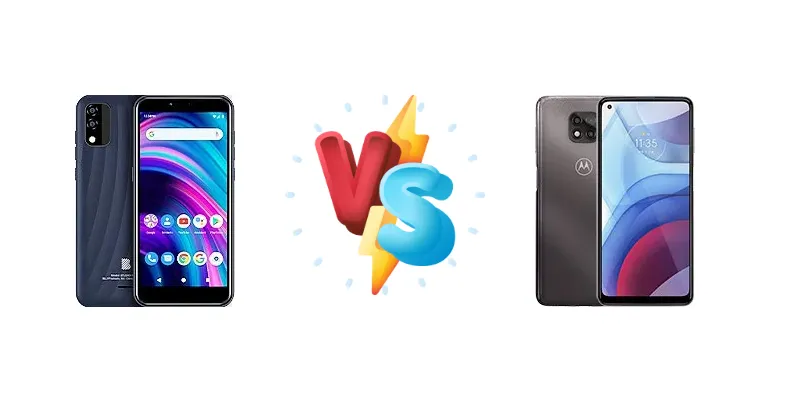
The BLU Studio X5 Max and the Motorola Moto G Power (2021) represent two distinct approaches to the budget smartphone market. The BLU aims for affordability above all else, while the Motorola prioritizes a balance of features, particularly extended battery life. This comparison dissects their core components to determine which device best suits your needs.
🏆 Quick Verdict
For the average user prioritizing consistent performance and reliable battery life, the Motorola Moto G Power (2021) is the clear winner. Its Snapdragon 662 chipset offers a significant performance advantage over the BLU Studio X5 Max’s Cortex-A53, translating to smoother multitasking and a more responsive user experience.
| Network |
|---|
| 2G bands | GSM 850 / 900 / 1800 / 1900 | GSM 850 / 900 / 1800 / 1900 |
| 3G bands | HSDPA 850 / 900 / 1700(AWS) / 1900 / 2100 | HSDPA 850 / 900 / 1700(AWS) / 1900 / 2100 |
| 4G bands | 2, 3, 5, 7, 12, 17, 28, 66 | 1, 2, 3, 4, 5, 7, 8, 12, 13, 14, 17, 25, 26, 29, 30, 38, 41, 66, 71 |
| Speed | HSPA 21.1/5.76 Mbps | HSPA, LTE |
| Technology | GSM / HSPA / LTE | GSM / CDMA / HSPA / EVDO / LTE |
| | - | CDMA2000 1xEV-DO |
| Launch |
|---|
| Announced | 2022, July | 2021, January 08 |
| Status | Available. Released 2022, July | Available. Released 2021, January 14 |
| Body |
|---|
| Build | - | Glass front, plastic back, plastic frame |
| Dimensions | 164.7 x 76 x 8.9 mm (6.48 x 2.99 x 0.35 in) | 165.3 x 75.9 x 9.5 mm (6.51 x 2.99 x 0.37 in) |
| SIM | Nano-SIM + Nano-SIM | Nano-SIM |
| Weight | 202 g (7.13 oz) | 206.5 g (7.30 oz) |
| | - | Water-repellent coating |
| Display |
|---|
| Resolution | 480 x 960 pixels, 18:9 ratio (~188 ppi density) | 720 x 1600 pixels, 20:9 ratio (~266 ppi density) |
| Size | 5.7 inches, 83.8 cm2 (~67.0% screen-to-body ratio) | 6.6 inches, 105.2 cm2 (~83.8% screen-to-body ratio) |
| Type | IPS LCD | IPS LCD |
| Platform |
|---|
| CPU | Quad-core 1.3 GHz Cortex-A53 | Octa-core (4x2.0 GHz Kryo 260 Gold & 4x1.8 GHz Kryo 260 Silver) |
| Chipset | - | Qualcomm SM6115 Snapdragon 662 (11 nm) |
| GPU | - | Adreno 610 |
| OS | Android 11 (Go edition) | Android 10 |
| Memory |
|---|
| Card slot | microSDXC | microSDXC (dedicated slot) |
| Internal | 32GB 2GB RAM | 32GB 3GB RAM, 64GB 4GB RAM |
| | eMMC 5.1 | eMMC 5.1 |
| Main Camera |
|---|
| Dual | 5 MP
Secondary unspecified camera | - |
| Features | LED flash | LED flash, HDR, panorama |
| Single | 2 MP | - |
| Triple | - | 48 MP, f/1.7, (wide), 1/2.0", 0.8µm, PDAF
2 MP (macro)
Auxiliary lens |
| Video | 720p@30fps | 1080p@30/60fps, gyro-EIS |
| Selfie camera |
|---|
| Features | - | HDR |
| Single | 2 MP | 8 MP, f/2.0, 1.12µm |
| Video | 720p@30fps | 1080p@30fps, gyro-EIS |
| Sound |
|---|
| 3.5mm jack | Yes | Yes |
| 35mm jack | Yes | Yes |
| Loudspeaker | Yes | Yes |
| Comms |
|---|
| Bluetooth | 4.2, A2DP | 5.0, A2DP, LE |
| NFC | No | No |
| Positioning | GPS | GPS, GLONASS, GALILEO |
| Radio | FM radio | FM radio |
| USB | microUSB 2.0 | USB Type-C 2.0 |
| WLAN | Wi-Fi 802.11 b/g/n, Wi-Fi Direct | Wi-Fi 802.11 a/b/g/n/ac, dual-band, Wi-Fi Direct |
| Features |
|---|
| Sensors | Accelerometer | Fingerprint (side-mounted), accelerometer, gyro, proximity, compass, barometer |
| Battery |
|---|
| Charging | - | 15W wired |
| Type | Li-Ion 2700 mAh, removable | Li-Po 5000 mAh |
| Misc |
|---|
| Colors | Green, Bronze, Black, Blue | Flash Gray, Polar Silver |
| Price | About 50 EUR | About 60 EUR |
BLU Studio X5 Max
- Lowest possible price point
- Functional for basic tasks
- Potentially compact size (speculation based on brand history)
- Outdated processor
- Limited performance
- Likely poor camera quality
- Unknown battery capacity
Motorola Moto G Power (2021)
- Significantly faster processor
- Long-lasting 5000mAh battery
- Larger, higher-resolution display
- Better camera performance
- 15W charging is relatively slow
- IPS LCD isn't the most vibrant display technology
- Can feel bulky due to large battery
Display Comparison
Neither device boasts a standout display. The BLU Studio X5 Max’s display specifications are not provided, suggesting a basic panel likely with a 720p resolution. The Moto G Power (2021) features a 6.6-inch Max Vision IPS LCD. While the Moto G Power’s panel isn’t known for exceptional color accuracy, its larger size and higher resolution provide a more immersive viewing experience. Both likely utilize a 60Hz refresh rate, common in this price bracket. The lack of detailed display specs for the BLU makes a direct comparison difficult, but the Motorola’s larger size is a clear advantage.
Camera Comparison
Camera performance is likely similar in real-world results, given the focus on affordability for both devices. Detailed camera specs for the BLU Studio X5 Max are unavailable, but budget phones often feature lower-resolution sensors and limited image processing capabilities. The Moto G Power (2021) features a 48MP main sensor, which, while not flagship-level, provides a reasonable level of detail in good lighting conditions. Both phones likely include secondary cameras (depth, macro) that offer limited utility. The Motorola’s larger sensor and Qualcomm’s image signal processor (ISP) give it a slight edge in image quality and low-light performance.
Performance
The performance gap is substantial. The BLU Studio X5 Max is equipped with a Quad-core 1.3 GHz Cortex-A53 processor, an older architecture designed for basic tasks. In contrast, the Motorola Moto G Power (2021) utilizes the Qualcomm SM6115 Snapdragon 662, an Octa-core (4x2.0 GHz Kryo 260 Gold & 4x1.8 GHz Kryo 260 Silver) chipset built on an 11nm process. This means the Motorola offers significantly faster processing speeds, improved multitasking capabilities, and better graphics performance. The Snapdragon 662’s architecture allows for more efficient task allocation, resulting in a smoother and more responsive user experience, especially noticeable when running multiple apps or playing moderately demanding games. The Cortex-A53 will struggle with anything beyond basic app usage.
Battery Life
The Motorola Moto G Power (2021) shines in the battery department. It features a massive 5000mAh battery and supports 15W wired charging. While the BLU Studio X5 Max’s battery capacity is unknown, it’s unlikely to match the Motorola’s. The Snapdragon 662’s 11nm process contributes to better power efficiency, allowing the Moto G Power to deliver multi-day battery life with moderate usage. The 15W charging, while not the fastest, is sufficient to replenish the battery overnight. The BLU, lacking detailed specs, likely offers shorter battery life and potentially slower charging speeds.
Buying Guide
Buy the BLU Studio X5 Max if you absolutely need the lowest possible price point and basic smartphone functionality is sufficient. It’s a viable option for first-time smartphone users or as a temporary device. Buy the Motorola Moto G Power (2021) if you value a more fluid user experience, better app performance, and the peace of mind that comes with a significantly more capable processor and a proven track record of battery longevity.
Frequently Asked Questions
❓ Is the Snapdragon 662 in the Moto G Power (2021) capable of playing modern mobile games?
The Snapdragon 662 can handle many popular mobile games, but you'll likely need to lower graphics settings for more demanding titles like PUBG or Call of Duty: Mobile to achieve smooth frame rates. It's not a gaming powerhouse, but it's a significant step up from the BLU Studio X5 Max's processor.
❓ How long does the Motorola Moto G Power (2021) typically last on a single charge with moderate use?
With moderate use (browsing, social media, calls, some video streaming), the Motorola Moto G Power (2021) can easily last two full days, and potentially even three, on a single charge thanks to its 5000mAh battery and efficient processor.
❓ What kind of storage options are available on the Motorola Moto G Power (2021), and is it expandable?
The Motorola Moto G Power (2021) typically comes in 32GB or 64GB storage configurations. Importantly, it includes a microSD card slot, allowing you to expand the storage up to 512GB, which is crucial for storing photos, videos, and apps.
❓ Given the BLU Studio X5 Max's lower price, is it a good option for a first-time smartphone user?
If budget is the absolute primary concern, the BLU Studio X5 Max can function as a basic smartphone. However, be prepared for slower performance and a less refined user experience. It's suitable for simple tasks like calls, texts, and light browsing, but may struggle with more demanding apps.