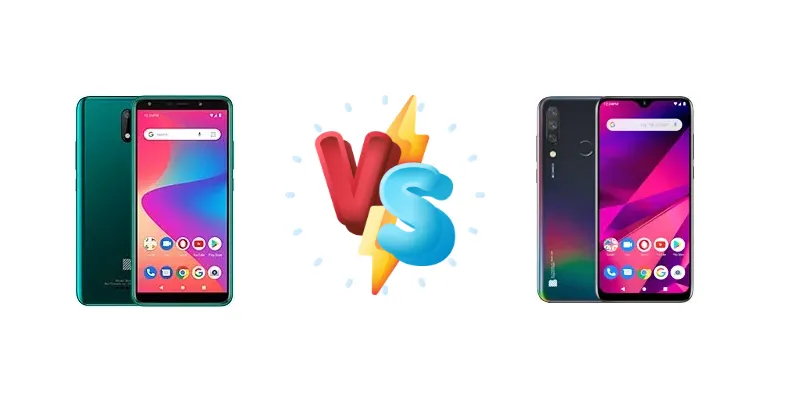
BLU offers a range of affordable smartphones, and the Studio X12 and G80 represent distinct points within their budget lineup. The Studio X12 focuses on basic functionality at a very low price point, while the G80 attempts to offer a more modern experience with a more powerful chipset. This comparison dissects the key differences to help you determine which BLU phone best suits your needs.
🏆 Quick Verdict
For most users, the BLU G80 is the superior choice. Its Mediatek Helio P23 chipset, featuring an octa-core CPU, delivers significantly better performance than the Studio X12’s quad-core Cortex-A7. While the Studio X12 is cheaper, the G80’s improved processing power justifies the price difference for anyone beyond the most basic smartphone tasks.
| Network |
|---|
| 2G bands | GSM 850 / 900 / 1800 / 1900 | GSM 850 / 900 / 1800 / 1900 |
| 3G bands | HSDPA 850 / 900 / 1900 / 2100 | HSDPA 850 / 900 / 1700(AWS) / 1900 / 2100 |
| 4G bands | - | 1, 2, 3, 4, 5, 7, 12, 17, 28 |
| Speed | HSPA 21.1/5.76 Mbps | HSPA, LTE |
| Technology | GSM / HSPA | GSM / HSPA / LTE |
| Launch |
|---|
| Announced | 2021, February 16. Released 2021, February 16 | 2020, June 24. Released 2020, June 24 |
| Status | Discontinued | Discontinued |
| Body |
|---|
| Dimensions | 160 x 77.5 x 9 mm (6.30 x 3.05 x 0.35 in) | 163.9 x 75.5 x 8.4 mm (6.45 x 2.97 x 0.33 in) |
| SIM | Nano-SIM + Nano-SIM | Nano-SIM + Nano-SIM |
| Weight | 189 g (6.67 oz) | 185 g (6.53 oz) |
| Display |
|---|
| Resolution | 480 x 960 pixels, 18:9 ratio (~179 ppi density) | 720 x 1600 pixels, 20:9 ratio (~270 ppi density) |
| Size | 6.0 inches, 92.9 cm2 (~74.9% screen-to-body ratio) | 6.5 inches, 102.0 cm2 (~82.4% screen-to-body ratio) |
| Type | IPS LCD | IPS LCD |
| Platform |
|---|
| CPU | Quad-core 1.3 GHz Cortex-A7 | Octa-core (4x2.0 GHz Cortex-A53 & 4x1.5 GHz Cortex-A53) |
| Chipset | - | Mediatek MT6763 Helio P23 (16 nm) |
| GPU | - | Mali-G71 MP2 |
| OS | Android 10 (Go edition) | Android 10 |
| Memory |
|---|
| Card slot | microSDXC | microSDXC |
| Internal | 32GB 1GB RAM | 64GB 3GB RAM |
| | eMMC 5.1 | eMMC 5.1 |
| Main Camera |
|---|
| Features | LED flash | LED flash, panorama, HDR |
| Single | 8 MP | - |
| Triple | - | 13 MP, f/1.8, (wide), 1/3.06", 1.12µm, PDAF
8 MP, f/2.2, (ultrawide), 1/4.0", 1.12µm
Auxiliary lens |
| Video | 720p@30fps | 1080p@30fps |
| Selfie camera |
|---|
| Single | 8 MP | 13 MP, f/2.9 |
| Video | 720p@30fps | 720p@30fps |
| Sound |
|---|
| 3.5mm jack | Yes | Yes |
| 35mm jack | Yes | Yes |
| Loudspeaker | Yes | Yes |
| Comms |
|---|
| Bluetooth | 4.0, A2DP | 4.1, A2DP, LE |
| NFC | No | No |
| Positioning | GPS | GPS |
| Radio | FM radio | FM radio |
| USB | microUSB 2.0 | microUSB 2.0, OTG |
| WLAN | Wi-Fi 802.11 b/g/n, Wi-Fi Direct | Wi-Fi 802.11 a/b/g/n, Wi-Fi Direct |
| Features |
|---|
| Sensors | Accelerometer | Fingerprint (rear-mounted), accelerometer, proximity |
| Battery |
|---|
| Charging | - | 10W wired |
| Type | Li-Ion 3000 mAh | Li-Po 4000 mAh, removable |
| Misc |
|---|
| Colors | Black, Blue, Green, Red | Black, Green |
| Price | About 60 EUR | About 90 EUR |
BLU Studio X12
- Lowest possible price point
- Functional for basic tasks
- Potentially longer battery life due to less powerful processor (speculation)
- Very slow performance
- Outdated processor architecture
- Limited software support
BLU G80
- Significantly faster performance
- More efficient processor
- 10W wired charging
- Higher price than Studio X12
- 10W charging is relatively slow
- Still a budget device with limitations
Display Comparison
Details regarding the displays of both devices are unavailable. However, given the price points, it's reasonable to assume both utilize LCD panels. The Studio X12 likely features a lower resolution and smaller screen size. The G80, being the more premium model, may have a slightly larger display and potentially better viewing angles, but neither is expected to compete with higher-end OLED or IPS displays.
Camera Comparison
Camera specifications are limited. It's safe to assume both phones feature basic camera setups. Without specific sensor details, it’s difficult to make a definitive comparison. However, the G80’s more powerful processor likely allows for faster image processing and potentially better low-light performance. The inclusion of a chipset like the Helio P23 suggests a greater capacity for computational photography features, even if the sensor itself isn't high-end. Any 2MP macro or depth sensors on either device should be considered marketing features rather than significant photographic assets.
Performance
The performance gap between these two devices is substantial. The BLU Studio X12’s quad-core 1.3 GHz Cortex-A7 CPU is based on an older architecture and is significantly less powerful than the BLU G80’s Mediatek Helio P23. The Helio P23 boasts an octa-core configuration (4x2.0 GHz Cortex-A53 & 4x1.5 GHz Cortex-A53) built on a 16nm process, offering a considerable boost in multi-tasking and application loading speeds. The Cortex-A53 cores, while not flagship-level, are far more efficient and capable than the Cortex-A7, resulting in a smoother user experience. This difference is particularly noticeable when running multiple apps or playing graphically demanding games.
Battery Life
Battery capacity details are unavailable for either device. However, the BLU G80’s 10W wired charging capability suggests a slightly more modern charging system than what might be found in the Studio X12. While 10W is slow by today’s standards, it’s still a benefit over potentially slower or non-standard charging solutions. The Helio P23’s 16nm process also contributes to better power efficiency, potentially offsetting a smaller battery capacity compared to the Studio X12.
Buying Guide
Buy the BLU Studio X12 if you need a functional smartphone for essential tasks like calls, texts, and light web browsing, and your budget is extremely limited. It’s a good option for a first smartphone or a backup device. Buy the BLU G80 if you prefer a smoother, more responsive experience for social media, streaming video, and casual gaming. The G80’s more powerful processor and potentially better software support make it a more future-proof investment.
Frequently Asked Questions
❓ Will the BLU G80 be able to run popular social media apps like TikTok and Instagram smoothly?
Yes, the BLU G80’s Mediatek Helio P23 chipset is capable of running social media apps like TikTok and Instagram without significant lag. The octa-core CPU and improved architecture compared to the Studio X12 will provide a much smoother experience when scrolling through feeds and recording videos.
❓ Is the BLU Studio X12 suitable for playing mobile games?
The BLU Studio X12 is not well-suited for gaming. Its quad-core Cortex-A7 processor lacks the power to run most modern mobile games at playable frame rates. Even simpler games may experience significant lag and stuttering. The G80 is a better, though still limited, option for casual gaming.
❓ What kind of software updates can I expect on the BLU G80?
BLU’s software update track record is inconsistent. While the G80 running on a more modern chipset *could* receive more updates than the Studio X12, users should not expect frequent or long-term support. It’s best to assume limited software updates and plan accordingly.