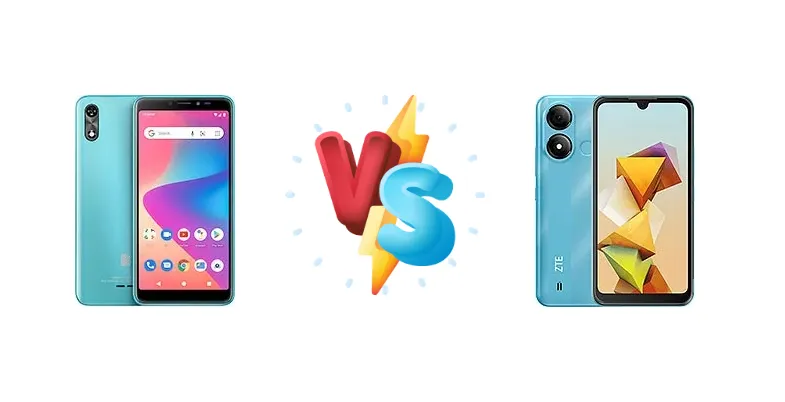
The BLU Studio X10+ and ZTE Blade A33s represent the fiercely competitive sub-$150 smartphone market. While both aim to deliver essential smartphone functionality at an accessible price, they take different approaches to achieving this. The X10+ relies on a simpler, older architecture, while the A33s leverages a newer, more complex octa-core chipset. This comparison will dissect their key differences to help you determine which device best suits your needs.
🏆 Quick Verdict
For the average user prioritizing multitasking and responsiveness, the ZTE Blade A33s is the better choice. Its Unisoc SC9863A chipset, with its eight Cortex-A55 cores, offers a significant performance advantage over the BLU Studio X10+'s quad-core Cortex-A7, making it more capable for everyday tasks and light gaming.
| Network |
|---|
| 2G bands | GSM 850 / 900 / 1800 / 1900 | GSM 850 / 900 / 1800 / 1900 |
| 3G bands | HSDPA 850 / 900 / 1900 / 2100 | HSDPA 850 / 900 / 1900 / 2100 |
| 4G bands | - | LTE |
| Speed | HSPA 21.1/5.76 Mbps | HSPA, LTE |
| Technology | GSM / HSPA | GSM / HSPA / LTE |
| Launch |
|---|
| Announced | 2021, February 09. Released 2021, February 09 | 2023, November |
| Status | Discontinued | Available. Released 2023, November |
| Body |
|---|
| Dimensions | 146 x 72.3 x 9 mm (5.75 x 2.85 x 0.35 in) | 160 x 78 x 10.3 mm (6.30 x 3.07 x 0.41 in) |
| SIM | Nano-SIM + Nano-SIM | Nano-SIM + Nano-SIM |
| Weight | 167 g (5.89 oz) | - |
| Display |
|---|
| Resolution | 480 x 960 pixels, 18:9 ratio (~195 ppi density) | 480 x 1014 pixels, 19:9 ratio (~178 ppi density) |
| Size | 5.5 inches, 78.1 cm2 (~74.0% screen-to-body ratio) | 6.3 inches, 99.0 cm2 (~79.3% screen-to-body ratio) |
| Type | IPS LCD | IPS LCD |
| Platform |
|---|
| CPU | Quad-core 1.3 GHz Cortex-A7 | Octa-core (4x1.6 GHz Cortex-A55 & 4x1.2 GHz Cortex-A55) |
| Chipset | - | Unisoc SC9863A (28 nm) |
| GPU | - | IMG8322 |
| OS | Android 10 (Go edition) | Android 12 (Go edition) |
| Memory |
|---|
| Card slot | microSDXC | microSDXC (dedicated slot) |
| Internal | 32GB 1GB RAM | 32GB 2GB RAM |
| Main Camera |
|---|
| Features | LED flash | LED flash |
| Single | 8 MP | 5 MP (interpolated to 8 MP), AF |
| Video | 720p@30fps | 1080p@30fps |
| Selfie camera |
|---|
| Single | 8 MP | 2 MP (interpolated to 5 MP) |
| Video | 720p@30fps | Yes |
| Sound |
|---|
| 35mm jack | Yes | Yes |
| Loudspeaker | Yes | Yes |
| Comms |
|---|
| Bluetooth | 4.0, A2DP | 5.2, A2DP, LE |
| NFC | No | No |
| Positioning | GPS | GPS |
| Radio | FM radio | Unspecified |
| USB | microUSB 2.0 | microUSB |
| WLAN | Wi-Fi 802.11 b/g/n, Wi-Fi Direct | Wi-Fi 802.11 b/g/n |
| Features |
|---|
| Sensors | Accelerometer | Fingerprint (rear-mounted, optional), accelerometer |
| Battery |
|---|
| Type | Li-Ion 2550 mAh | 4000 mAh |
| Misc |
|---|
| Colors | Black, Blue, Green, Red | Silver, Blue, Green |
| Price | About 50 EUR | - |
BLU Studio X10+
- Potentially lower price point
- Simpler user experience
- May be more readily available in certain regions
- Significantly weaker processor performance
- Less efficient architecture
- Likely limited multitasking capabilities
ZTE Blade A33s
- More powerful octa-core processor
- More efficient Cortex-A55 cores
- Better multitasking and responsiveness
- May be slightly more expensive
- Unisoc chipset may have limited software support
- Potentially similar battery life despite efficiency gains
Display Comparison
Neither device boasts a standout display. Given the lack of display specifications for the BLU Studio X10+, we can assume it utilizes a standard LCD panel common in this price bracket. The ZTE Blade A33s, while also likely LCD, benefits from a more modern chipset potentially offering better image processing. However, both will likely exhibit limited viewing angles and color accuracy. Bezels are expected to be substantial on both devices, reflecting their budget positioning.
Camera Comparison
Camera details are sparse for both devices. It's safe to assume both feature basic camera setups geared towards casual photography. Without sensor size or aperture information, a direct comparison is difficult. However, the ZTE Blade A33s’ more powerful processor could potentially enable better image processing algorithms, resulting in slightly improved image quality, particularly in low-light conditions. The prevalence of 2MP macro lenses in this segment suggests neither phone will deliver exceptional macro photography.
Performance
The core difference lies in the processors. The BLU Studio X10+’s quad-core 1.3 GHz Cortex-A7 is an older architecture, designed for basic smartphone functions. The ZTE Blade A33s’ Unisoc SC9863A, built on a 28nm process, features an octa-core configuration (4x1.6 GHz Cortex-A55 & 4x1.2 GHz Cortex-A55). The Cortex-A55 cores are significantly more efficient and offer better performance per clock cycle than the Cortex-A7. This translates to smoother multitasking, faster app loading times, and a more responsive user experience on the A33s. The A33s’ octa-core setup also allows for better power management, potentially extending battery life during sustained use. The 28nm process node, while not cutting-edge, is a reasonable compromise for cost-effectiveness.
Battery Life
Battery capacity is not specified for either device. However, given their price points, both likely house batteries in the 2500-3500 mAh range. The ZTE Blade A33s’ more efficient processor and octa-core architecture could translate to better battery life despite a potentially similar capacity. Charging wattage is also unknown, but both are likely to ship with standard 5W or 10W chargers, resulting in relatively slow charging times – expect several hours for a full charge.
Buying Guide
Buy the BLU Studio X10+ if you need a basic, functional smartphone for calls, texts, and very light app usage, and are on an extremely tight budget. Its simplicity may appeal to those who prefer a less cluttered experience. Buy the ZTE Blade A33s if you prefer a phone that can handle more demanding tasks like social media browsing, video streaming, and occasional gaming without significant lag, and value a more modern processor architecture.
Frequently Asked Questions
❓ Will the ZTE Blade A33s struggle with popular apps like Facebook or WhatsApp?
While the ZTE Blade A33s isn't a powerhouse, its octa-core processor and Cortex-A55 cores are sufficient to run apps like Facebook and WhatsApp smoothly. You might experience some slowdown with multiple apps open simultaneously, but for typical social media usage, it should perform adequately.
❓ Is the BLU Studio X10+ suitable for playing mobile games?
The BLU Studio X10+ is not well-suited for gaming. Its older quad-core processor and Cortex-A7 architecture will struggle with most modern mobile games, resulting in low frame rates and significant lag. It's best reserved for very simple, less demanding games.
❓ How does the Unisoc SC9863A chipset compare to Qualcomm's Snapdragon series in this price range?
The Unisoc SC9863A generally falls below Qualcomm's Snapdragon 400 series in terms of raw performance and GPU capabilities. However, it offers a competitive octa-core configuration at a lower price point, making it a viable option for budget-conscious consumers. Snapdragon chips typically benefit from better software optimization and wider carrier support.