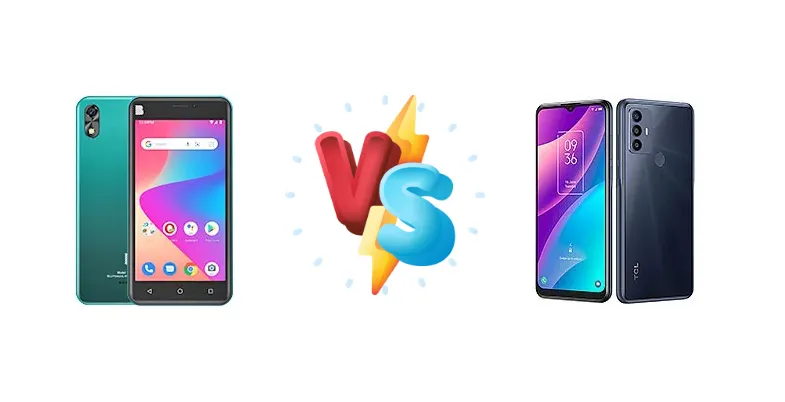
The BLU Studio X10 and TCL 30 SE represent the lower end of the smartphone market, targeting users prioritizing affordability. However, a significant gap exists in their internal hardware. This comparison dissects the differences between the older Mediatek MT6580 in the BLU and the newer Helio G25 in the TCL, revealing which device delivers the best experience for the money.
🏆 Quick Verdict
For most users, the TCL 30 SE is the superior choice. Its Helio G25 chipset, built on a more efficient 12nm process, offers a substantial performance uplift over the BLU Studio X10’s aging MT6580. While the BLU is cheaper, the TCL’s improved responsiveness and potential for smoother multitasking justify the price difference.
| Network |
|---|
| 2G bands | GSM 850 / 900 / 1800 / 1900 | GSM 850 / 900 / 1800 / 1900 |
| 3G bands | HSDPA 850 / 900 / 1900 / 2100 | HSDPA 850 / 900 / 1900 / 2100 - EMEA/APAC |
| 4G bands | - | 1, 3, 5, 7, 8, 20, 28, 38, 40, 41 - EMEA |
| Speed | HSPA 21.1/5.76 Mbps | HSPA 42.2/11.5 Mbps, LTE Cat4 150/50 Mbps |
| Technology | GSM / HSPA | GSM / HSPA / LTE |
| | - | 2, 3, 4, 5, 7, 8, 12, 13, 17, 26, 28, 66 - LATAM |
| Launch |
|---|
| Announced | 2020, August 05. Released 2020, August 05 | 2022, February 27 |
| Status | Discontinued | Available. Released 2022, April 20 |
| Body |
|---|
| Build | - | Glass front, plastic frame, plastic back |
| Dimensions | 146 x 73.5 x 9.3 mm (5.75 x 2.89 x 0.37 in) | 165.2 x 75.5 x 8.9 mm (6.50 x 2.97 x 0.35 in) |
| SIM | Nano-SIM + Nano-SIM | · Nano-SIM· Nano-SIM + Nano-SIM |
| Weight | 169 g (5.96 oz) | 190 g (6.70 oz) |
| Display |
|---|
| Resolution | 480 x 854 pixels, 16:9 ratio (~196 ppi density) | 720 x 1600 pixels, 20:9 ratio (~269 ppi density) |
| Size | 5.0 inches, 68.9 cm2 (~64.2% screen-to-body ratio) | 6.52 inches, 102.6 cm2 (~82.3% screen-to-body ratio) |
| Type | IPS LCD | IPS LCD, 450 nits (typ) |
| Platform |
|---|
| CPU | Quad-core 1.3 GHz Cortex-A7 | Octa-core (4x2.0 GHz Cortex-A53 & 4x1.5 GHz Cortex-A53) |
| Chipset | Mediatek MT6580 (28 nm) | Mediatek MT6762G Helio G25 (12 nm) |
| GPU | Mali-400MP2 | PowerVR GE8320 |
| OS | Android 10 (Go edition) | Android 12, TCL UI 4.0 |
| Memory |
|---|
| Card slot | microSDXC | microSDXC (dedicated slot) |
| Internal | 16GB 1GB RAM | 64GB 4GB RAM, 128GB 4GB RAM |
| | eMMC 5.1 | eMMC 5.1 |
| Main Camera |
|---|
| Features | LED flash | LED flash, HDR, panorama |
| Single | 8 MP | 8 MP, f/2.0, 26mm (wide), 1/4", 1.12µm |
| Triple | - | 50 MP, f/1.9, 28mm (wide), 1/2.76", 0.64µm, PDAF
2 MP (macro)
Auxiliary lens |
| Video | 720p@30fps | 1080p@30fps |
| Selfie camera |
|---|
| Features | - | HDR |
| Single | 5 MP | 8 MP, f/2.0, 26mm (wide), 1/4.0", 1.12µm |
| Video | 720p@30fps | 1080p@30fps |
| Sound |
|---|
| 3.5mm jack | Yes | Yes |
| 35mm jack | Yes | Yes |
| Loudspeaker | Yes | Yes |
| Comms |
|---|
| Bluetooth | 4.0, A2DP | 5.0, A2DP, LE |
| NFC | No | Yes (6165H/6165H1 only) |
| Positioning | GPS | GPS, GLONASS, GALILEO, BDS |
| Radio | FM radio | Unspecified |
| USB | microUSB 2.0 | USB Type-C 2.0 |
| WLAN | Wi-Fi 802.11 b/g/n, Wi-Fi Direct | Wi-Fi 802.11 b/g/n, Wi-Fi Direct |
| Features |
|---|
| Sensors | Accelerometer | Fingerprint (rear-mounted), accelerometer, proximity, compass |
| Battery |
|---|
| Charging | - | 15W wired |
| Type | Li-Ion 2100 mAh battery | Li-Po 5000 mAh |
| Misc |
|---|
| Colors | Green, Red, Black, Blue | Atlantic Blue, Space Gray, Glacial Blue |
| Models | - | 6165H, 6156H1, 6165A, 6165A1, 6165S |
| Price | About 50 EUR | - |
BLU Studio X10
- Lowest possible price point
- Simple and straightforward user experience
- Potentially longer standby time (depending on battery capacity)
- Significantly slower performance
- Outdated chipset architecture
- Likely poor multitasking capabilities
TCL 30 SE
- Faster and more responsive performance
- More efficient chipset (Helio G25)
- 15W fast charging support
- Higher price than the BLU Studio X10
- Display quality likely similar to BLU
- Camera performance likely only marginally better
Display Comparison
Neither device is expected to boast a high-end display. Details regarding panel type, resolution, and brightness are absent for the BLU Studio X10, suggesting a basic LCD. The TCL 30 SE also likely features a basic LCD, but its focus is on affordability rather than display quality. The absence of information on refresh rates or HDR support on either device confirms their budget positioning. Bezels are likely to be substantial on both, prioritizing cost reduction over a modern, immersive viewing experience.
Camera Comparison
Camera details are sparse for both devices. It’s safe to assume both rely on basic sensors. Without specific megapixel counts or aperture information, a detailed comparison is impossible. However, given the price points, image quality will likely be adequate for casual snapshots but will struggle in low-light conditions. The TCL 30 SE’s newer image signal processor (ISP) within the Helio G25 may offer slightly better image processing, but the difference will likely be marginal. Expect both to include a basic front-facing camera for video calls.
Performance
The core difference lies in the chipsets. The BLU Studio X10’s Mediatek MT6580, fabricated on a 28nm process, features a quad-core Cortex-A7 CPU. This architecture is several generations old and struggles with modern applications. Conversely, the TCL 30 SE’s Helio G25, built on a 12nm process, utilizes an octa-core configuration (4x2.0 GHz Cortex-A53 & 4x1.5 GHz Cortex-A53). The 12nm process is significantly more efficient, reducing heat and improving battery life. The octa-core design provides a substantial advantage in multitasking and handling demanding apps. The Helio G25’s Cortex-A53 cores, while not high-end, are a significant step up from the A7 cores in the MT6580.
Battery Life
Battery capacity is not specified for the BLU Studio X10. The TCL 30 SE includes 15W wired charging, a feature absent on the BLU. While battery capacity isn’t known for the BLU, the more efficient Helio G25 in the TCL 30 SE will likely translate to longer real-world battery life, even if the BLU has a slightly larger capacity. The 15W charging on the TCL will also significantly reduce charging times compared to a slower, unspecified charging solution on the BLU.
Buying Guide
Buy the BLU Studio X10 if you absolutely need the lowest possible price and your smartphone usage is limited to basic tasks like calls, texts, and light web browsing. Buy the TCL 30 SE if you value a more responsive user experience, occasional gaming, and a device that will feel less sluggish over time. The TCL’s 15W charging is also a benefit for those who dislike long charge times.
Frequently Asked Questions
❓ Will the TCL 30 SE be able to run popular social media apps smoothly?
Yes, the Helio G25 chipset in the TCL 30 SE is capable of running popular social media apps like Facebook, Instagram, and TikTok without significant lag. The octa-core processor and improved efficiency compared to the BLU Studio X10’s chipset will provide a much smoother experience.
❓ Is the TCL 30 SE suitable for playing mobile games?
The TCL 30 SE can handle casual mobile games, but it’s not a gaming powerhouse. The Helio G25 is an entry-level gaming chip. Demanding titles may require reduced graphics settings to maintain playable frame rates. The BLU Studio X10’s MT6580 will struggle even with basic games.
❓ How much storage does each phone have, and can it be expanded?
Storage details are not provided in the context data. However, given the price point, both devices likely offer limited internal storage (e.g., 32GB or 64GB). It’s highly probable that both include a microSD card slot for storage expansion, allowing users to add more space for photos, videos, and apps.
❓ What kind of software experience should I expect on the TCL 30 SE?
TCL typically uses a customized version of Android on their devices. Expect a user interface that differs from stock Android, potentially including pre-installed apps (bloatware). Software updates may be infrequent, given the budget nature of the device. The BLU Studio X10 likely runs a similarly customized Android version, potentially with even less frequent updates.