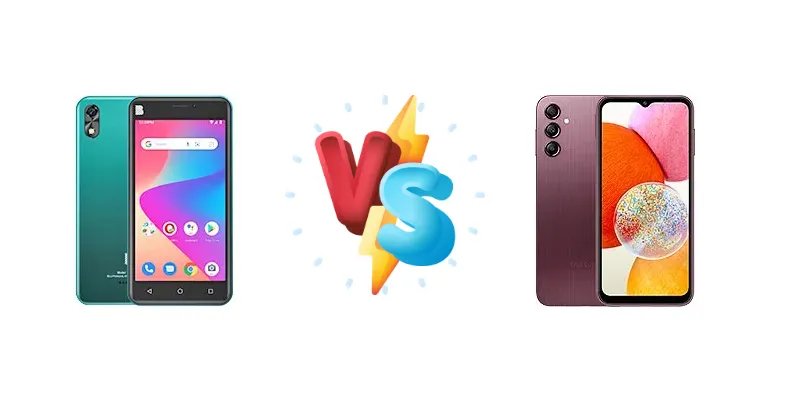
The BLU Studio X10 and Samsung Galaxy A14 represent distinct approaches to the budget smartphone market. The X10 aims for extreme affordability, while the A14 attempts to balance cost with a more modern feature set. This comparison dissects their core components to determine which device delivers the best value for your money.
🏆 Quick Verdict
For most users, the Samsung Galaxy A14 is the superior choice. Its significantly more powerful Mediatek Helio G80 (or Exynos 850) chipset provides a smoother experience for everyday tasks and even light gaming, justifying the price difference over the aging Mediatek MT6580 in the BLU Studio X10.
| Network |
|---|
| 2G bands | GSM 850 / 900 / 1800 / 1900 | GSM 850 / 900 / 1800 / 1900 |
| 3G bands | HSDPA 850 / 900 / 1900 / 2100 | HSDPA 850 / 900 / 2100 |
| 4G bands | - | 1, 3, 5, 7, 8, 20, 28, 38, 40, 41 |
| Speed | HSPA 21.1/5.76 Mbps | HSPA, LTE |
| Technology | GSM / HSPA | GSM / HSPA / LTE |
| Launch |
|---|
| Announced | 2020, August 05. Released 2020, August 05 | 2023, February 28 |
| Status | Discontinued | Available. Released 2023, March 27 |
| Body |
|---|
| Build | - | Glass front, plastic back, plastic frame |
| Dimensions | 146 x 73.5 x 9.3 mm (5.75 x 2.89 x 0.37 in) | 167.7 x 78 x 9.1 mm (6.60 x 3.07 x 0.36 in) |
| SIM | Nano-SIM + Nano-SIM | · Nano-SIM· Nano-SIM + Nano-SIM |
| Weight | 169 g (5.96 oz) | 201 g (7.09 oz) |
| Display |
|---|
| Resolution | 480 x 854 pixels, 16:9 ratio (~196 ppi density) | 1080 x 2408 pixels, 20:9 ratio (~400 ppi density) |
| Size | 5.0 inches, 68.9 cm2 (~64.2% screen-to-body ratio) | 6.6 inches, 104.9 cm2 (~80.2% screen-to-body ratio) |
| Type | IPS LCD | PLS LCD |
| Platform |
|---|
| CPU | Quad-core 1.3 GHz Cortex-A7 | Octa-core (2x2.0 GHz Cortex-A75 & 6x1.8 GHz Cortex-A55) - Version AOcta-core (4x2.0 GHz Cortex-A55 & 4x2.0 GHz Cortex-A55) - Version B |
| Chipset | Mediatek MT6580 (28 nm) | Mediatek MT6769 Helio G80 (12 nm) - Version AExynos 850 (8 nm) - Version B |
| GPU | Mali-400MP2 | Mali-G52 MC2 |
| OS | Android 10 (Go edition) | Android 13, upgradable to Android 15, One UI 7 |
| Memory |
|---|
| Card slot | microSDXC | microSDXC (dedicated slot) |
| Internal | 16GB 1GB RAM | 64GB 4GB RAM, 128GB 4GB RAM, 128GB 6GB RAM |
| | eMMC 5.1 | - |
| Main Camera |
|---|
| Features | LED flash | LED flash, panorama, HDR |
| Single | 8 MP | 13 MP, f/2.0, (wide) |
| Triple | - | 50 MP, f/1.8, 26mm (wide), 1/2.75", 0.64µm, PDAF
5 MP, f/2.2, 17mm (ultrawide), 1/5.0", 1.12µm
2 MP (macro) |
| Video | 720p@30fps | 1080p@30fps |
| Selfie camera |
|---|
| Single | 5 MP | 13 MP, f/2.0, 26mm (wide), 1/3.1", 1.12µm |
| Video | 720p@30fps | 1080p@30fps |
| Sound |
|---|
| 3.5mm jack | Yes | Yes |
| 35mm jack | Yes | Yes |
| Loudspeaker | Yes | Yes |
| Comms |
|---|
| Bluetooth | 4.0, A2DP | 5.1 or 5.3, A2DP, LE |
| NFC | No | Yes (market/region dependent) |
| Positioning | GPS | GPS, GALILEO, GLONASS, BDS, QZSS |
| Radio | FM radio | Unspecified |
| USB | microUSB 2.0 | USB Type-C 2.0 |
| WLAN | Wi-Fi 802.11 b/g/n, Wi-Fi Direct | Wi-Fi 802.11 a/b/g/n/ac, dual-band, Wi-Fi Direct |
| Features |
|---|
| Sensors | Accelerometer | Fingerprint (side-mounted), accelerometer, proximity, compass |
| Battery |
|---|
| Charging | - | 15W wired |
| Type | Li-Ion 2100 mAh battery | Li-Po 5000 mAh |
| Misc |
|---|
| Colors | Green, Red, Black, Blue | Black, Dark Red, Silver, Green |
| Models | - | SM-A145F, SM-A145F/DSN, SM-A145M, SM-A145M/DS, SM-A145P, SM-A145R |
| Price | About 50 EUR | € 85.76 / $ 147.60 / £ 79.95 |
| SAR EU | - | 0.46 W/kg (head) 1.37 W/kg (body) |
BLU Studio X10
- Extremely affordable price point
- Compact and lightweight design (likely)
- Functional for basic communication
- Outdated and slow processor
- Poor camera performance
- Limited software support
Samsung Galaxy A14
- Significantly faster processor (Helio G80 or Exynos 850)
- Larger battery capacity for longer runtime
- Better camera quality with 50MP main sensor
- Higher price than the BLU Studio X10
- 15W charging is relatively slow
- Still a budget device with compromises
Display Comparison
Neither device boasts a standout display. Specifics on the BLU Studio X10's panel are scarce, but given its price point, it likely utilizes a lower-quality IPS LCD. The Samsung Galaxy A14 features a 6.6-inch PLS LCD, a Samsung-specific LCD technology that aims to improve viewing angles and color reproduction compared to standard IPS. While neither supports high refresh rates, the A14’s larger size and potentially better panel quality offer a more immersive viewing experience. Bezels are expected to be larger on the X10 due to its lower cost of manufacturing.
Camera Comparison
Camera performance is likely to be a weak point on both devices. The BLU Studio X10’s camera specifications are unknown, but it’s reasonable to expect a basic sensor. The Samsung Galaxy A14 typically features a 50MP main sensor, which, while not flagship-level, will capture more detailed images than the X10. The A14 also includes depth and macro sensors, though the 2MP macro lens is unlikely to deliver usable results. Image processing will favor the A14, benefiting from Samsung’s software optimizations. OIS (Optical Image Stabilization) is absent on both, meaning low-light performance will be limited.
Performance
The performance gap is the most significant differentiator. The BLU Studio X10’s Mediatek MT6580, built on a 28nm process, features a quad-core Cortex-A7 CPU. This is a very dated architecture, struggling with modern app demands. Conversely, the Samsung Galaxy A14 offers two chipset variants: the Mediatek Helio G80 (12nm) and the Exynos 850 (8nm). Both are substantial upgrades. The Helio G80’s octa-core configuration (2x2.0 GHz Cortex-A75 & 6x1.8 GHz Cortex-A55) provides significantly faster processing speeds and improved multi-tasking capabilities. The Exynos 850, while using a slightly older process, still offers a considerable performance boost over the MT6580. The A14’s more efficient chipsets also translate to better thermal management, preventing significant throttling during sustained use.
Battery Life
Battery capacity is a key consideration. While the BLU Studio X10’s battery size is unspecified, it’s likely smaller than the Samsung Galaxy A14’s 5000mAh cell. The A14 supports 15W wired charging, which isn’t fast, but adequate for its battery size. The X10’s charging speed is also likely to be 10W or less. The A14’s larger battery and more efficient chipset will translate to significantly longer battery life, potentially lasting a full day with moderate use, while the X10 may require a mid-day charge.
Buying Guide
Buy the BLU Studio X10 if you absolutely need the lowest possible price and your smartphone usage is limited to basic communication – calls, texts, and very light web browsing. Buy the Samsung Galaxy A14 if you prioritize a responsive user experience, occasional gaming, and a more future-proofed device, even if it means spending a bit more.
Frequently Asked Questions
❓ Does the Samsung Galaxy A14's Exynos 850 chip overheat during prolonged gaming sessions?
The Exynos 850 is generally well-behaved in terms of thermal management. While it will get warm during extended gaming, it's unlikely to overheat and cause significant performance throttling. The 8nm process node contributes to its efficiency, and the A14's chassis provides adequate heat dissipation.
❓ Is the 2MP macro camera on the Samsung Galaxy A14 actually useful for taking close-up photos?
Unfortunately, the 2MP macro camera on the A14 is largely a marketing feature. The low resolution and lack of autofocus result in images that are often soft and lack detail. It's best to rely on the 50MP main sensor and digital zoom for close-up shots.
❓ Can the Samsung Galaxy A14 handle popular games like PUBG Mobile at acceptable frame rates?
The Samsung Galaxy A14, particularly the Helio G80 variant, can run PUBG Mobile at medium settings with reasonably stable frame rates. Expect around 30-40 FPS. The Exynos 850 version may offer slightly better performance. However, don't expect a flagship-level gaming experience.
❓ How long will the BLU Studio X10 likely receive software updates?
Given BLU's track record and the Studio X10's budget positioning, software update support is likely to be limited. Expect at most one major Android update, and security patches may be infrequent or non-existent. This is a significant drawback compared to Samsung's more robust software support.