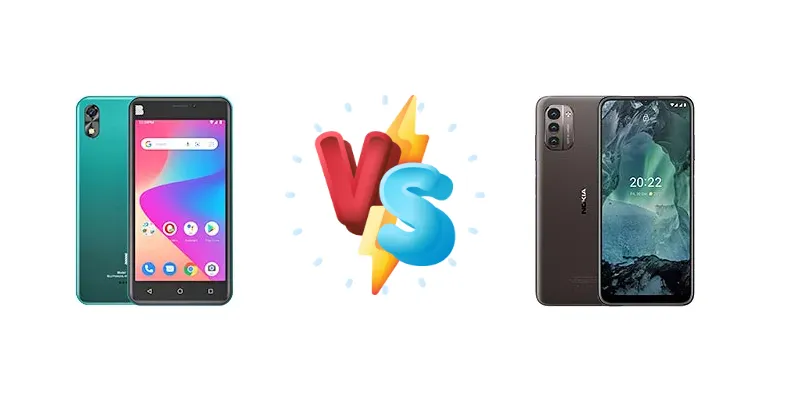
The BLU Studio X10 and Nokia G21 represent the extreme end of the smartphone price spectrum. Both aim to deliver essential functionality at a minimal cost, but they take drastically different approaches to achieving this. The X10 relies on an older, power-efficient chipset, while the G21 opts for a newer, more capable processor, albeit with a focus on endurance. This comparison dissects these choices to determine which phone offers the best value.
🏆 Quick Verdict
For most users, the Nokia G21 is the superior choice. Its Unisoc T606 chipset provides a substantial performance uplift over the BLU Studio X10’s Mediatek MT6580, making everyday tasks and even light multitasking significantly smoother. While both offer similar battery endurance, the G21’s 18W charging is a welcome addition.
| Network |
|---|
| 2G bands | GSM 850 / 900 / 1800 / 1900 | GSM 850 / 900 / 1800 / 1900 |
| 3G bands | HSDPA 850 / 900 / 1900 / 2100 | HSDPA 850 / 900 / 2100 - International |
| 4G bands | - | 1, 3, 5, 7, 8, 20, 28, 38, 40, 41 - International |
| Speed | HSPA 21.1/5.76 Mbps | HSPA 42.2/5.76 Mbps, LTE Cat4 150/50 Mbps |
| Technology | GSM / HSPA | GSM / HSPA / LTE |
| | - | 1, 2, 3, 4, 5, 7, 8, 12, 17, 28, 40, 66 - LATAM |
| Launch |
|---|
| Announced | 2020, August 05. Released 2020, August 05 | 2022, February 14 |
| Status | Discontinued | Available. Released 2022, February 15 |
| Body |
|---|
| Build | - | Glass front, plastic frame, plastic back |
| Dimensions | 146 x 73.5 x 9.3 mm (5.75 x 2.89 x 0.37 in) | 164.6 x 75.9 x 8.5 mm (6.48 x 2.99 x 0.33 in) |
| SIM | Nano-SIM + Nano-SIM | · Nano-SIM· Nano-SIM + Nano-SIM |
| Weight | 169 g (5.96 oz) | 190 g (6.70 oz) |
| Display |
|---|
| Resolution | 480 x 854 pixels, 16:9 ratio (~196 ppi density) | 720 x 1600 pixels, 20:9 ratio (~270 ppi density) |
| Size | 5.0 inches, 68.9 cm2 (~64.2% screen-to-body ratio) | 6.5 inches, 102.0 cm2 (~81.6% screen-to-body ratio) |
| Type | IPS LCD | IPS LCD, 90Hz, 400 nits (typ) |
| Platform |
|---|
| CPU | Quad-core 1.3 GHz Cortex-A7 | Octa-core (2x1.6 GHz Cortex-A75 & 6x1.6 GHz Cortex-A55) |
| Chipset | Mediatek MT6580 (28 nm) | Unisoc T606 (12 nm) |
| GPU | Mali-400MP2 | Mali-G57 MP1 |
| OS | Android 10 (Go edition) | Android 11, upgradable to Android 13 |
| Memory |
|---|
| Card slot | microSDXC | microSDXC (dedicated slot) |
| Internal | 16GB 1GB RAM | 64GB 3GB RAM, 64GB 4GB RAM, 128GB 4GB RAM, 128GB 6GB RAM |
| | eMMC 5.1 | eMMC 5.1 |
| Main Camera |
|---|
| Features | LED flash | LED flash, HDR, panorama |
| Single | 8 MP | 8 MP, f/2.0, (wide) |
| Triple | - | 50 MP, f/1.8, 28mm (wide), 1/2.76", 0.64µm, PDAF
2 MP (macro)
Auxiliary lens |
| Video | 720p@30fps | 1080p@30fps |
| Selfie camera |
|---|
| Single | 5 MP | 8 MP, f/2.0, (wide) |
| Video | 720p@30fps | 1080p@30fps |
| Sound |
|---|
| 3.5mm jack | Yes | Yes |
| 35mm jack | Yes | Yes |
| Loudspeaker | Yes | Yes |
| Comms |
|---|
| Bluetooth | 4.0, A2DP | 5.0, A2DP, LE |
| NFC | No | Yes (market/region dependent) |
| Positioning | GPS | GPS, GLONASS, GALILEO |
| Radio | FM radio | FM radio, RDS |
| USB | microUSB 2.0 | USB Type-C 2.0, OTG |
| WLAN | Wi-Fi 802.11 b/g/n, Wi-Fi Direct | Wi-Fi 802.11 a/b/g/n/ac, dual-band, Wi-Fi Direct |
| Features |
|---|
| Sensors | Accelerometer | Fingerprint (side-mounted), accelerometer, proximity |
| Battery |
|---|
| Charging | - | 18W wired, PD3.0 |
| Type | Li-Ion 2100 mAh battery | Li-Po 5050 mAh |
| Misc |
|---|
| Colors | Green, Red, Black, Blue | Nordic Blue, Dusk |
| Models | - | TA-1418, TA-1477, TA-1415, TA-1405, TA-1404, TA-1412 |
| Price | About 50 EUR | About 90 EUR |
| SAR | - | 1.00 W/kg (head) 1.10 W/kg (body) |
| SAR EU | - | 0.34 W/kg (head) 1.05 W/kg (body) |
| Tests |
|---|
| Battery life | - |
Endurance rating 126h
|
| Camera | - |
Photo / Video |
| Display | - |
Contrast ratio: 1631:1 (nominal) |
| Loudspeaker | - |
-30.7 LUFS (Below average)
|
| Performance | - |
AnTuTu: 171299 (v9)
GeekBench: 1193 (v5.1)
GFXBench: 8.9fps (ES 3.1 onscreen) |
BLU Studio X10
- Extremely affordable
- Simple and easy to use
- Potentially longer software support due to lower complexity
- Very slow performance
- Low display brightness
- Limited camera capabilities
Nokia G21
- Significantly faster processor
- Brighter display for better visibility
- Faster 18W charging with PD3.0
- Slightly higher price
- Unisoc chipset may have limited software updates
- Camera quality likely remains basic
Display Comparison
Both devices share a contrast ratio of 1631:1, suggesting similar panel characteristics in terms of black levels. However, the Nokia G21 boasts a measured peak brightness of 500 nits, a significant advantage over the BLU Studio X10, which lacks published brightness data. This higher brightness translates to better visibility outdoors and in brightly lit environments. While neither phone is likely to offer exceptional color accuracy, the G21’s brighter display provides a more usable visual experience.
Camera Comparison
Both phones list 'Photo / Video' capabilities, but lack specific details regarding sensor size, aperture, or image processing. Given the price point, expectations should be tempered. It’s safe to assume both cameras will struggle in low-light conditions. Without further information, it’s difficult to declare a clear winner, but the Nokia G21’s more powerful processor *could* potentially enable slightly better image processing algorithms, leading to marginally improved image quality. The lack of detail suggests neither camera is a key selling point.
Performance
The performance gap between these two phones is substantial. The BLU Studio X10’s Mediatek MT6580, built on a 28nm process, features a quad-core Cortex-A7 CPU. In contrast, the Nokia G21’s Unisoc T606, fabricated on a more efficient 12nm node, utilizes an octa-core configuration with a mix of Cortex-A75 and Cortex-A55 cores. The A75 cores provide a noticeable boost in single-core performance, while the additional cores improve multitasking capabilities. This means the G21 will handle app switching, web browsing, and even light gaming far more smoothly than the X10.
Battery Life
Both the BLU Studio X10 and Nokia G21 achieve an endurance rating of 126 hours, indicating comparable battery life under similar usage patterns. However, the Nokia G21 includes 18W wired charging with PD3.0 support, a significant advantage over the X10, which lacks any charging speed information. This faster charging allows the G21 to replenish its battery much quicker, reducing downtime. While both phones will likely last a full day on a single charge for moderate users, the G21’s charging capabilities offer greater convenience.
Buying Guide
Buy the BLU Studio X10 if your primary need is a very basic, ultra-affordable phone for calls, texts, and minimal app usage, and you prioritize absolute simplicity. Buy the Nokia G21 if you want a more responsive experience, better multitasking capabilities, and faster charging, even if it means spending a little more. The G21 is ideal for users who occasionally browse the web, use social media, or play casual games.
Frequently Asked Questions
❓ Is the Unisoc T606 chipset in the Nokia G21 known for overheating under sustained load?
The Unisoc T606 is a relatively efficient chipset. While it's not a powerhouse, it's unlikely to suffer from significant overheating during typical usage scenarios like web browsing or social media. Prolonged gaming sessions *may* cause some thermal throttling, but it shouldn't be a major issue given the phone's modest performance capabilities.
❓ Does the Nokia G21 support any form of fast charging beyond the advertised 18W?
The Nokia G21 supports PD3.0 (Power Delivery 3.0) which is a standard for fast charging. While the included charger is 18W, the phone can potentially negotiate higher power delivery with a compatible PD charger, though the actual benefit will be limited by the phone's internal charging circuitry.
❓ How does the BLU Studio X10 handle basic multitasking, like switching between a messaging app and a web browser?
The BLU Studio X10’s Mediatek MT6580 and limited RAM will struggle with multitasking. Expect noticeable lag and app reloading when switching between applications. It’s best suited for running one app at a time.
❓ Will either phone receive significant software updates in the future?
Software update support is a concern for both devices. BLU has a historically spotty update record. Nokia, while generally better, often provides limited updates for its entry-level G-series phones. Expect at most one major Android version update, and security patches may be infrequent.