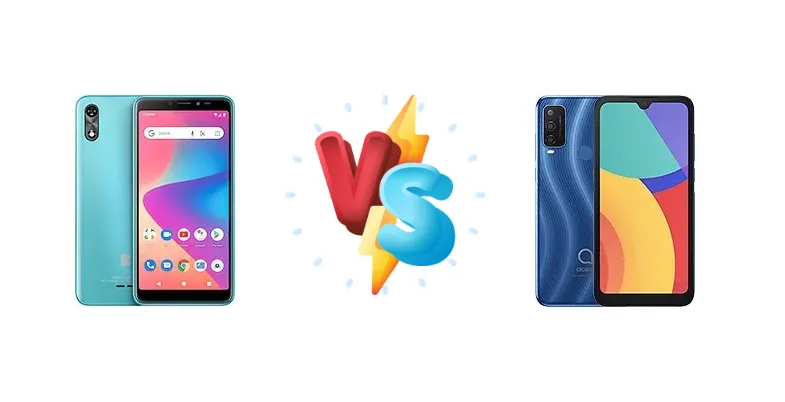
The BLU Studio X10+ and the alcatel 1L Pro (2021) represent the absolute bottom end of the smartphone market, targeting users who prioritize affordability above all else. While neither device will challenge flagship performance, understanding their differences is crucial for making the best choice within this price bracket. This comparison focuses on how the alcatel's more modern chipset stacks up against the BLU's older architecture.
🏆 Quick Verdict
For the average user needing a basic smartphone for calls, texts, and light app usage, the alcatel 1L Pro (2021) is the better choice. Its Unisoc SC9863A chipset, with its octa-core configuration and Cortex-A55 cores, provides a significantly more responsive experience than the BLU Studio X10+'s aging quad-core Cortex-A7.
| Network |
|---|
| 2G bands | GSM 850 / 900 / 1800 / 1900 - SIM 1 & SIM 2 | GSM 850 / 900 / 1800 / 1900 |
| 3G bands | HSDPA 850 / 900 / 1900 / 2100 | HSDPA 850 / 900 / 1700(AWS) / 1900 / 2100 |
| 4G bands | - | 2, 3, 4, 5, 7, 8, 12, 17, 28, 66 - USA |
| Speed | HSPA 21.1/5.76 Mbps | HSPA 21.1/5.76 Mbps, LTE Cat4 150/50 Mbps |
| Technology | GSM / HSPA | GSM / HSPA / LTE |
| Launch |
|---|
| Announced | 2021, February 09 | 2021, June 25 |
| Status | Available. Released 2021, February 09 | Available. Released 2021, Q2 |
| Body |
|---|
| Build | - | Glass front, plastic back, plastic frame |
| Dimensions | 146 x 72.3 x 9 mm (5.75 x 2.85 x 0.35 in) | 156.4 x 74.8 x 9.7 mm (6.16 x 2.94 x 0.38 in) |
| SIM | Dual SIM (Nano-SIM, dual stand-by) | · Nano-SIM· Nano-SIM + Nano-SIM |
| Weight | 167 g (5.89 oz) | 190 g (6.70 oz) |
| Display |
|---|
| Resolution | 480 x 960 pixels, 18:9 ratio (~195 ppi density) | 720 x 1560 pixels, 19.5:9 ratio (~282 ppi density) |
| Size | 5.5 inches, 78.1 cm2 (~74.0% screen-to-body ratio) | 6.1 inches, 91.3 cm2 (~78.1% screen-to-body ratio) |
| Type | IPS LCD | IPS LCD |
| Platform |
|---|
| CPU | Quad-core 1.3 GHz Cortex-A7 | Octa-core (4x1.6 GHz Cortex-A55 & 4x1.2 GHz Cortex-A55) |
| Chipset | - | Unisoc SC9863A (28 nm) |
| GPU | - | IMG8322 |
| OS | Android 10 (Go edition) | Android 11 (Go edition) |
| Memory |
|---|
| Card slot | microSDXC | microSDXC (uses shared SIM slot) |
| Internal | 32GB 1GB RAM | 32GB 2GB RAM |
| | eMMC 5.1 | eMMC 5.1 |
| Main Camera |
|---|
| Dual | - | 13 MP, f/2.2, 26mm (wide), 1/3.06", 1.12µm, AF
Auxiliary lens |
| Features | LED flash | LED flash, HDR, panorama |
| Single | 8 MP | - |
| Video | 720p@30fps | 1080p@30fps |
| Selfie camera |
|---|
| Features | - | HDR |
| Single | 8 MP | 5 MP, f/2.2, 27mm (wide), 1/5.0", 1.12µm |
| Video | 720p@30fps | 1080p@30fps |
| Sound |
|---|
| 3.5mm jack | Yes | Yes |
| 35mm jack | - | Yes |
| Loudspeaker | Yes | Yes |
| Comms |
|---|
| Bluetooth | 4.0, A2DP | 4.2, A2DP |
| NFC | No | No |
| Positioning | GPS | GPS |
| Radio | FM radio | FM radio |
| USB | microUSB 2.0 | microUSB 2.0, OTG |
| WLAN | Wi-Fi 802.11 b/g/n, Wi-Fi Direct | Wi-Fi 802.11 b/g/n, Wi-Fi Direct |
| Features |
|---|
| Sensors | Accelerometer | Fingerprint (rear-mounted), accelerometer, proximity |
| Battery |
|---|
| Type | Li-Ion 2550 mAh | Li-Ion 3000 mAh |
| Misc |
|---|
| Colors | Black, Blue, Green, Red | Power Grey, Twilight Blue |
| Price | About 50 EUR | About 110 EUR |
BLU Studio X10+
- Potentially the lowest price available
- Basic functionality for calls and texts
- Simple user interface
- Extremely slow performance
- Outdated processor architecture
- Likely poor camera quality
- Limited app compatibility
alcatel 1L Pro (2021)
- More responsive performance thanks to octa-core processor
- More efficient Cortex-A55 cores
- Better multitasking capabilities
- Slightly more modern chipset
- Still limited performance compared to mid-range phones
- Basic camera quality
- May still struggle with demanding apps
Display Comparison
Neither device is expected to boast a high-quality display. Specifics regarding panel type, resolution, and brightness are unavailable for the BLU Studio X10+. The alcatel 1L Pro, while also likely using a basic LCD panel, benefits from a more modern manufacturing process. The lack of detailed display specs suggests both phones prioritize cost savings over visual fidelity, meaning color accuracy and viewing angles will likely be subpar on both.
Camera Comparison
Given the price point, camera performance is unlikely to be a strong suit for either device. Details regarding camera sensors are scarce for both. It's safe to assume both phones feature basic sensors, likely with limited low-light capabilities. The presence of a 2MP macro camera on the alcatel 1L Pro is a common marketing tactic, but its practical utility is minimal due to the low resolution and lack of optical image stabilization (OIS). Image processing will likely be basic on both, relying heavily on software algorithms to enhance photos.
Performance
The core difference lies in the chipset. The BLU Studio X10+ utilizes a quad-core 1.3 GHz Cortex-A7 processor. This architecture dates back several years and is known for its limited performance. In contrast, the alcatel 1L Pro (2021) features the Unisoc SC9863A, an octa-core chip with four cores clocked at 1.6 GHz and four at 1.2 GHz, all based on the more efficient Cortex-A55 architecture. This represents a substantial leap in processing power and efficiency. The Cortex-A55 cores offer improved instructions per clock cycle (IPC) compared to the A7, resulting in faster app loading times and smoother multitasking on the alcatel. The 28nm process node of the Unisoc chip, while not cutting-edge, is still more efficient than what the X10+ likely uses.
Battery Life
Battery capacity details are unavailable for the BLU Studio X10+. The alcatel 1L Pro (2021) likely features a modest battery, typical for this price range. The Unisoc SC9863A's improved efficiency should translate to better battery life compared to the BLU, despite potentially having a similar capacity. Charging wattage is also unknown for both devices, but it's unlikely to be fast charging, meaning a full charge will likely take several hours.
Buying Guide
Buy the BLU Studio X10+ if you absolutely need the lowest possible price and are willing to tolerate significantly slower performance. It's suitable for users who primarily make calls and send texts, and rarely use apps. Buy the alcatel 1L Pro (2021) if you prefer a more fluid user experience, even for basic tasks, and anticipate using apps like WhatsApp or Facebook regularly. The alcatel offers a better balance of performance and affordability.
Frequently Asked Questions
❓ Will the alcatel 1L Pro (2021) be able to run popular social media apps like Facebook and WhatsApp smoothly?
Yes, the alcatel 1L Pro's octa-core Unisoc SC9863A processor and Cortex-A55 cores are sufficient to run Facebook, WhatsApp, and similar apps without significant lag. While it won't offer a high-end experience, it will provide a usable and responsive experience for these common tasks.
❓ Is the BLU Studio X10+ suitable for playing mobile games?
The BLU Studio X10+ is not recommended for gaming. Its quad-core Cortex-A7 processor is severely underpowered for even basic mobile games. Expect significant lag, low frame rates, and potential crashes. The alcatel 1L Pro is also not a gaming phone, but it will offer a slightly better experience with less demanding titles.
❓ How much storage does the alcatel 1L Pro (2021) offer, and is it expandable?
While specific storage configurations vary by region, the alcatel 1L Pro (2021) typically comes with 32GB of internal storage. Crucially, it *does* support microSD card expansion, allowing you to add up to 128GB of additional storage for photos, videos, and apps. This is essential given the limited internal storage.