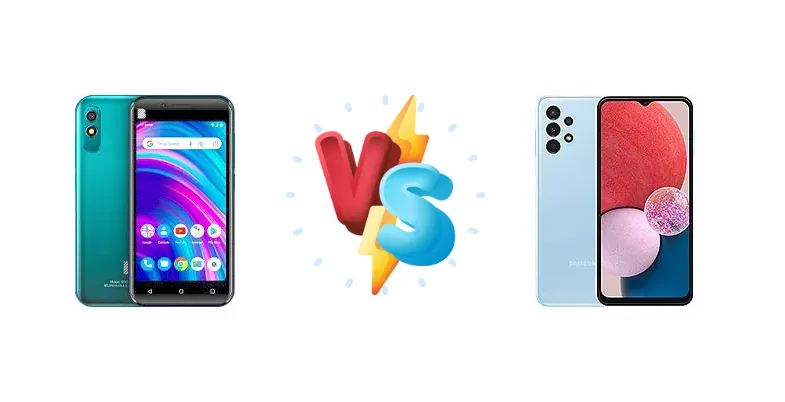
The BLU Studio X10 2022 and the Samsung Galaxy A13 (SM-A137) represent the lower end of the smartphone market, targeting users prioritizing affordability. However, significant differences in their internal hardware dictate vastly different user experiences. This comparison dissects those differences, focusing on performance, battery, and camera capabilities to determine which device offers the best value.
🏆 Quick Verdict
For the average user, the Samsung Galaxy A13 is the clear winner. Its Mediatek Helio G80 chipset provides a substantial performance uplift over the BLU Studio X10’s aging MT6580, making it far more capable for everyday tasks and even light gaming. While the BLU Studio X10 may be cheaper, the A13’s improved processing power justifies the price difference.
| Network |
|---|
| 2G bands | GSM 850 / 900 / 1800 / 1900 | GSM 850 / 900 / 1800 / 1900 |
| 3G bands | HSDPA 850 / 900 / 1900 / 2100 | HSDPA 850 / 900 / 2100 |
| 4G bands | - | 1, 3, 5, 7, 8, 20, 28, 38, 40, 41 |
| Speed | HSPA 21.1/5.76 Mbps | HSPA, LTE |
| Technology | GSM / HSPA | GSM / HSPA / LTE |
| Launch |
|---|
| Announced | 2022, January | 2022, June |
| Status | Available. Released 2022, January | Available. Released 2022, July |
| Body |
|---|
| Build | - | Glass front (Gorilla Glass 5), plastic frame, plastic back |
| Dimensions | 145.9 x 73.5 x 9.8 mm (5.74 x 2.89 x 0.39 in) | 165.1 x 76.4 x 8.8 mm (6.5 x 3.01 x 0.35 in) |
| SIM | Nano-SIM + Nano-SIM | · Nano-SIM· Nano-SIM + Nano-SIM |
| Weight | 175 g (6.17 oz) | 195 g (6.88 oz) |
| Display |
|---|
| Protection | - | Corning Gorilla Glass 5 |
| Resolution | 480 x 854 pixels, 16:9 ratio (~196 ppi density) | 1080 x 2408 pixels, 20:9 ratio (~400 ppi density) |
| Size | 5.0 inches, 68.9 cm2 (~64.2% screen-to-body ratio) | 6.6 inches, 104.9 cm2 (~83.2% screen-to-body ratio) |
| Type | IPS LCD | PLS LCD |
| Platform |
|---|
| CPU | Quad-core 1.3 GHz Cortex-A7 | Octa-core (2x2.0 GHz Cortex-A75 & 6x1.8 GHz Cortex-A55) |
| Chipset | Mediatek MT6580 (28 nm) | Mediatek MT6769V/CU Helio G80 (12 nm) |
| GPU | Mali-400MP2 | Mali-G52 MC2 |
| OS | Android 11 (Go edition) | Android 12, upgradable to Android 14, One UI 6.1 |
| Memory |
|---|
| Card slot | microSDXC | microSDXC (dedicated slot) |
| Internal | 32GB 1GB RAM | 32GB 3GB RAM, 32GB 4GB RAM, 64GB 4GB RAM, 128GB 4GB RAM |
| | eMMC 5.1 | eMMC 5.1 |
| Main Camera |
|---|
| Features | LED flash | LED flash, panorama, HDR |
| Quad | - | 50 MP, f/1.8, (wide), PDAF
5 MP, f/2.2, 123˚ (ultrawide), 1/5.0", 1.12µm
2 MP (macro)
Auxiliary lens |
| Single | 8 MP, AF | 8 MP, f/2.2, (wide) |
| Video | 1080p@30fps | 1080p@30fps |
| Selfie camera |
|---|
| Single | 5 MP | 8 MP, f/2.2, (wide) |
| Video | 720p@30fps | 1080p@30fps |
| Sound |
|---|
| 3.5mm jack | Yes | Yes |
| 35mm jack | Yes | Yes |
| Loudspeaker | Yes | Yes |
| Comms |
|---|
| Bluetooth | 4.1, A2DP | 5.2, A2DP, LE |
| NFC | No | Yes |
| Positioning | GPS | GPS, GLONASS, GALILEO, BDS |
| Radio | FM radio | No |
| USB | microUSB 2.0 | USB Type-C 2.0, OTG |
| WLAN | Wi-Fi 802.11 b/g/n, Wi-Fi Direct | Wi-Fi 802.11 a/b/g/n/ac, dual-band, Wi-Fi Direct |
| Features |
|---|
| Sensors | Accelerometer | Fingerprint (side-mounted), accelerometer, compass |
| | - | Virtual proximity sensing |
| Battery |
|---|
| Charging | - | 15W wired |
| Type | Li-Po 2000 mAh | Li-Po 5000 mAh |
| Misc |
|---|
| Colors | Green, Red, Black, Blue | Black, White, Blue |
| Models | - | SM-A137F, SM-A137F/DSN, SM-A137F/DS |
| Price | About 50 EUR | About 180 EUR |
| SAR EU | - | 0.35 W/kg (head) 1.22 W/kg (body) |
BLU Studio X10 2022
- Potentially lower price point
- Compact size (slightly smaller screen)
- Basic functionality for essential tasks
- Outdated and slow processor
- Poor performance for multitasking or gaming
- Likely inferior camera quality
- Charging speed unknown and likely slow
Samsung Galaxy A13 (SM-A137)
- Significantly faster processor (Helio G80)
- Larger, higher-resolution display
- Larger battery capacity (5000mAh)
- 15W fast charging support
- Higher price than the BLU Studio X10
- Still an entry-level device with limitations
- Camera performance may be average
Display Comparison
Neither device boasts a standout display. Both likely utilize LCD panels, a common trait in this price bracket. However, the lack of detailed display specs for the BLU Studio X10 makes a direct comparison difficult. The Samsung Galaxy A13’s larger screen size (6.6 inches vs. the X10’s 6.5 inches) offers a slightly more immersive viewing experience. The A13’s resolution (FHD+) is also likely superior to the X10’s, resulting in sharper images. The absence of high refresh rates on either device is expected at this price point.
Camera Comparison
Camera performance is likely to be a weak point on both devices, but the A13 has a potential edge. While both likely feature a primary camera, the A13 benefits from a more modern ISP (Image Signal Processor) integrated within the Helio G80 chipset. This allows for better image processing and potentially improved low-light performance. The prevalence of 2MP macro and depth sensors on both devices suggests these are largely marketing features with limited real-world utility. The A13’s larger sensor size (if present, specs unavailable for either) would further enhance its image quality.
Performance
The performance gap between these two phones is substantial. The Samsung Galaxy A13’s Mediatek Helio G80 (12nm) is a modern octa-core processor featuring two Cortex-A75 performance cores and six Cortex-A55 efficiency cores, clocked at 2.0 GHz and 1.8 GHz respectively. This architecture provides a significant advantage over the BLU Studio X10’s Mediatek MT6580 (28nm), a quad-core Cortex-A7 processor running at 1.3 GHz. The Helio G80’s 12nm manufacturing process is also more efficient, leading to better thermal management and potentially sustained performance. The A13 will handle multitasking, app loading, and web browsing far more smoothly than the X10.
Battery Life
Battery life will depend heavily on usage patterns. The Samsung Galaxy A13 includes 15W wired charging, a modest but useful feature absent from any publicly available information regarding the BLU Studio X10. While battery capacity isn’t specified for the X10, the A13’s 5000mAh battery provides a substantial reserve. The Helio G80’s improved power efficiency also contributes to longer battery life on the A13, even with more demanding tasks. The 15W charging on the A13 will provide a noticeable top-up speed advantage over the X10, assuming the X10 charges at a significantly slower rate.
Buying Guide
Buy the BLU Studio X10 2022 if you absolutely need the lowest possible price and your smartphone usage is limited to basic calling, texting, and very light app use. Buy the Samsung Galaxy A13 (SM-A137) if you want a phone that can handle social media, streaming video, and occasional gaming without significant lag, and if you value a more responsive user experience.
Frequently Asked Questions
❓ Is the Mediatek Helio G80 in the Samsung Galaxy A13 capable of playing demanding games like PUBG Mobile?
While the Helio G80 isn't a gaming powerhouse, it can run PUBG Mobile at medium settings with reasonable frame rates. Expect some occasional stuttering, especially in intense firefights. The BLU Studio X10’s MT6580 would struggle significantly with PUBG, likely offering an unplayable experience.
❓ Does the Samsung Galaxy A13 overheat during prolonged use, such as video streaming or gaming?
The Helio G80 is generally efficient, and the Samsung Galaxy A13’s thermal design is adequate for its class. While some warming is expected during extended use, it’s unlikely to experience significant overheating or throttling. The BLU Studio X10’s older processor is more prone to thermal throttling due to its less efficient 28nm process.
❓ How much storage does each phone offer, and is it expandable?
The Samsung Galaxy A13 typically comes in 32GB, 64GB, or 128GB storage configurations, with microSD card support for expansion. The BLU Studio X10’s storage capacity is less clear, but it likely offers a smaller base storage option and also supports microSD expansion.
❓ What software updates can I expect on each device?
Samsung provides more consistent software updates than BLU. The Galaxy A13 will likely receive at least one major Android version update and several security patches. BLU’s update track record is less reliable, and the Studio X10 may not receive significant software support.