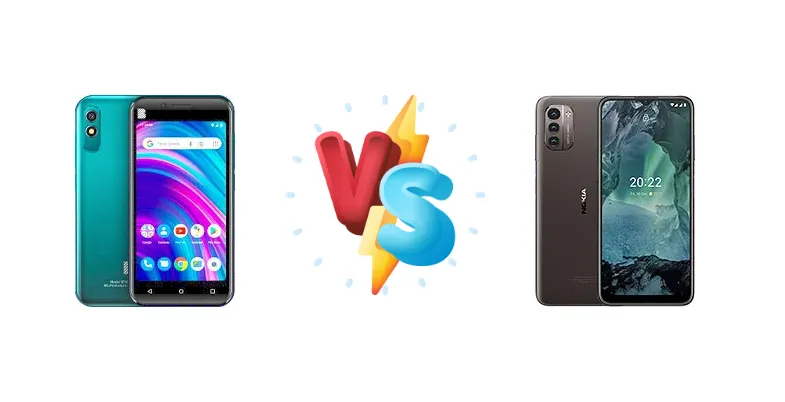
The ultra-budget smartphone market is fiercely competitive. The BLU Studio X10 2022 and Nokia G21 both aim to deliver essential smartphone functionality at a low price point, but they take very different approaches. The BLU focuses on basic functionality, while the Nokia G21 attempts to offer a more modern experience with a more powerful chipset and faster charging.
🏆 Quick Verdict
For the average user, the Nokia G21 is the better choice. Its Unisoc T606 chipset, built on a 12nm process, provides a substantial performance uplift over the BLU Studio X10’s aging Mediatek MT6580. While both offer similar battery endurance ratings, the Nokia’s 18W PD3.0 charging is a significant convenience advantage.
| Network |
|---|
| 2G bands | GSM 850 / 900 / 1800 / 1900 | GSM 850 / 900 / 1800 / 1900 |
| 3G bands | HSDPA 850 / 900 / 1900 / 2100 | HSDPA 850 / 900 / 2100 - International |
| 4G bands | - | 1, 3, 5, 7, 8, 20, 28, 38, 40, 41 - International |
| Speed | HSPA 21.1/5.76 Mbps | HSPA 42.2/5.76 Mbps, LTE Cat4 150/50 Mbps |
| Technology | GSM / HSPA | GSM / HSPA / LTE |
| | - | 1, 2, 3, 4, 5, 7, 8, 12, 17, 28, 40, 66 - LATAM |
| Launch |
|---|
| Announced | 2022, January | 2022, February 14 |
| Status | Available. Released 2022, January | Available. Released 2022, February 15 |
| Body |
|---|
| Build | - | Glass front, plastic frame, plastic back |
| Dimensions | 145.9 x 73.5 x 9.8 mm (5.74 x 2.89 x 0.39 in) | 164.6 x 75.9 x 8.5 mm (6.48 x 2.99 x 0.33 in) |
| SIM | Nano-SIM + Nano-SIM | · Nano-SIM· Nano-SIM + Nano-SIM |
| Weight | 175 g (6.17 oz) | 190 g (6.70 oz) |
| Display |
|---|
| Resolution | 480 x 854 pixels, 16:9 ratio (~196 ppi density) | 720 x 1600 pixels, 20:9 ratio (~270 ppi density) |
| Size | 5.0 inches, 68.9 cm2 (~64.2% screen-to-body ratio) | 6.5 inches, 102.0 cm2 (~81.6% screen-to-body ratio) |
| Type | IPS LCD | IPS LCD, 90Hz, 400 nits (typ) |
| Platform |
|---|
| CPU | Quad-core 1.3 GHz Cortex-A7 | Octa-core (2x1.6 GHz Cortex-A75 & 6x1.6 GHz Cortex-A55) |
| Chipset | Mediatek MT6580 (28 nm) | Unisoc T606 (12 nm) |
| GPU | Mali-400MP2 | Mali-G57 MP1 |
| OS | Android 11 (Go edition) | Android 11, upgradable to Android 13 |
| Memory |
|---|
| Card slot | microSDXC | microSDXC (dedicated slot) |
| Internal | 32GB 1GB RAM | 64GB 3GB RAM, 64GB 4GB RAM, 128GB 4GB RAM, 128GB 6GB RAM |
| | eMMC 5.1 | eMMC 5.1 |
| Main Camera |
|---|
| Features | LED flash | LED flash, HDR, panorama |
| Single | 8 MP, AF | 8 MP, f/2.0, (wide) |
| Triple | - | 50 MP, f/1.8, 28mm (wide), 1/2.76", 0.64µm, PDAF
2 MP (macro)
Auxiliary lens |
| Video | 1080p@30fps | 1080p@30fps |
| Selfie camera |
|---|
| Single | 5 MP | 8 MP, f/2.0, (wide) |
| Video | 720p@30fps | 1080p@30fps |
| Sound |
|---|
| 3.5mm jack | Yes | Yes |
| 35mm jack | Yes | Yes |
| Loudspeaker | Yes | Yes |
| Comms |
|---|
| Bluetooth | 4.1, A2DP | 5.0, A2DP, LE |
| NFC | No | Yes (market/region dependent) |
| Positioning | GPS | GPS, GLONASS, GALILEO |
| Radio | FM radio | FM radio, RDS |
| USB | microUSB 2.0 | USB Type-C 2.0, OTG |
| WLAN | Wi-Fi 802.11 b/g/n, Wi-Fi Direct | Wi-Fi 802.11 a/b/g/n/ac, dual-band, Wi-Fi Direct |
| Features |
|---|
| Sensors | Accelerometer | Fingerprint (side-mounted), accelerometer, proximity |
| Battery |
|---|
| Charging | - | 18W wired, PD3.0 |
| Type | Li-Po 2000 mAh | Li-Po 5050 mAh |
| Misc |
|---|
| Colors | Green, Red, Black, Blue | Nordic Blue, Dusk |
| Models | - | TA-1418, TA-1477, TA-1415, TA-1405, TA-1404, TA-1412 |
| Price | About 50 EUR | About 90 EUR |
| SAR | - | 1.00 W/kg (head) 1.10 W/kg (body) |
| SAR EU | - | 0.34 W/kg (head) 1.05 W/kg (body) |
| Tests |
|---|
| Battery life | - |
Endurance rating 126h
|
| Camera | - |
Photo / Video |
| Display | - |
Contrast ratio: 1631:1 (nominal) |
| Loudspeaker | - |
-30.7 LUFS (Below average)
|
| Performance | - |
AnTuTu: 171299 (v9)
GeekBench: 1193 (v5.1)
GFXBench: 8.9fps (ES 3.1 onscreen) |
BLU Studio X10 2022
- Potentially the lowest price point available.
- Basic smartphone functionality is covered.
- Acceptable battery life.
- Outdated and slow Mediatek MT6580 chipset.
- Likely a lower-quality display.
- Slow charging (assumed).
Nokia G21
- Significantly faster Unisoc T606 chipset.
- Brighter display for better outdoor visibility.
- 18W PD3.0 fast charging.
- Higher price than the BLU Studio X10 2022.
- Camera performance likely limited.
- Still a budget device with inherent limitations.
Display Comparison
Both devices share a contrast ratio of 1631:1, suggesting similar panel characteristics in terms of black levels. However, the Nokia G21 boasts a measured peak brightness of 500 nits, a crucial advantage for outdoor visibility compared to the BLU Studio X10 2022, whose brightness remains unspecified. The lack of information regarding the BLU’s panel technology suggests it likely utilizes a less advanced display, potentially impacting color accuracy and viewing angles.
Camera Comparison
Both phones list 'Photo / Video' capabilities, but lack specific details. Without sensor size or aperture information, a direct comparison is difficult. However, given the overall positioning of these devices, it’s safe to assume both cameras will deliver adequate results in good lighting conditions, but struggle in low light. The presence of a camera is more about functionality than photographic quality at this price point.
Performance
The performance gap between these two devices is significant. The Nokia G21’s Unisoc T606, fabricated on a 12nm process, features an octa-core configuration with Cortex-A75 performance cores, offering a substantial improvement over the BLU Studio X10 2022’s quad-core 1.3 GHz Cortex-A7 processor built on a dated 28nm node. This translates to faster app launches, smoother multitasking, and a more responsive user interface on the Nokia. The 12nm process also contributes to better power efficiency, despite the higher core count.
Battery Life
Both the BLU Studio X10 2022 and Nokia G21 achieve an endurance rating of 126 hours, indicating comparable battery life under similar usage scenarios. However, the Nokia G21’s 18W wired charging with PD3.0 support provides a significant advantage. While the BLU’s charging speed is unknown, it’s likely considerably slower, meaning longer times tethered to a power outlet. The faster charging on the Nokia G21 offers a more convenient user experience.
Buying Guide
Buy the BLU Studio X10 2022 if you absolutely need the lowest possible price and only require basic smartphone functions like calls, texts, and light social media use. Buy the Nokia G21 if you prioritize a smoother user experience, faster app loading times, and the ability to handle more demanding tasks like video streaming or casual gaming, even if it means spending a bit more.
Frequently Asked Questions
❓ Is the Unisoc T606 in the Nokia G21 powerful enough for casual gaming?
Yes, the Unisoc T606 is capable of handling casual games like PUBG Mobile at lower settings. While it won't deliver a flagship gaming experience, it provides a significantly smoother experience than the Mediatek MT6580 in the BLU Studio X10 2022, which would struggle with even less demanding titles.
❓ How long does it realistically take to charge the Nokia G21 from 0% to 100%?
With the 18W PD3.0 charger, the Nokia G21 should charge from 0% to 100% in approximately 2 hours and 30 minutes to 3 hours, depending on usage during charging. This is considerably faster than the BLU Studio X10 2022, which likely takes 4+ hours with a standard charger.
❓ Will the BLU Studio X10 2022 struggle with modern apps like Facebook or WhatsApp?
Yes, the BLU Studio X10 2022's Mediatek MT6580 chipset and limited RAM will likely result in slow app loading times and occasional lag when using apps like Facebook or WhatsApp. The Nokia G21 offers a much smoother experience with these apps due to its more powerful processor.