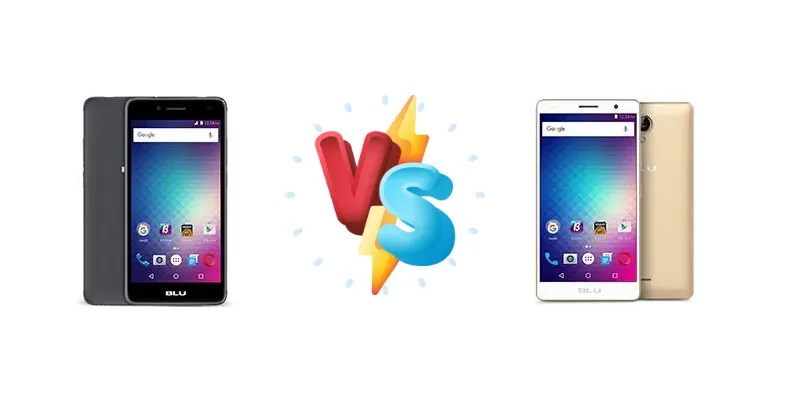
The BLU Studio C 8+8 and G Plus HD represent the ultra-budget end of the Android smartphone spectrum. Both devices aim to deliver essential smartphone functionality at a minimal cost. This comparison dissects their similarities and differences, helping you determine which offers the best value for your money, given their shared Mediatek MT6580 chipset.
🏆 Quick Verdict
For the average user prioritizing basic functionality, the BLU Studio G Plus HD likely offers a slightly better experience due to its potential for optimized software and potentially better display quality, despite both phones sharing the same core hardware. The C 8+8 isn't a bad choice, but doesn't demonstrably outperform its sibling.
| Network |
|---|
| 2G bands | GSM 850 / 900 / 1800 / 1900 - SIM 1 & SIM 2 | GSM 850 / 900 / 1800 / 1900 - SIM 1 & SIM 2 |
| 3G bands | HSDPA 850 / 1700(AWS) / 1900 / 2100 - S270Q | HSDPA 850 / 1700(AWS) / 1900 / 2100 |
| Speed | HSPA 21.1/5.76 Mbps | HSPA 21.1/5.76 Mbps |
| Technology | GSM / HSPA | GSM / HSPA |
| Launch |
|---|
| Announced | 2016, August. Released 2016, August | 2016, November. Released 2016, November |
| Status | Discontinued | Discontinued |
| Body |
|---|
| Dimensions | 144.4 x 72.5 x 8.5 mm (5.69 x 2.85 x 0.33 in) | 148.7 x 77.4 x 8.9 mm (5.85 x 3.05 x 0.35 in) |
| SIM | Dual SIM (Micro-SIM, dual stand-by) | Dual SIM (Micro-SIM, dual stand-by) |
| Weight | 152 g (5.36 oz) | 189 g (6.67 oz) |
| Display |
|---|
| Resolution | 720 x 1280 pixels, 16:9 ratio (~294 ppi density) | 720 x 1280 pixels, 16:9 ratio (~267 ppi density) |
| Size | 5.0 inches, 68.9 cm2 (~65.8% screen-to-body ratio) | 5.5 inches, 83.4 cm2 (~72.5% screen-to-body ratio) |
| Type | LCD | IPS LCD |
| Platform |
|---|
| CPU | Quad-core 1.3 GHz Cortex-A7 | Quad-core 1.3 GHz Cortex-A7 |
| Chipset | Mediatek MT6580 (28 nm) | Mediatek MT6580 (28 nm) |
| GPU | Mali-400MP2 | Mali-400MP2 |
| OS | Android 6.0 (Marshmallow) | Android 6.0 (Marshmallow) |
| Memory |
|---|
| Card slot | microSDXC | microSDXC |
| Internal | 8GB 1GB RAM | 8GB 1GB RAM |
| Main Camera |
|---|
| Features | LED flash | LED flash |
| Single | 8 MP, AF | 5 MP, AF |
| Video | 1080p@30fps | 720p@30fps |
| Selfie camera |
|---|
| Single | 8 MP | 5 MP |
| Sound |
|---|
| 3.5mm jack | - | Yes |
| 35mm jack | Yes | Yes |
| Loudspeaker | Yes | Yes |
| Comms |
|---|
| Bluetooth | 4.0, A2DP | 4.0, A2DP |
| NFC | No | No |
| Positioning | GPS | GPS |
| Radio | Stereo FM radio | FM radio |
| USB | microUSB 2.0 | microUSB 2.0 |
| WLAN | Wi-Fi 802.11 b/g/n, Wi-Fi Direct | Wi-Fi 802.11 b/g/n, Wi-Fi Direct |
| Features |
|---|
| Sensors | Accelerometer, proximity | Accelerometer, proximity |
| Battery |
|---|
| Stand-by | Up to 775 h (2G) / Up to 650 h (3G) | Up to 625 h (3G) |
| Talk time | Up to 32 h (2G) / Up to 24 h (3G) | Up to 22 h (2G) / Up to 20 h (3G) |
| Type | Li-Po 3000 mAh, removable | Li-Po 2500 mAh, non-removable |
| Misc |
|---|
| Colors | Blue, Rose Gold, Bronze | Gold, Gray, Rose Gold |
BLU Studio C 8+8
- Potentially lower price point
- Basic smartphone functionality
- Compact form factor (likely)
- Limited performance due to aging chipset
- Potentially lower display resolution
- Uncertain software support
BLU Studio G Plus HD
- ‘HD’ display suggests higher resolution
- Potentially more refined software experience
- Good value for the price
- Limited performance due to aging chipset
- Slow charging (likely)
- Basic camera capabilities
Display Comparison
Both the BLU Studio C 8+8 and G Plus HD utilize unspecified display technologies, but given their price point, it's safe to assume they are IPS LCD panels. Without knowing the resolution or brightness levels, it's difficult to definitively say which offers a superior viewing experience. However, the 'HD' designation in the G Plus HD's name suggests a higher resolution than the C 8+8, potentially leading to sharper images. The 28nm chipset will likely limit the ability to drive a high-resolution, high-brightness panel efficiently, so the G Plus HD's resolution choice will be critical.
Camera Comparison
Camera specifications are likely similar, and potentially low-resolution on both devices. Without specific sensor details, it's difficult to assess image quality. It's probable that both phones feature a primary camera and a basic front-facing camera. Any additional cameras, such as a 2MP macro lens (common in this segment), will likely offer limited practical benefit due to the small sensor size and lack of optical image stabilization. Image processing will be crucial, and the G Plus HD may benefit from slightly more refined software algorithms.
Performance
The core of both devices is the Mediatek MT6580 chipset, featuring a quad-core 1.3 GHz Cortex-A7 CPU. This chipset is known for its basic functionality and is suitable for light tasks like calling, texting, and browsing. Performance will be nearly identical between the two phones; the 28nm manufacturing process indicates limited thermal headroom, meaning sustained performance will be constrained. The Cortex-A7 architecture is aging, and users should expect noticeable lag when multitasking or running demanding applications. RAM capacity, which is not specified, will be a significant factor in real-world performance, with more RAM mitigating some of the chipset's limitations.
Battery Life
Battery capacity is not specified for either device. Given the power-efficient MT6580 chipset, both phones should offer at least a full day of standby time and moderate usage. Charging wattage is also unknown, but likely to be slow (5W or less) due to the budget nature of the devices. Battery life will depend heavily on screen brightness, usage patterns, and network conditions. The G Plus HD's potentially higher resolution display could slightly impact battery life if not optimized.
Buying Guide
Buy the BLU Studio C 8+8 if you need a secondary device for calls and basic messaging, and are comfortable with potentially less refined software. Buy the BLU Studio G Plus HD if you prefer a potentially more polished user experience and are looking for a slightly more capable all-around budget smartphone, even if the core performance remains identical.
Frequently Asked Questions
❓ Will either of these phones run popular apps like WhatsApp and Facebook smoothly?
Yes, both the BLU Studio C 8+8 and G Plus HD should be able to run apps like WhatsApp and Facebook, but expect some lag and slower loading times. The Mediatek MT6580 chipset is sufficient for basic app functionality, but it's not designed for demanding applications.
❓ Can I play games on these phones?
Simple, less-demanding games are playable, but don't expect a great gaming experience. The MT6580 chipset and Cortex-A7 CPU lack the graphical power for modern, high-end games. Frame rates will be low, and you may encounter stuttering and lag.
❓ What kind of storage options are available on these devices?
Storage capacity is not specified, but it's likely to be limited (8GB or 16GB). Both phones likely support microSD card expansion, allowing you to increase storage capacity for photos, videos, and apps.
❓ How long will software updates be supported for these phones?
Software update support is likely to be limited. BLU typically doesn't provide extensive software updates for its budget devices. Expect to receive minimal security patches, if any.