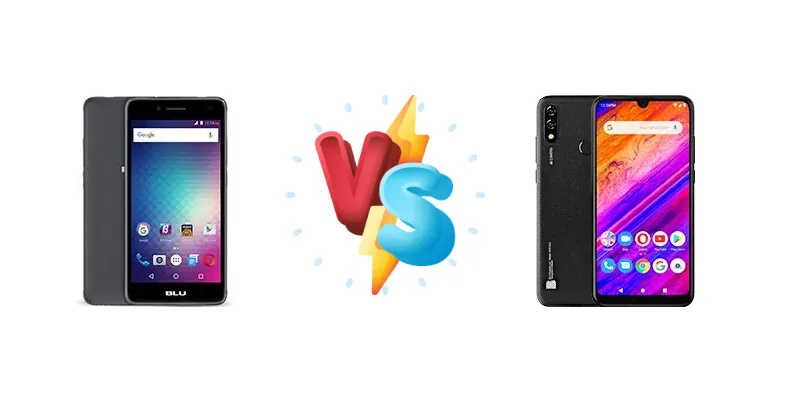
BLU offers compelling options in the ultra-budget smartphone space, but choosing between models like the Studio C 8+8 LTE and the Vivo XL5 requires a careful look under the hood. While both aim for affordability, they take different approaches to performance and user experience. This comparison dissects the key differences to help you make the right choice.
🏆 Quick Verdict
For most users, the BLU Vivo XL5 is the superior choice. Its octa-core Cortex-A55 CPU provides a significantly more responsive experience than the Studio C 8+8 LTE’s quad-core Cortex-A53, especially when multitasking or running demanding apps. While both phones likely share similar display and camera limitations, the performance boost justifies the potential price difference.
| Network |
|---|
| 2G bands | GSM 850 / 900 / 1800 / 1900 - SIM 1 & SIM 2 | GSM 850 / 900 / 1800 / 1900 |
| 3G bands | HSDPA 850 / 1700(AWS) / 1900 / 2100 | HSDPA 850 / 1700(AWS) / 1900 |
| 4G bands | 2, 4, 7, 12, 17 | 2, 4, 5, 12, 17 |
| Speed | HSPA 21.1/5.76 Mbps, LTE Cat4 150/50 Mbps | HSPA 42.2/11.5 Mbps, LTE Cat4 150/50 Mbps |
| Technology | GSM / HSPA / LTE | GSM / HSPA / LTE |
| Launch |
|---|
| Announced | 2016, August. Released 2016, August | 2019, July. Released 2019, July |
| Status | Discontinued | Discontinued |
| Body |
|---|
| Dimensions | 144.4 x 72.5 x 8.5 mm (5.69 x 2.85 x 0.33 in) | 161.4 x 78 x 9.6 mm (6.35 x 3.07 x 0.38 in) |
| SIM | Dual SIM (Micro-SIM, dual stand-by) | Nano-SIM + Nano-SIM |
| Weight | 143 g (5.04 oz) | 181 g (6.38 oz) |
| Display |
|---|
| Resolution | 720 x 1280 pixels, 16:9 ratio (~294 ppi density) | 720 x 1520 pixels, 19:9 ratio (~267 ppi density) |
| Size | 5.0 inches, 68.9 cm2 (~65.8% screen-to-body ratio) | 6.3 inches, 99.1 cm2 (~78.7% screen-to-body ratio) |
| Type | LCD | IPS LCD |
| Platform |
|---|
| CPU | Quad-core 1.0 GHz Cortex-A53 | Octa-core 1.6 GHz Cortex-A55 |
| Chipset | Mediatek MT6735 (28 nm) | - |
| GPU | Mali-T720 | IMG8322 |
| OS | Android 6.0 (Marshmallow) | Android 9.0 (Pie) |
| Memory |
|---|
| Card slot | microSDXC | microSDXC |
| Internal | 8GB 1GB RAM | 64GB 3GB RAM |
| Main Camera |
|---|
| Dual | - | 13 MP, AF
Auxiliary lens |
| Features | LED flash | LED flash |
| Single | 8 MP, AF | - |
| Video | 1080p@30fps | 1080p@30fps |
| Selfie camera |
|---|
| Features | - | LED flash |
| Single | 8 MP | 13 MP |
| Video | - | 1080p@30fps |
| Sound |
|---|
| 3.5mm jack | - | Yes |
| 35mm jack | Yes | Yes |
| Loudspeaker | Yes | Yes |
| Comms |
|---|
| Bluetooth | 4.0, A2DP | 4.1, A2DP |
| NFC | No | No |
| Positioning | GPS | GPS |
| Radio | Stereo FM radio | FM radio |
| USB | microUSB 2.0 | microUSB 2.0 |
| WLAN | Wi-Fi 802.11 b/g/n, Wi-Fi Direct | Wi-Fi 802.11 b/g/n, Wi-Fi Direct |
| Features |
|---|
| Sensors | Accelerometer, proximity | Fingerprint (rear-mounted), accelerometer, proximity |
| Battery |
|---|
| Stand-by | Up to 750 h (2G) / Up to 650 h (3G) | Up to 750 h (2G) / Up to 650 h (3G) |
| Talk time | Up to 30 h (2G) / Up to 20 h (3G) | Up to 30 h (2G) / Up to 24 h (3G) |
| Type | Li-Po 3000 mAh, removable | Li-Po 4000 mAh, non-removable |
BLU Studio C 8+8 LTE
- Potentially lower price point
- May offer slightly better battery life under light use
- Functional for basic smartphone tasks
- Significantly slower processor
- Struggles with multitasking and demanding apps
- Outdated CPU architecture
BLU Vivo XL5
- Faster and more efficient octa-core processor
- Smoother user experience
- Better suited for multitasking and modern apps
- Potentially shorter battery life under heavy use
- May be slightly more expensive
- Likely similar camera performance to the Studio C 8+8 LTE
Display Comparison
Neither BLU provides detailed display specifications. Given the price point, both the Studio C 8+8 LTE and Vivo XL5 likely feature 720p LCD panels. Expect limited brightness, narrow viewing angles, and standard color accuracy. The absence of information suggests neither phone boasts advanced features like high refresh rates or HDR support. Bezels are likely substantial on both devices, maximizing screen real estate within a budget-friendly form factor.
Camera Comparison
Without sensor details, a camera comparison is difficult. Both phones likely feature basic camera setups geared towards casual photography. Expect limited low-light performance and average image quality. The presence of a 2MP macro lens on either device is largely marketing fluff; its image quality will be significantly lower than the main sensor. Image processing will likely be minimal on both, relying heavily on software algorithms to enhance photos.
Performance
The core difference lies in the CPUs. The BLU Vivo XL5’s octa-core 1.6 GHz Cortex-A55 processor represents a significant architectural leap over the Studio C 8+8 LTE’s quad-core 1.0 GHz Cortex-A53. The Cortex-A55 cores are more efficient and offer higher instructions per clock (IPC) than the older A53 design. This translates to faster app loading times, smoother multitasking, and improved responsiveness. The Mediatek MT6735 in the Studio C 8+8 LTE, built on a 28nm process, will struggle with modern app demands compared to the XL5. While RAM details are missing, the CPU difference is the dominant factor.
Battery Life
Battery capacity is not specified for either device. However, given the less power-hungry CPU in the Studio C 8+8 LTE, it *may* offer slightly better battery life under light usage. The Vivo XL5’s more powerful processor will consume more energy, but the difference may be negligible with similar battery capacities. Charging wattage is also unknown; expect slow charging speeds on both devices, likely utilizing micro-USB connectivity.
Buying Guide
Buy the BLU Studio C 8+8 LTE if you prioritize absolute lowest cost and only need a phone for basic tasks like calls, texts, and light web browsing. It's a functional device for minimal smartphone usage. Buy the BLU Vivo XL5 if you value a smoother, more responsive user experience, even for everyday tasks, and anticipate using your phone for more than just the essentials. The XL5 offers a better long-term experience.
Frequently Asked Questions
❓ Will the BLU Vivo XL5 handle popular social media apps like TikTok and Instagram smoothly?
Yes, the Vivo XL5’s octa-core Cortex-A55 processor is significantly better equipped to handle the demands of social media apps compared to the Studio C 8+8 LTE. You should experience smoother scrolling, faster loading times, and fewer instances of lag while using these apps.
❓ Is the Mediatek MT6735 in the Studio C 8+8 LTE sufficient for playing basic Android games?
The Mediatek MT6735 can handle very basic Android games, but expect low frame rates and graphical settings. More demanding games will likely be unplayable or suffer from significant lag. The Vivo XL5 offers a better gaming experience, though still limited by its budget hardware.
❓ What type of charging port do these phones use, and how long does it take to charge?
Both phones likely use a micro-USB port, given their price point. Charging times will be slow, likely taking several hours to fully charge from 0% to 100%. Neither BLU specifies fast charging capabilities for these models.