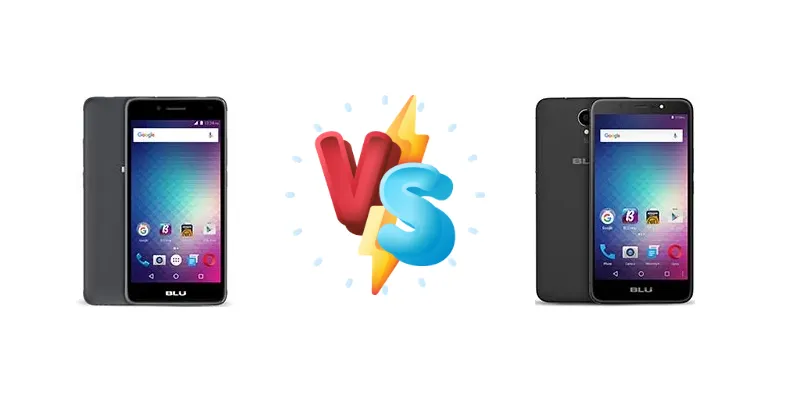
The BLU Studio C 8+8 LTE and the BLU Energy X Plus 2 represent two distinct approaches to the ultra-budget smartphone market. The Studio C 8+8 LTE, with its Mediatek chipset, aims for a balance of features, while the Energy X Plus 2 focuses on a slightly higher clocked CPU. This comparison dissects their core components to determine which device delivers the best experience for the price-conscious consumer.
🏆 Quick Verdict
For the average user prioritizing consistent performance in everyday tasks, the BLU Studio C 8+8 LTE emerges as the better choice. While the Energy X Plus 2 boasts a marginally faster CPU clock speed, the MT6735's architecture and likely optimizations provide a smoother, more reliable experience overall.
| Network |
|---|
| 2G bands | GSM 850 / 900 / 1800 / 1900 - SIM 1 & SIM 2 | GSM 850 / 900 / 1800 / 1900 - SIM 1 & SIM 2 |
| 3G bands | HSDPA 850 / 1700(AWS) / 1900 / 2100 | HSDPA 850 / 1700(AWS) / 1900 |
| 4G bands | 2, 4, 7, 12, 17 | - |
| Speed | HSPA 21.1/5.76 Mbps, LTE Cat4 150/50 Mbps | HSPA 21.1/5.76 Mbps |
| Technology | GSM / HSPA / LTE | GSM / HSPA |
| Launch |
|---|
| Announced | 2016, August. Released 2016, August | 2016, November. Released 2016, December |
| Status | Discontinued | Discontinued |
| Body |
|---|
| Dimensions | 144.4 x 72.5 x 8.5 mm (5.69 x 2.85 x 0.33 in) | 154.3 x 77.5 x 9.6 mm (6.07 x 3.05 x 0.38 in) |
| SIM | Dual SIM (Micro-SIM, dual stand-by) | Dual SIM (Micro-SIM) |
| Weight | 143 g (5.04 oz) | 172 g (6.07 oz) |
| Display |
|---|
| Resolution | 720 x 1280 pixels, 16:9 ratio (~294 ppi density) | 720 x 1280 pixels, 16:9 ratio (~267 ppi density) |
| Size | 5.0 inches, 68.9 cm2 (~65.8% screen-to-body ratio) | 5.5 inches, 83.4 cm2 (~69.7% screen-to-body ratio) |
| Type | LCD | IPS LCD |
| Platform |
|---|
| CPU | Quad-core 1.0 GHz Cortex-A53 | Quad-core 1.3 GHz Cortex-A7 |
| Chipset | Mediatek MT6735 (28 nm) | - |
| GPU | Mali-T720 | Mali-400 |
| OS | Android 6.0 (Marshmallow) | Android 6.0 (Marshmallow) |
| Memory |
|---|
| Card slot | microSDXC | microSDXC |
| Internal | 8GB 1GB RAM | 8GB 1GB RAM |
| Main Camera |
|---|
| Features | LED flash | LED flash |
| Single | 8 MP, AF | 8 MP, AF |
| Video | 1080p@30fps | 1080p@30fps |
| Selfie camera |
|---|
| Features | - | LED flash |
| Single | 8 MP | 5 MP |
| Sound |
|---|
| 3.5mm jack | - | Yes |
| 35mm jack | Yes | Yes |
| Loudspeaker | Yes | Yes |
| Comms |
|---|
| Bluetooth | 4.0, A2DP | 4.0, A2DP |
| NFC | No | No |
| Positioning | GPS | GPS |
| Radio | Stereo FM radio | Stereo FM radio |
| USB | microUSB 2.0 | microUSB 2.0 |
| WLAN | Wi-Fi 802.11 b/g/n, Wi-Fi Direct | Wi-Fi 802.11 b/g/n, Wi-Fi Direct |
| Features |
|---|
| Sensors | Accelerometer, proximity | Accelerometer, proximity, compass |
| Battery |
|---|
| Stand-by | Up to 750 h (2G) / Up to 650 h (3G) | Up to 900 h (2G) / Up to 875 h (3G) |
| Talk time | Up to 30 h (2G) / Up to 20 h (3G) | Up to 42 h (2G) / Up to 28 h (3G) |
| Type | Li-Po 3000 mAh, removable | Li-Po 4900 mAh, non-removable |
| Misc |
|---|
| Colors | Black | Grey, Gold, Rose Gold |
| Models | - | ENERGY X PLUS 2 |
BLU Studio C 8+8 LTE
- More efficient processor (MT6735)
- Likely better sustained performance
- Potentially better image processing
- Lower CPU clock speed
- Display specifications unknown
BLU Energy X Plus 2
- Higher CPU clock speed (1.3 GHz)
- Potentially lower cost
- Simple processor architecture
- Less efficient processor (Cortex-A7)
- Potential for throttling under load
- Likely less advanced ISP
Display Comparison
Unfortunately, display specifications are unavailable for either device. However, given their price point, both likely utilize LCD panels with 720p resolution. The Studio C 8+8 LTE's inclusion of 'LTE' suggests a potentially more modern panel with better color reproduction than the Energy X Plus 2, which may be based on older stock. Bezels are expected to be substantial on both devices, typical of this market segment.
Camera Comparison
Camera details are sparse for both devices. It's safe to assume both feature basic camera setups, likely with a primary sensor and potentially a secondary sensor for depth or macro. Without specific sensor size or aperture information, it's difficult to assess image quality. However, the MT6735 chipset in the Studio C 8+8 LTE includes an integrated image signal processor (ISP) that is likely more advanced than the ISP paired with the Cortex-A7 in the Energy X Plus 2, potentially leading to better image processing and noise reduction.
Performance
The core difference lies in the processors. The BLU Studio C 8+8 LTE features the Mediatek MT6735, a 28nm quad-core processor with Cortex-A53 cores clocked at 1.0 GHz. The BLU Energy X Plus 2 utilizes a quad-core Cortex-A7 processor clocked at 1.3 GHz. While the A7 cores have a higher clock speed, the A53 architecture found in the MT6735 is more efficient and generally offers better sustained performance. The 28nm process node of the MT6735 also contributes to better thermal management, reducing the likelihood of throttling during prolonged use. This means the Studio C 8+8 LTE is likely to maintain consistent performance for longer periods.
Battery Life
Battery capacity is unknown for both devices. However, given the lower power consumption of the MT6735 chipset in the Studio C 8+8 LTE, it's reasonable to expect slightly better battery life compared to the Energy X Plus 2, even with a similarly sized battery. Charging wattage is also unspecified, but both likely support standard 5W charging.
Buying Guide
Buy the BLU Studio C 8+8 LTE if you need a phone that handles multitasking and basic apps without significant lag, and value a chipset known for broader software compatibility. Buy the BLU Energy X Plus 2 if you prioritize a slightly faster theoretical CPU speed and are willing to potentially trade off some stability and optimization for that marginal gain.
Frequently Asked Questions
❓ Will the BLU Studio C 8+8 LTE handle popular social media apps like Facebook and Instagram smoothly?
Yes, the Mediatek MT6735 chipset is capable of running social media apps without significant lag. The Cortex-A53 cores, while not high-end, are sufficient for these everyday tasks. The 28nm process node also helps prevent overheating during prolonged use.
❓ Is the difference in CPU clock speed between the BLU Energy X Plus 2 and the BLU Studio C 8+8 LTE noticeable in real-world use?
While the Energy X Plus 2 has a slightly higher clocked CPU, the architectural differences between the Cortex-A7 and Cortex-A53 cores are more significant. The A53 cores in the Studio C 8+8 LTE are more efficient and generally provide better sustained performance, making the difference in clock speed less noticeable in everyday tasks.
❓ Can either of these phones play modern mobile games?
Both phones will struggle with graphically demanding modern mobile games. They may be able to run less intensive games at low settings, but expect significant frame rate drops and potential lag. Neither phone is designed for gaming.