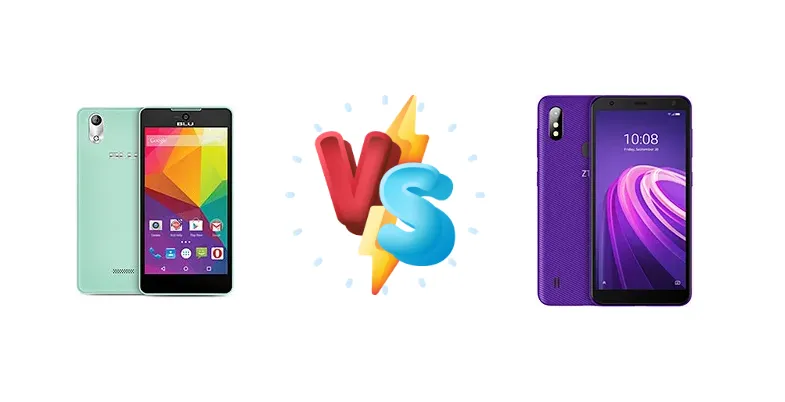
The BLU Studio C 5+5 and ZTE Blade A3Y represent the extreme end of the smartphone price spectrum. Both aim to deliver basic functionality at an incredibly low cost, but they achieve this with significantly different hardware. This comparison dissects their core components to determine which offers the best experience for the money, focusing on the impact of their respective chipsets.
🏆 Quick Verdict
For the average user, the ZTE Blade A3Y is the superior choice. Its Mediatek Helio A22 chipset, built on a 12nm process, provides a noticeable performance boost over the BLU Studio C 5+5’s older 28nm Mediatek MT6582. While both phones are limited, the A3Y offers a smoother, more responsive experience for everyday tasks.
| Network |
|---|
| 2G bands | GSM 850 / 900 / 1800 / 1900 - SIM 1 & SIM 2 | GSM 850 / 900 / 1800 / 1900 |
| 3G bands | HSDPA 850 / 1700(AWS) / 1900 - D890U | HSDPA 850 / 900 / 2100 |
| 4G bands | - | 2, 4, 5, 12, 13 |
| Speed | HSPA 21.1/5.76 Mbps | HSPA, LTE |
| Technology | GSM / HSPA | GSM / HSPA / LTE |
| Launch |
|---|
| Announced | 2015, July. Released 2015, July | 2020, October 30. Released 2020, October 30 |
| Status | Discontinued | Discontinued |
| Body |
|---|
| Dimensions | 143 x 71.8 x 9 mm (5.63 x 2.83 x 0.35 in) | 146 x 71 x 9.7 mm (5.75 x 2.80 x 0.38 in) |
| SIM | Dual SIM (Mini-SIM/ Micro-SIM, dual stand-by) | Nano-SIM + Nano-SIM |
| Weight | 157 g (5.54 oz) | 162 g (5.71 oz) |
| Display |
|---|
| Resolution | 480 x 854 pixels, 16:9 ratio (~196 ppi density) | 720 x 1440 pixels, 18:9 ratio (~293 ppi density) |
| Size | 5.0 inches, 68.9 cm2 (~67.1% screen-to-body ratio) | 5.5 inches, 78.1 cm2 (~75.3% screen-to-body ratio) |
| Type | IPS LCD | IPS LCD |
| Platform |
|---|
| CPU | Quad-core 1.3 GHz Cortex-A7 | Quad-core 2.0 GHz Cortex-A53 |
| Chipset | Mediatek MT6582 (28 nm) | Mediatek MT6761 Helio A22 (12 nm) |
| GPU | Mali-400MP2 | PowerVR GE8320 |
| OS | Android 5.0 (Lollipop) | Android 10 |
| Memory |
|---|
| Card slot | microSDXC | microSDXC |
| Internal | 8GB 1GB RAM | 32GB 2GB RAM |
| | - | eMMC 5.1 |
| Main Camera |
|---|
| Features | LED flash | Dual-LED flash, HDR |
| Single | 5 MP, AF | 8 MP |
| Video | 720p@30fps | 1080p@30fps |
| Selfie camera |
|---|
| Single | 5 MP | 5 MP |
| Video | - | 720p@30fps |
| Sound |
|---|
| 3.5mm jack | - | Yes |
| 35mm jack | Yes | Yes |
| Loudspeaker | Yes | Yes |
| Comms |
|---|
| Bluetooth | 4.0, A2DP | 4.2, A2DP |
| NFC | No | No |
| Positioning | GPS | GPS |
| Radio | Stereo FM radio | No |
| USB | microUSB 2.0 | USB Type-C 2.0 |
| WLAN | Wi-Fi 802.11 b/g/n, Wi-Fi Direct, hotspot | Wi-Fi 802.11 b/g/n/ac, dual-band, Wi-Fi Direct |
| Features |
|---|
| Sensors | Accelerometer, proximity | Fingerprint (rear-mounted), accelerometer, proximity, gyro |
| Battery |
|---|
| Stand-by | Up to 900 h (2G) / Up to 750 h (3G) | - |
| Talk time | Up to 24 h (2G) / Up to 12 h (3G) | - |
| Type | Li-Po 2000 mAh, removable | Li-Ion 2660 mAh, removable |
| Misc |
|---|
| Colors | Black, Blue, Gold, Green, Orange, Pink, White | Purple |
| Price | - | About 50 EUR |
BLU Studio C 5 + 5
- Potentially the lowest price point available.
- Simple and straightforward Android experience.
- May be suitable for users with extremely basic needs.
- Outdated and slow processor.
- Poor performance for multitasking or gaming.
- Likely limited software support.
ZTE Blade A3Y
- More powerful and efficient processor.
- Smoother user experience.
- Better battery life due to the 12nm process.
- Likely to receive more software updates.
- Still a budget device with limitations.
- Camera quality will be basic.
- May still struggle with demanding apps.
Display Comparison
Neither BLU nor ZTE provide detailed display specifications. Given their price points, both likely utilize LCD panels with modest resolutions (likely 720p or lower). The key difference lies in the underlying technology driving the phones. Without specific brightness data, it's difficult to assess viewing experience in direct sunlight. However, the newer chipset in the A3Y *could* support slightly better display processing, potentially leading to more accurate colors, though this is speculative.
Camera Comparison
Both devices likely feature basic camera setups. Without detailed sensor information, it’s safe to assume both rely on low-resolution sensors. The presence of a 2MP macro camera on either device is largely marketing fluff; image quality will be limited. The A3Y *may* benefit from slightly improved image signal processing (ISP) capabilities within the Helio A22 chipset, potentially leading to marginally better image quality in good lighting conditions, but don't expect flagship-level results from either.
Performance
The performance gap is the most significant differentiator. The ZTE Blade A3Y’s Mediatek Helio A22 (12nm) features a quad-core Cortex-A53 CPU clocked at 2.0 GHz. This is a substantial upgrade over the BLU Studio C 5+5’s Mediatek MT6582 (28nm) with its quad-core 1.3 GHz Cortex-A7 CPU. The 12nm process node of the Helio A22 is far more efficient, resulting in better thermal management and sustained performance. The Cortex-A53 architecture is also more modern and efficient than the Cortex-A7. This translates to faster app loading times, smoother scrolling, and a more responsive overall experience on the A3Y. The A3Y will handle basic games and apps with significantly less lag.
Battery Life
Battery capacity details are unavailable for both devices. However, the Helio A22’s 12nm process offers a significant advantage in power efficiency. This means the ZTE Blade A3Y will likely achieve longer battery life on a single charge compared to the BLU Studio C 5+5, even if they have similar battery capacities. Charging wattage is also unknown, but the A3Y’s more modern chipset *could* support faster charging protocols, though this is speculative.
Buying Guide
Buy the BLU Studio C 5+5 if you absolutely need the lowest possible price and are willing to tolerate significant performance limitations. It's suitable for very basic communication – calls, texts, and minimal app usage. Buy the ZTE Blade A3Y if you prioritize a more fluid user experience, even within the budget segment. The A3Y’s newer chipset makes it better suited for light multitasking, social media browsing, and occasional gaming.
Frequently Asked Questions
❓ Will the ZTE Blade A3Y run popular social media apps like Facebook and WhatsApp smoothly?
Yes, the ZTE Blade A3Y’s Helio A22 chipset is capable of running Facebook, WhatsApp, and similar social media apps with acceptable performance. While it won’t be lightning-fast, it should provide a smoother experience than the BLU Studio C 5+5, especially when multitasking between apps.
❓ Is the BLU Studio C 5+5 a good choice for a first smartphone for a senior citizen?
The BLU Studio C 5+5 *could* be considered for a senior citizen if simplicity and the absolute lowest price are the primary concerns. However, its slow performance may lead to frustration. The ZTE Blade A3Y, while slightly more expensive, offers a more responsive experience that might be preferable for a first-time smartphone user.
❓ Can either of these phones play PUBG Mobile?
While technically possible to *launch* PUBG Mobile on both devices, the experience will be severely limited. The BLU Studio C 5+5 is unlikely to run it at playable framerates. The ZTE Blade A3Y might allow for very low-setting gameplay, but expect significant lag and stuttering. Neither phone is suitable for serious PUBG Mobile gaming.