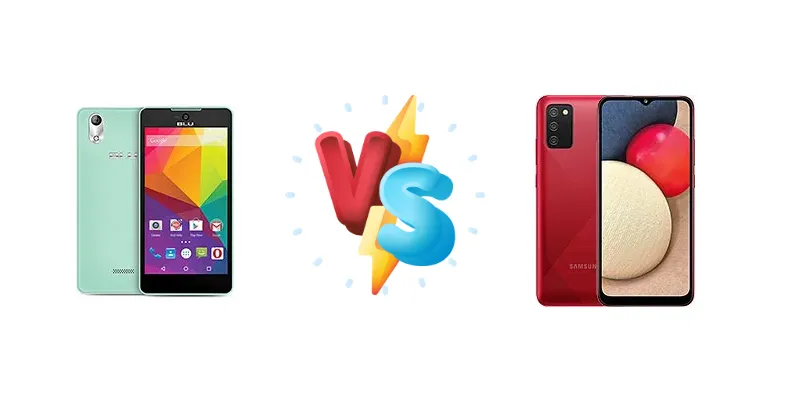
The sub-$150 smartphone market is fiercely competitive. Both the Samsung Galaxy A02s and the BLU Studio C 5 + 5 aim to deliver essential smartphone functionality at an accessible price. However, they take different approaches to achieving this, with Samsung leveraging its brand recognition and the Qualcomm Snapdragon 450 chipset, while BLU opts for the Mediatek MT6582. This comparison dissects the key differences to determine which device offers the best value.
🏆 Quick Verdict
For most users, the Samsung Galaxy A02s is the better choice. Its more modern Qualcomm Snapdragon 450 chipset, coupled with a brighter display and 15W charging, provides a smoother and more responsive experience than the BLU Studio C 5 + 5, despite both phones sharing an identical endurance rating.
| Network |
|---|
| 2G bands | GSM 850 / 900 / 1800 / 1900 - SIM 1 & SIM 2 | GSM 850 / 900 / 1800 / 1900 |
| 3G bands | HSDPA 850 / 1700(AWS) / 1900 - D890U | HSDPA 850 / 900 / 2100 |
| 4G bands | - | 1, 3, 5, 7, 8, 20, 28, 38, 40, 41 |
| Speed | HSPA 21.1/5.76 Mbps | HSPA 42.2/5.76 Mbps, LTE Cat4 150/50 Mbps |
| Technology | GSM / HSPA | GSM / HSPA / LTE |
| Launch |
|---|
| Announced | 2015, July. Released 2015, July | 2020, November 24. Released 2021, January 04 |
| Status | Discontinued | Discontinued |
| Body |
|---|
| Build | - | Glass front, plastic back, plastic frame |
| Dimensions | 143 x 71.8 x 9 mm (5.63 x 2.83 x 0.35 in) | 164.2 x 75.9 x 9.1 mm (6.46 x 2.99 x 0.36 in) |
| SIM | Dual SIM (Mini-SIM/ Micro-SIM, dual stand-by) | · Nano-SIM· Nano-SIM + Nano-SIM |
| Weight | 157 g (5.54 oz) | 196 g (6.91 oz) |
| Display |
|---|
| Protection | - | Scratch-resistant glass |
| Resolution | 480 x 854 pixels, 16:9 ratio (~196 ppi density) | 720 x 1600 pixels, 20:9 ratio (~270 ppi density) |
| Size | 5.0 inches, 68.9 cm2 (~67.1% screen-to-body ratio) | 6.5 inches, 102.0 cm2 (~81.8% screen-to-body ratio) |
| Type | IPS LCD | PLS LCD |
| Platform |
|---|
| CPU | Quad-core 1.3 GHz Cortex-A7 | Octa-core 1.8 GHz Cortex-A53 |
| Chipset | Mediatek MT6582 (28 nm) | Qualcomm SDM450 Snapdragon 450 (14 nm) |
| GPU | Mali-400MP2 | Adreno 506 |
| OS | Android 5.0 (Lollipop) | Android 10, upgradable to Android 12, One UI 4.1 |
| Memory |
|---|
| Card slot | microSDXC | microSDXC (dedicated slot) |
| Internal | 8GB 1GB RAM | 16GB 1GB RAM, 32GB 2GB RAM, 32GB 3GB RAM, 32GB 4GB RAM, 64GB 3GB RAM, 64GB 4GB RAM |
| | - | eMMC 5.1 |
| Main Camera |
|---|
| Features | LED flash | LED flash |
| Single | 5 MP, AF | 3.15 MP |
| Triple | - | 13 MP, f/2.2, (wide), AF
2 MP (macro)
Auxiliary lens |
| Video | 720p@30fps | 1080p@30fps |
| Selfie camera |
|---|
| Single | 5 MP | 5 MP, f/2.2 |
| Sound |
|---|
| 3.5mm jack | - | Yes |
| 35mm jack | Yes | Yes |
| Loudspeaker | Yes | Yes |
| Comms |
|---|
| Bluetooth | 4.0, A2DP | 4.2, A2DP |
| NFC | No | No |
| Positioning | GPS | GPS, GLONASS, GALILEO, BDS |
| Radio | Stereo FM radio | Unspecified |
| USB | microUSB 2.0 | USB Type-C 2.0 |
| WLAN | Wi-Fi 802.11 b/g/n, Wi-Fi Direct, hotspot | Wi-Fi 802.11 b/g/n, Wi-Fi Direct |
| Features |
|---|
| Sensors | Accelerometer, proximity | Accelerometer, proximity |
| Battery |
|---|
| Charging | - | 15W wired |
| Stand-by | Up to 900 h (2G) / Up to 750 h (3G) | Up to 530 h (2G) / Up to 530 h (3G) |
| Talk time | Up to 24 h (2G) / Up to 12 h (3G) | Up to 6 h 12 min (2G) / Up to 6 h 18 min (3G) |
| Type | Li-Po 2000 mAh, removable | Li-Po 5000 mAh |
| Misc |
|---|
| Colors | Black, Blue, Gold, Green, Orange, Pink, White | Black, White, Red, Blue |
| Models | - | SM-A025F, SM-A025F/DS, SM-A025G, SM-A025G/DS, SM-A025M, SM-A025M/DS, SM-A025U, SM-A025V, SM-A025A, SM-A025U1, SM-A025AZ, SM-S124DL |
| Price | - | About 110 EUR |
| SAR | - | 1.15 W/kg (head) 0.79 W/kg (body) |
| SAR EU | - | 0.40 W/kg (head) 1.37 W/kg (body) |
| Tests |
|---|
| Audio quality | - |
Noise -81.4dB / Crosstalk -80.5dB |
| Battery life | - |
Endurance rating 114h
|
| Camera | - |
Photo / Video |
| Display | - |
Contrast ratio: 1765:1 (nominal) |
| Loudspeaker | - |
-29.8 LUFS (Average)
|
| Performance | - |
AnTuTu: 90811 (v8)
GeekBench: 495 (v5.1)
GFXBench: 6.1fps (ES 3.1 onscreen) |
BLU Studio C 5 + 5
- More powerful Snapdragon 450 chipset
- Brighter display for better outdoor visibility
- Faster 15W charging
- Better brand reputation and software support
- Potentially slightly higher price
- Basic camera system
Samsung Galaxy A02s
- Lower price point
- Acceptable battery endurance
- Functional for basic smartphone tasks
- Outdated Mediatek MT6582 chipset
- Likely dimmer display
- Slower charging
- Limited software updates
Display Comparison
The Samsung Galaxy A02s boasts a significantly more usable display experience. While both phones share a 1765:1 contrast ratio, the A02s achieves a measured peak brightness of 406 nits, ensuring better visibility outdoors. The BLU Studio C 5 + 5’s display specifications are not provided, suggesting a lower brightness level. This difference is crucial for everyday usability, especially in bright environments. While contrast is similar, the A02s’ higher brightness makes a tangible difference.
Camera Comparison
Both devices are listed as having 'Photo / Video' capabilities, but lack specific details. Given their price point, image quality is unlikely to be a differentiating factor. It’s safe to assume both phones feature basic camera sensors, and image processing will be limited. Without sensor size or aperture information, a detailed comparison is impossible. The presence of a 2MP macro lens on many A02s variants is largely a marketing tactic, offering minimal practical benefit.
Performance
The core difference lies in the chipsets. The Samsung Galaxy A02s utilizes the Qualcomm Snapdragon 450, an octa-core processor built on a 14nm process. This contrasts sharply with the BLU Studio C 5 + 5’s Mediatek MT6582, a quad-core processor fabricated on a larger 28nm node. The 14nm process of the Snapdragon 450 is more efficient, leading to better thermal management and sustained performance. The A02s’ eight cores, clocked at 1.8 GHz, also provide a substantial advantage over the MT6582’s four 1.3 GHz cores, resulting in faster app loading times and smoother multitasking. The architectural difference (Cortex-A53 vs Cortex-A7) further favors the Snapdragon, offering improved instruction set efficiency.
Battery Life
Interestingly, both the Samsung Galaxy A02s and the BLU Studio C 5 + 5 share an endurance rating of 114 hours. However, this doesn’t tell the whole story. The A02s supports 15W wired charging, allowing for significantly faster replenishment of the battery compared to the BLU Studio C 5 + 5, which likely utilizes a slower charging standard. While both may last a similar amount of time on a single charge, the A02s’ faster charging capability reduces downtime.
Buying Guide
Buy the BLU Studio C 5 + 5 if your primary need is a functional smartphone for basic tasks like calls, texts, and light social media, and you are prioritizing the absolute lowest possible price. Buy the Samsung Galaxy A02s if you value a more responsive user experience, a brighter and more viewable display, and faster charging, even if it means spending slightly more.
Frequently Asked Questions
❓ Is the Mediatek MT6582 in the BLU Studio C 5 + 5 sufficient for running popular apps like WhatsApp and Facebook?
Yes, the MT6582 can handle basic apps like WhatsApp and Facebook, but expect slower loading times and potential lag when multitasking. It's designed for light usage, and demanding apps may struggle.
❓ Does the Samsung Galaxy A02s support VoLTE and Wi-Fi calling, and are these features carrier-dependent?
The Samsung Galaxy A02s *should* support VoLTE and Wi-Fi calling, but compatibility is heavily dependent on your carrier. Check with your mobile provider to confirm support for these features on their network.
❓ What type of USB port do both phones use, and is a USB-C to USB-A adapter required for modern chargers?
Both the BLU Studio C 5 + 5 and the Samsung Galaxy A02s utilize a micro-USB port. This means you may need a micro-USB to USB-A cable or adapter if you primarily use modern USB-C chargers.
❓ How much storage does each phone offer, and is it expandable via microSD card?
While the exact storage configuration isn't specified, both phones typically come with 32GB of internal storage, expandable via a microSD card slot. This is crucial for storing photos, videos, and apps.