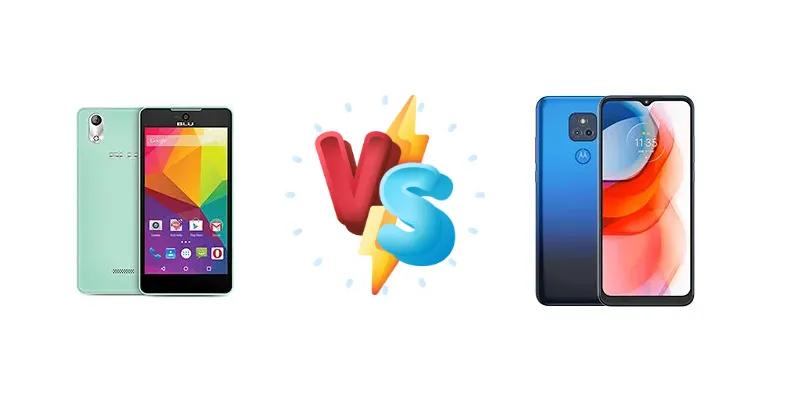
The BLU Studio C 5 + 5 and Motorola Moto G Play (2021) represent opposite ends of the entry-level smartphone spectrum. The BLU is an older device relying on a tried-and-true, but aging, chipset, while the Moto G Play aims to deliver a modern Android experience at an accessible price. This comparison dissects their core differences to help you determine which best suits your needs.
🏆 Quick Verdict
For the vast majority of users, the Motorola Moto G Play (2021) is the clear winner. Its Qualcomm Snapdragon 460 chipset provides a substantial performance boost over the BLU Studio C 5 + 5’s Mediatek MT6582, translating to smoother multitasking, faster app loading, and a more responsive overall experience. While the BLU may be cheaper, the Moto G Play’s improved performance justifies the price difference.
| Network |
|---|
| 2G bands | GSM 850 / 900 / 1800 / 1900 - SIM 1 & SIM 2 | GSM 850 / 900 / 1800 / 1900 |
| 3G bands | HSDPA 850 / 1700(AWS) / 1900 - D890U | HSDPA 850 / 900 / 1700(AWS) / 1900 / 2100 |
| 4G bands | - | 1, 2, 3, 4, 5, 7, 8, 12, 13, 17, 25, 26, 38, 41, 66, 71 |
| Speed | HSPA 21.1/5.76 Mbps | HSPA, LTE |
| Technology | GSM / HSPA | GSM / CDMA / HSPA / LTE |
| | - | 2, 4, 5, 12, 14, 30, 66 |
| Launch |
|---|
| Announced | 2015, July. Released 2015, July | 2021, January 08 |
| Status | Discontinued | Available. Released 2021, January 14 |
| Body |
|---|
| Build | - | Plastic frame, plastic back |
| Dimensions | 143 x 71.8 x 9 mm (5.63 x 2.83 x 0.35 in) | 166.6 x 76 x 9.4 mm (6.56 x 2.99 x 0.37 in) |
| SIM | Dual SIM (Mini-SIM/ Micro-SIM, dual stand-by) | Nano-SIM |
| Weight | 157 g (5.54 oz) | 204 g (7.20 oz) |
| | - | Water-repellent coating |
| Display |
|---|
| Resolution | 480 x 854 pixels, 16:9 ratio (~196 ppi density) | 720 x 1600 pixels, 20:9 ratio (~270 ppi density) |
| Size | 5.0 inches, 68.9 cm2 (~67.1% screen-to-body ratio) | 6.5 inches, 102.0 cm2 (~80.6% screen-to-body ratio) |
| Type | IPS LCD | IPS LCD |
| Platform |
|---|
| CPU | Quad-core 1.3 GHz Cortex-A7 | Octa-core (4x1.8 GHz Kryo 240 & 4x1.6 GHz Kryo 240) |
| Chipset | Mediatek MT6582 (28 nm) | Qualcomm SM4250 Snapdragon 460 (11 nm) |
| GPU | Mali-400MP2 | Adreno 610 |
| OS | Android 5.0 (Lollipop) | Android 10 |
| Memory |
|---|
| Card slot | microSDXC | microSDXC (dedicated slot) |
| Internal | 8GB 1GB RAM | 32GB 3GB RAM |
| | - | eMMC 5.1 |
| Main Camera |
|---|
| Dual | - | 13 MP, f/2.0, (wide), 1/3.1", 1.12µm, PDAF
Auxiliary lens |
| Features | LED flash | LED flash, HDR, panorama |
| Single | 5 MP, AF | - |
| Video | 720p@30fps | 1080p@30/60fps |
| Selfie camera |
|---|
| Features | - | HDR |
| Single | 5 MP | 5 MP, f/2.2, (wide), 1.12µm |
| Video | - | 1080p@30fps |
| Sound |
|---|
| 3.5mm jack | - | Yes |
| 35mm jack | Yes | Yes |
| Loudspeaker | Yes | Yes |
| Comms |
|---|
| Bluetooth | 4.0, A2DP | 5.0, A2DP, LE |
| NFC | No | No |
| Positioning | GPS | GPS, GLONASS, GALILEO |
| Radio | Stereo FM radio | Unspecified |
| USB | microUSB 2.0 | USB Type-C 2.0 |
| WLAN | Wi-Fi 802.11 b/g/n, Wi-Fi Direct, hotspot | Wi-Fi 802.11 a/b/g/n/ac, dual-band, Wi-Fi Direct |
| Features |
|---|
| Sensors | Accelerometer, proximity | Fingerprint (rear-mounted), accelerometer, proximity |
| Battery |
|---|
| Charging | - | 10W wired |
| Stand-by | Up to 900 h (2G) / Up to 750 h (3G) | - |
| Talk time | Up to 24 h (2G) / Up to 12 h (3G) | - |
| Type | Li-Po 2000 mAh, removable | Li-Po 5000 mAh |
| Misc |
|---|
| Colors | Black, Blue, Gold, Green, Orange, Pink, White | Misty Blue |
| Models | - | XT2093-3, XT2093-7, XT2093-DL, XT2093DL |
| Price | - | About 60 EUR |
BLU Studio C 5 + 5
- Potentially lower upfront cost.
- Simple and straightforward Android experience.
- May be more readily available in certain regions.
- Significantly slower performance.
- Outdated chipset architecture.
- Likely inferior camera quality.
- Potentially larger bezels and lower display quality.
Motorola Moto G Play (2021)
- Much faster and more responsive performance.
- More efficient Snapdragon 460 chipset.
- 10W wired charging support.
- Better app compatibility and future-proofing.
- Improved image processing capabilities.
- Slightly higher price point.
- Still an entry-level device with limitations.
Display Comparison
Neither device boasts a standout display. Given the context data focuses on processing power, we can infer both likely utilize LCD panels. The BLU Studio C 5 + 5, being an older model, likely has larger bezels and a lower peak brightness. The Moto G Play, while still budget-focused, benefits from more recent manufacturing techniques, potentially offering slightly better color accuracy and viewing angles. However, neither is expected to compete with devices featuring OLED or high refresh rate technology.
Camera Comparison
Without detailed camera specifications, a direct comparison is difficult. However, given the price points, both devices likely feature basic camera setups. The Moto G Play likely benefits from Qualcomm’s image signal processor (ISP), offering improved image processing capabilities compared to the Mediatek-powered BLU. While neither is expected to excel in low-light conditions, the Moto G Play’s ISP will likely produce more detailed and vibrant photos in good lighting. We can assume both devices have a primary camera and potentially a secondary depth or macro sensor, but image quality will be heavily reliant on software optimization.
Performance
The performance gap is the most significant differentiator. The Motorola Moto G Play’s Qualcomm Snapdragon 460, built on an 11nm process, is a generational leap ahead of the BLU Studio C 5 + 5’s Mediatek MT6582 (28nm). The Snapdragon 460’s octa-core configuration (4x1.8 GHz Kryo 240 & 4x1.6 GHz Kryo 240) provides significantly more processing power than the Mediatek’s quad-core 1.3 GHz Cortex-A7. This translates to faster app launches, smoother multitasking, and improved responsiveness. The 11nm process also contributes to better thermal efficiency, reducing the likelihood of throttling during sustained use. Users who play mobile games or use demanding apps will see a dramatic improvement with the Moto G Play.
Battery Life
The Moto G Play includes 10W wired charging, a feature not explicitly mentioned for the BLU Studio C 5 + 5. While battery capacity isn’t specified, the Snapdragon 460’s improved power efficiency means the Moto G Play will likely offer comparable or better battery life despite potentially having a similar capacity to the BLU. The 10W charging, while not fast, provides a reliable way to replenish the battery, and the more efficient chipset will reduce the frequency of charging.
Buying Guide
Buy the BLU Studio C 5 + 5 if you absolutely need the lowest possible upfront cost and your smartphone usage is limited to basic tasks like calls, texts, and light web browsing. Buy the Motorola Moto G Play (2021) if you prioritize a smoother, more responsive user experience, better app compatibility, and the benefits of a more modern chipset, even if it means spending a bit more.
Frequently Asked Questions
❓ Will the Moto G Play (2021) struggle with popular apps like Facebook or WhatsApp?
No, the Snapdragon 460 is more than capable of handling everyday apps like Facebook, WhatsApp, and most other commonly used applications. The performance difference compared to the Mediatek MT6582 is substantial, resulting in smoother scrolling and faster loading times within these apps.
❓ Is the Motorola Moto G Play (2021) a good choice for mobile gaming?
While not a dedicated gaming phone, the Moto G Play (2021) offers a significantly better gaming experience than the BLU Studio C 5 + 5. The Snapdragon 460’s GPU can handle less demanding games at reasonable settings. However, graphically intensive titles may require lower settings to maintain playable frame rates.
❓ How long will software updates be supported on the Motorola Moto G Play (2021)?
Motorola typically provides at least one major Android update and a few years of security patches for its G Play series. While not on par with flagship devices, users can expect a reasonable level of software support, extending the device's usability and security.