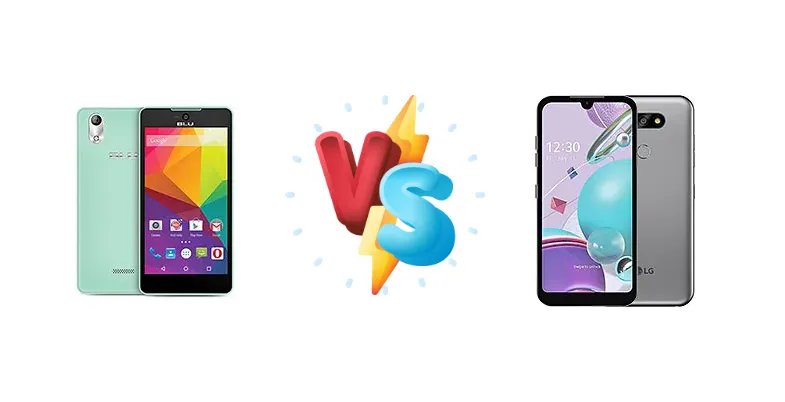
The BLU Studio C 5+5 and LG K31 represent the lower end of the smartphone market, targeting users prioritizing affordability. However, a significant difference in chipset architecture separates these two devices. This comparison dissects the implications of that difference, alongside other key features, to determine which phone delivers the best value.
🏆 Quick Verdict
For the average user seeking a basic smartphone experience, the LG K31 emerges as the better choice. Its newer Mediatek Helio P22 chipset, built on a 12nm process, provides a noticeable performance uplift over the BLU Studio C 5+5’s older MT6582, translating to smoother multitasking and app loading times.
| Network |
|---|
| 2G bands | GSM 850 / 900 / 1800 / 1900 - SIM 1 & SIM 2 | GSM 850 / 900 / 1800 / 1900 |
| 3G bands | HSDPA 850 / 1700(AWS) / 1900 - D890U | HSDPA 850 / 900 / 1700(AWS) / 1900 / 2100 |
| 4G bands | - | 2, 4, 5, 12, 13, 25, 26, 41, 66, 71 |
| Speed | HSPA 21.1/5.76 Mbps | HSPA, LTE |
| Technology | GSM / HSPA | GSM / CDMA / HSPA / LTE |
| | - | CDMA 800 / 1900 |
| Launch |
|---|
| Announced | 2015, July. Released 2015, July | 2020, August 21. Released 2020, August 21 |
| Status | Discontinued | Discontinued |
| Body |
|---|
| Dimensions | 143 x 71.8 x 9 mm (5.63 x 2.83 x 0.35 in) | 147.8 x 71.1 x 8.6 mm (5.82 x 2.80 x 0.34 in) |
| SIM | Dual SIM (Mini-SIM/ Micro-SIM, dual stand-by) | Nano-SIM + Nano-SIM |
| Weight | 157 g (5.54 oz) | 146 g (5.15 oz) |
| | - | MIL-STD-810G compliant*
*does not guarantee ruggedness or use in extreme conditions |
| Display |
|---|
| Resolution | 480 x 854 pixels, 16:9 ratio (~196 ppi density) | 720 x 1520 pixels, 19:9 ratio (~295 ppi density) |
| Size | 5.0 inches, 68.9 cm2 (~67.1% screen-to-body ratio) | 5.7 inches, 81.1 cm2 (~77.2% screen-to-body ratio) |
| Type | IPS LCD | IPS LCD |
| Platform |
|---|
| CPU | Quad-core 1.3 GHz Cortex-A7 | Octa-core 2.0 GHz Cortex-A53 |
| Chipset | Mediatek MT6582 (28 nm) | Mediatek MT6762 Helio P22 (12 nm) |
| GPU | Mali-400MP2 | PowerVR GE8320 |
| OS | Android 5.0 (Lollipop) | Android 10, LG UX 9.1 |
| Memory |
|---|
| Card slot | microSDXC | microSDXC |
| Internal | 8GB 1GB RAM | 32GB 2GB RAM |
| | - | eMMC 5.1 |
| Main Camera |
|---|
| Dual | - | 13 MP, f/1.8, 27mm (wide), 1/3.1", 1.12µm, PDAF
5 MP, f/2.2, 120˚ (ultrawide), 1/5.0", 1.12µm |
| Features | LED flash | LED flash, panorama, HDR |
| Single | 5 MP, AF | - |
| Video | 720p@30fps | 1080p@30fps |
| Selfie camera |
|---|
| Single | 5 MP | 5 MP, f/2.2, 24mm (wide), 1/5.0", 1.12µm |
| Video | - | 1080p@30fps |
| Sound |
|---|
| 3.5mm jack | - | Yes |
| 35mm jack | Yes | Yes |
| Loudspeaker | Yes | Yes |
| Comms |
|---|
| Bluetooth | 4.0, A2DP | 5.0, A2DP, LE |
| NFC | No | No |
| Positioning | GPS | GPS |
| Radio | Stereo FM radio | No |
| USB | microUSB 2.0 | microUSB 2.0 |
| WLAN | Wi-Fi 802.11 b/g/n, Wi-Fi Direct, hotspot | Wi-Fi 802.11 b/g/n, Wi-Fi Direct |
| Features |
|---|
| Sensors | Accelerometer, proximity | Fingerprint (rear-mounted), accelerometer |
| Battery |
|---|
| Stand-by | Up to 900 h (2G) / Up to 750 h (3G) | - |
| Talk time | Up to 24 h (2G) / Up to 12 h (3G) | - |
| Type | Li-Po 2000 mAh, removable | Li-Ion 3000 mAh |
| Misc |
|---|
| Colors | Black, Blue, Gold, Green, Orange, Pink, White | Gray |
| Models | - | LM-K300Q, LMK300, LGL355DL |
| Price | - | About 130 EUR |
BLU Studio C 5 + 5
- Likely the most affordable option.
- Simple and straightforward user experience.
- Functional for basic communication tasks.
- Outdated chipset with limited performance.
- Less efficient power consumption.
- Potentially slower app loading times.
LG K31
- More powerful and efficient Mediatek Helio P22 chipset.
- Smoother multitasking and app performance.
- Potentially longer battery life.
- Likely more expensive than the BLU Studio C 5+5.
- Camera performance is still likely basic.
- May still struggle with demanding games.
Display Comparison
Neither device is expected to boast a high-end display. Given the price point, both likely utilize IPS LCD panels. However, details regarding resolution, brightness, and color accuracy are unavailable. The LG K31 benefits from being a newer model, potentially offering slightly improved panel quality, but this is speculative. Bezels are likely substantial on both devices, reflecting their budget status.
Camera Comparison
Camera performance is likely to be similar on both devices, leaning towards basic functionality. Without sensor size or aperture information, it’s difficult to make definitive claims. Both phones likely feature a primary camera and potentially a secondary depth sensor. The LG K31, being a slightly newer device, *might* benefit from improved image processing algorithms, but the difference will likely be marginal. Expect acceptable results in good lighting conditions, but struggles in low light.
Performance
The core difference lies in the chipsets. The BLU Studio C 5+5’s Mediatek MT6582, a quad-core processor built on a 28nm process, is significantly older and less efficient than the LG K31’s Mediatek MT6762 Helio P22. The Helio P22 features an octa-core CPU based on the Cortex-A53 architecture running at 2.0 GHz, compared to the C5+5’s 1.3 GHz Cortex-A7 cores. This translates to a substantial performance advantage for the K31 in CPU-intensive tasks. The 12nm fabrication process of the Helio P22 also contributes to better power efficiency, reducing heat and potentially improving sustained performance. While RAM details are missing, the K31’s chipset is more capable of handling multitasking.
Battery Life
Battery capacity is not specified for either device. However, the LG K31’s more efficient Mediatek Helio P22 chipset will likely result in longer battery life, even with a similar capacity battery. The 12nm process consumes less power than the 28nm process of the BLU Studio C 5+5’s chipset. Charging wattage is also unknown, but the K31’s efficiency could translate to faster overall charging times, even with a lower wattage charger.
Buying Guide
Buy the BLU Studio C 5+5 if you absolutely need the lowest possible price and your smartphone usage is limited to calls, texts, and very light app use. Buy the LG K31 if you want a more responsive experience, even for basic tasks, and anticipate using more apps or occasionally playing casual games. The K31’s more efficient chipset also suggests potentially better battery life under moderate load.
Frequently Asked Questions
❓ Will the LG K31 be able to handle popular social media apps like Facebook and Instagram without significant lag?
Yes, the LG K31’s Mediatek Helio P22 chipset, with its octa-core Cortex-A53 CPU, is significantly more capable of running social media apps smoothly compared to the BLU Studio C 5+5’s older processor. While not a high-end experience, you should expect acceptable performance for browsing and using these apps.
❓ Is the difference in chipset architecture (Cortex-A7 vs Cortex-A53) really that noticeable in everyday use?
Absolutely. The Cortex-A53 is a more modern and efficient architecture than the Cortex-A7. This translates to faster processing speeds, improved multitasking, and a more responsive user interface. The LG K31 will feel noticeably snappier when opening apps, switching between tasks, and navigating the operating system.
❓ If I primarily use my phone for calls and texts, will I even notice the difference between these two devices?
For *strictly* calls and texts, the difference will be minimal. However, even basic smartphone usage often extends beyond these core functions. The LG K31’s improved performance will be noticeable even when checking email or browsing the web, offering a more pleasant overall experience.