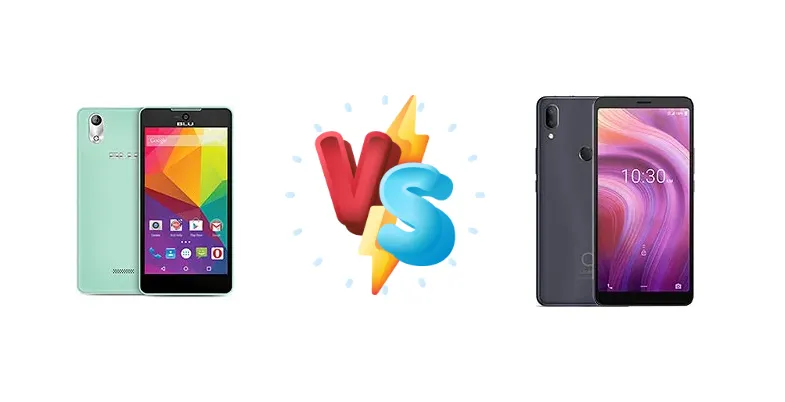
The BLU Studio C 5+5 and the Alcatel 3v (2019) represent the extreme end of the smartphone price spectrum. Both aim to deliver basic functionality at an incredibly low cost, but they achieve this with significantly different hardware. This comparison dissects those differences, focusing on how the chipset choices impact real-world performance and usability.
🏆 Quick Verdict
For the average user, the Alcatel 3v (2019) is the clear winner. Its newer Mediatek Helio P22 chipset, built on a 12nm process, provides a substantial performance uplift over the BLU Studio C 5+5’s older, less efficient Mediatek MT6582. While neither phone excels, the Alcatel 3v offers a smoother, more responsive experience.
| Network |
|---|
| 2G bands | GSM 850 / 900 / 1800 / 1900 - SIM 1 & SIM 2 | GSM 850 / 900 / 1800 / 1900 |
| 3G bands | HSDPA 850 / 1700(AWS) / 1900 - D890U | HSDPA 850 / 900 / 1700(AWS) / 1900 / 2100 |
| 4G bands | - | 1, 2, 3, 4, 5, 7, 12, 13, 17, 20, 25, 26, 41, 66, 71 |
| Speed | HSPA 21.1/5.76 Mbps | HSPA 42.2/11.5 Mbps, LTE Cat4 150/50 Mbps |
| Technology | GSM / HSPA | GSM / HSPA / LTE |
| Launch |
|---|
| Announced | 2015, July. Released 2015, July | 2019, Q2. Released 2019, Q4 |
| Status | Discontinued | Discontinued |
| Body |
|---|
| Build | - | Glass front (DragonTrail Pro glass), plastic back, plastic frame |
| Dimensions | 143 x 71.8 x 9 mm (5.63 x 2.83 x 0.35 in) | 174.5 x 83.3 x 8.4 mm (6.87 x 3.28 x 0.33 in) |
| SIM | Dual SIM (Mini-SIM/ Micro-SIM, dual stand-by) | Nano-SIM |
| Weight | 157 g (5.54 oz) | 197.9 g (6.98 oz) |
| Display |
|---|
| Protection | - | DragonTrail Pro |
| Resolution | 480 x 854 pixels, 16:9 ratio (~196 ppi density) | 720 x 1440 pixels, 18:9 ratio (~240 ppi density) |
| Size | 5.0 inches, 68.9 cm2 (~67.1% screen-to-body ratio) | 6.7 inches, 115.8 cm2 (~79.7% screen-to-body ratio) |
| Type | IPS LCD | IPS LCD |
| Platform |
|---|
| CPU | Quad-core 1.3 GHz Cortex-A7 | Octa-core 2.0 GHz Cortex-A53 |
| Chipset | Mediatek MT6582 (28 nm) | Mediatek MT6762 Helio P22 (12 nm) |
| GPU | Mali-400MP2 | PowerVR GE8320 |
| OS | Android 5.0 (Lollipop) | Android 9.0 (Pie) |
| Memory |
|---|
| Card slot | microSDXC | microSDXC (dedicated slot) |
| Internal | 8GB 1GB RAM | 32GB 3GB RAM |
| | - | eMMC 5.1 |
| Main Camera |
|---|
| Dual | - | 16 MP, PDAF
Auxiliary lens |
| Features | LED flash | LED flash, HDR, panorama |
| Single | 5 MP, AF | - |
| Video | 720p@30fps | 1080p@30fps |
| Selfie camera |
|---|
| Single | 5 MP | 8 MP |
| Video | - | 720p@30fps |
| Sound |
|---|
| 3.5mm jack | - | Yes |
| 35mm jack | Yes | Yes |
| Loudspeaker | Yes | Yes, with stereo speakers |
| Comms |
|---|
| Bluetooth | 4.0, A2DP | 4.2, A2DP, LE |
| NFC | No | No |
| Positioning | GPS | GPS |
| Radio | Stereo FM radio | FM radio |
| USB | microUSB 2.0 | USB Type-C 2.0 |
| WLAN | Wi-Fi 802.11 b/g/n, Wi-Fi Direct, hotspot | Wi-Fi 802.11 a/b/g/n, dual-band, Wi-Fi Direct |
| Features |
|---|
| Sensors | Accelerometer, proximity | Fingerprint (rear-mounted), accelerometer, proximity, compass |
| Battery |
|---|
| Charging | - | 15W wired |
| Stand-by | Up to 900 h (2G) / Up to 750 h (3G) | - |
| Talk time | Up to 24 h (2G) / Up to 12 h (3G) | - |
| Type | Li-Po 2000 mAh, removable | Li-Po 4000 mAh |
| Misc |
|---|
| Colors | Black, Blue, Gold, Green, Orange, Pink, White | Elegant Black |
| Models | - | 5032W |
| Price | - | About 170 EUR |
BLU Studio C 5 + 5
- Potentially the lowest price point available.
- Functional for basic calling and texting.
- Simple and straightforward user experience.
- Very slow performance due to the outdated chipset.
- Inefficient power consumption.
- Likely limited software support.
alcatel 3v (2019)
- Significantly faster performance with the Helio P22.
- More efficient power consumption.
- 15W fast charging support.
- Still a budget device with limitations.
- Camera quality will be basic.
- May be slightly more expensive than the BLU.
Display Comparison
Neither device is expected to boast a high-quality display. Details on panel technology (IPS, TFT) and resolution are missing for both, but given the price point, TFT panels are highly probable. The key difference lies in the processing power driving them. The Alcatel 3v’s more capable chipset will allow for smoother animations and faster app loading, improving the perceived display experience. Bezels are likely substantial on both, as minimizing these is a cost-cutting measure in this segment.
Camera Comparison
Camera performance on both devices will be limited. Details on sensor sizes and lens apertures are unavailable, but it’s safe to assume both rely on low-resolution sensors. The presence of a 2MP macro camera on the Alcatel 3v is largely marketing fluff; its image quality will be minimal. The Alcatel 3v’s more powerful ISP (Image Signal Processor), integrated within the Helio P22, will likely result in slightly better image processing and noise reduction compared to the BLU Studio C 5+5’s older chipset. However, expectations should remain low.
Performance
The performance gap is the most significant differentiator. The BLU Studio C 5+5 utilizes the Mediatek MT6582, a quad-core Cortex-A7 processor built on a 28nm process. This is an aging architecture, known for its limited performance and inefficiency. Conversely, the Alcatel 3v (2019) features the Mediatek MT6762 Helio P22, an octa-core Cortex-A53 processor fabricated on a more modern 12nm process. This translates to roughly double the CPU performance and a more efficient power draw. The 12nm process is crucial; it allows for higher transistor density and reduced heat generation, meaning the Alcatel 3v is less likely to throttle under sustained load. The Alcatel 3v will handle multitasking and app switching far more gracefully.
Battery Life
Battery capacity details are missing for the BLU Studio C 5+5. The Alcatel 3v (2019) supports 15W wired charging, a significant advantage over the likely 5W or slower charging on the BLU. While battery life will depend heavily on usage patterns, the Alcatel 3v’s more efficient chipset and faster charging will provide a more convenient user experience. The 12nm process contributes to lower power consumption, extending battery life during typical use.
Buying Guide
Buy the BLU Studio C 5+5 if your absolute priority is the lowest possible price and you only need a phone for extremely basic tasks like calls and texts. Buy the Alcatel 3v (2019) if you want a more usable smartphone experience, even for light web browsing, social media, and occasional photo taking. The Alcatel 3v’s improved processor and 15W charging justify the likely price premium.
Frequently Asked Questions
❓ Will the Alcatel 3v (2019) be able to handle popular social media apps like Facebook and Instagram without significant lag?
Yes, the Mediatek Helio P22 in the Alcatel 3v (2019) provides enough processing power to run these apps reasonably well. While it won't offer a flagship-level experience, you should expect acceptable performance for browsing feeds and posting updates. The BLU Studio C 5+5, with its older chipset, will struggle significantly with these tasks.
❓ Is the Alcatel 3v (2019)'s 15W charging a significant benefit, or is it just a marketing gimmick?
It's a genuine benefit. While not on par with modern fast charging standards, 15W charging is considerably faster than the likely 5W charging on the BLU Studio C 5+5. This means you'll spend less time tethered to a wall charger, and can quickly top up the battery when needed. The difference in charging speed is noticeable in everyday use.
❓ Can I expect to play any games on the Alcatel 3v (2019)?
You'll be limited to very basic, less demanding games. The Helio P22's integrated GPU can handle simple 2D games and older 3D titles at low settings. However, don't expect to play graphically intensive games like PUBG or Fortnite smoothly. The BLU Studio C 5+5 will struggle even with the simplest games.