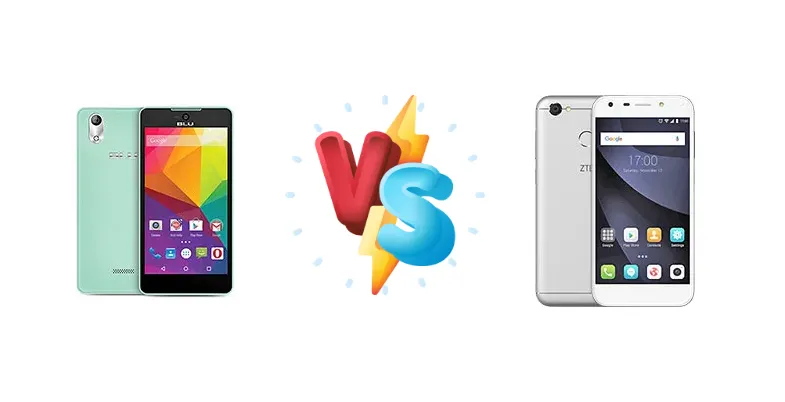
Both the BLU Studio C 5 + 5 LTE and the ZTE Blade A6 represent the ultra-budget end of the smartphone spectrum. However, beneath the similar price points lie significant differences in processing power, stemming from their respective Qualcomm Snapdragon chipsets. This comparison dissects those differences, focusing on real-world implications for the average user.
🏆 Quick Verdict
For most users, the ZTE Blade A6 is the superior choice. Its Snapdragon 435 chipset, featuring an octa-core CPU, delivers a noticeably smoother experience for everyday tasks and light multitasking compared to the quad-core Snapdragon 210 in the BLU Studio C 5 + 5 LTE. While neither phone excels, the A6 offers a more future-proof and responsive user experience.
| Network |
|---|
| 2G bands | GSM 850 / 900 / 1800 / 1900 - SIM 1 & SIM 2 | GSM 850 / 900 / 1800 / 1900 - SIM 1 & SIM 2 |
| 3G bands | HSDPA 850 / 1700(AWS) / 1900 / 2100 | HSDPA 850 / 900 / 2100 |
| 4G bands | 2, 4, 7, 17 | 1, 3, 5, 7, 8, 20, 38 |
| Speed | HSPA 21.1/5.76 Mbps, LTE Cat4 150/50 Mbps | HSPA 42.2/5.76 Mbps, LTE Cat4 150/50 Mbps |
| Technology | GSM / HSPA / LTE | GSM / HSPA / LTE |
| Launch |
|---|
| Announced | 2015, July. Released 2015, August | 2017, August. Released 2017, September |
| Status | Discontinued | Discontinued |
| Body |
|---|
| Build | - | Glass front, aluminum back, aluminum frame |
| Dimensions | 143 x 71.8 x 9 mm (5.63 x 2.83 x 0.35 in) | 147 x 71 x 8.5 mm (5.79 x 2.80 x 0.33 in) |
| SIM | Dual SIM (Mini-SIM/ Micro-SIM, dual stand-by) | Nano-SIM + Nano-SIM |
| Weight | 157 g (5.54 oz) | 160 g (5.64 oz) |
| Display |
|---|
| Resolution | 480 x 854 pixels, 16:9 ratio (~196 ppi density) | 720 x 1280 pixels, 16:9 ratio (~282 ppi density) |
| Size | 5.0 inches, 68.9 cm2 (~67.1% screen-to-body ratio) | 5.2 inches, 74.5 cm2 (~71.4% screen-to-body ratio) |
| Type | IPS LCD | IPS LCD |
| Platform |
|---|
| CPU | Quad-core 1.1 GHz Cortex-A7 | Octa-core 1.4 GHz Cortex-A53 |
| Chipset | Qualcomm MSM8909 Snapdragon 210 (28 nm) | Qualcomm MSM8940 Snapdragon 435 (28 nm) |
| GPU | Adreno 304 | Adreno 505 |
| OS | Android 5.0 (Lollipop) | Android 7.1 (Nougat), MiFavor 4.2 |
| Memory |
|---|
| Card slot | microSDXC | microSDXC (uses shared SIM slot) |
| Internal | 8GB 1GB RAM | 32GB 3GB RAM |
| | - | eMMC 5.1 |
| Main Camera |
|---|
| Features | LED flash | LED flash, HDR, panorama |
| Single | 5 MP, AF | 13 MP, AF |
| Video | 720p@30fps | 1080p@30fps |
| Selfie camera |
|---|
| Features | - | LED flash |
| Single | 5 MP | 5 MP |
| Sound |
|---|
| 3.5mm jack | - | Yes |
| 35mm jack | Yes | Yes |
| Loudspeaker | Yes | Yes |
| Comms |
|---|
| Bluetooth | 4.0, A2DP | 4.1, A2DP, LE |
| NFC | No | No |
| Positioning | GPS | GPS, GLONASS |
| Radio | Stereo FM radio | FM radio |
| USB | microUSB 2.0 | microUSB 2.0, OTG |
| WLAN | Wi-Fi 802.11 b/g/n, Wi-Fi Direct, hotspot | Wi-Fi 802.11 b/g/n, Wi-Fi Direct |
| Features |
|---|
| Sensors | Accelerometer, proximity, gravity | Fingerprint (rear-mounted), accelerometer, gyro, proximity, compass |
| Battery |
|---|
| Charging | - | 10W wired |
| Stand-by | Up to 800 h (2G) / Up to 700 h (3G) | - |
| Talk time | Up to 22 h (2G) / Up to 12 h (3G) | - |
| Type | Li-Po 2000 mAh, removable | Li-Ion 5000 mAh, non-removable |
| Misc |
|---|
| Colors | Black, White, Gold | Black, Silver |
| Models | - | A0622, BLADE A0605, BLADE A0620, BLADE A0622 |
| Price | - | About 190 EUR |
BLU Studio C 5 + 5 LTE
- Extremely affordable price point
- Functional for basic communication
- Compact and lightweight design (likely)
- Slow performance with the Snapdragon 210
- Limited multitasking capabilities
- Outdated chipset architecture
ZTE Blade A6
- Significantly faster performance with the Snapdragon 435
- Improved multitasking and app loading times
- More efficient power consumption
- Still an entry-level device with limitations
- Camera quality likely to be basic
- May be slightly more expensive than the BLU
Display Comparison
Neither BLU nor ZTE provide display specifications beyond size. Given the target market, both likely utilize IPS LCD panels with 720p resolutions. However, the chipset difference impacts display responsiveness; the Snapdragon 435’s GPU will render UI elements and scroll through webpages more fluidly. The lack of higher refresh rates or advanced panel technologies like LTPO is expected at this price point, meaning both phones will offer a standard visual experience.
Camera Comparison
Detailed camera specifications are unavailable for either device. However, given the price bracket, expectations should be tempered. Both likely feature a primary rear camera and a front-facing camera. The Snapdragon 435’s image signal processor (ISP) is more advanced than the 210’s, potentially leading to slightly better image quality in good lighting conditions. However, low-light performance will likely be poor on both devices. The presence of a 2MP macro camera on either device would be largely inconsequential due to its limited sensor size and lack of optical image stabilization.
Performance
The core difference lies in the chipsets. The BLU Studio C 5 + 5 LTE’s Qualcomm MSM8909 Snapdragon 210, with its quad-core 1.1 GHz Cortex-A7 CPU, is a significantly older and less powerful processor. The ZTE Blade A6’s Qualcomm MSM8940 Snapdragon 435 boasts an octa-core 1.4 GHz Cortex-A53 CPU. This translates to a substantial performance advantage for the A6, particularly in multitasking and app loading times. The Cortex-A53 architecture is more efficient than the A7, and the increased core count provides parallel processing capabilities the 210 simply lacks. While both are built on a 28nm process, the architectural improvements in the 435 are key.
Battery Life
Battery capacity is not specified for either device. However, the Snapdragon 435’s improved efficiency should translate to slightly better battery life on the ZTE Blade A6, even with a similar capacity battery. The A6 also supports 10W wired charging, which, while not fast, is a benefit over potentially slower or non-standard charging solutions on the BLU Studio C 5 + 5 LTE. The 435’s power management features contribute to a more optimized power draw during both active use and standby.
Buying Guide
Buy the BLU Studio C 5 + 5 LTE if your primary need is a functional, extremely affordable device for basic communication – calls, texts, and very light app usage. It's suitable for users who prioritize minimal cost above all else. Buy the ZTE Blade A6 if you want a more responsive experience for social media, web browsing, and occasional light gaming. The A6’s more powerful chipset provides a better overall user experience, justifying a potentially slightly higher price.
Frequently Asked Questions
❓ Will the ZTE Blade A6 handle popular social media apps like Facebook and Instagram smoothly?
Yes, the Snapdragon 435 in the ZTE Blade A6 provides sufficient processing power for smooth operation of most social media apps. While it won't offer a flagship-level experience, scrolling through feeds and loading images will be noticeably faster and more responsive than on the BLU Studio C 5 + 5 LTE.
❓ Is the Snapdragon 210 in the BLU Studio C 5 + 5 LTE sufficient for playing basic games like Candy Crush or Angry Birds?
The Snapdragon 210 can handle very simple games like Candy Crush or Angry Birds, but performance will be limited. Expect longer loading times and potential lag during more demanding moments. The ZTE Blade A6 will offer a significantly better gaming experience, even for casual titles.
❓ Can I expect to receive software updates on either of these devices?
Software update support is limited on both devices. Given their ultra-budget nature, neither BLU nor ZTE typically provide extensive or long-term software updates. Expect a basic Android Go edition or a heavily customized Android version with minimal updates.
❓ Which phone is better for someone who primarily uses their phone for calls and texts?
For basic communication, the BLU Studio C 5 + 5 LTE is sufficient. However, the ZTE Blade A6 offers a more pleasant overall experience even for these core functions due to its faster processor and smoother interface.