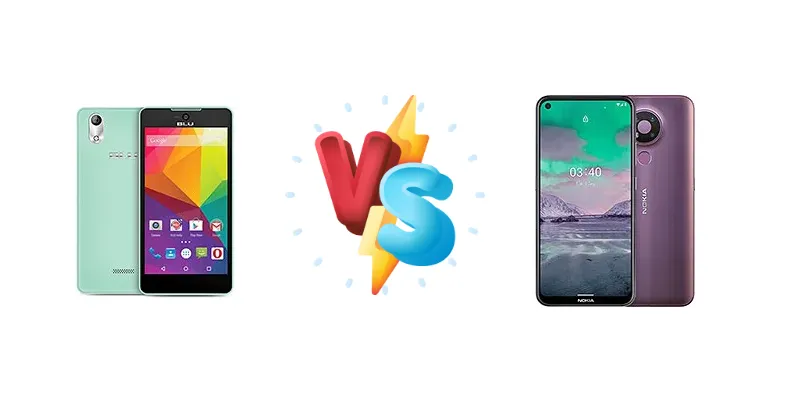
Both the BLU Studio C 5 + 5 LTE and the Nokia 3.4 target the ultra-budget smartphone market, but they represent different approaches. The BLU relies on an older, more basic chipset, while the Nokia opts for a newer generation Snapdragon, promising a more fluid user experience. This comparison dissects the key differences to help you choose the right device for your needs.
🏆 Quick Verdict
For the average user, the Nokia 3.4 is the superior choice. Its Snapdragon 460 chipset, with its octa-core CPU, provides a significantly faster and more responsive experience than the BLU Studio C 5 + 5 LTE’s aging Snapdragon 210. While the BLU may be cheaper, the Nokia’s performance boost justifies the price difference.
| Network |
|---|
| 2G bands | GSM 850 / 900 / 1800 / 1900 - SIM 1 & SIM 2 | GSM 850 / 900 / 1800 / 1900 |
| 3G bands | HSDPA 850 / 1700(AWS) / 1900 / 2100 | HSDPA 850 / 900 / 1700(AWS) / 1900 / 2100 |
| 4G bands | 2, 4, 7, 17 | 1, 2, 3, 4, 5, 7, 8, 12, 17, 13, 28, 66 |
| Speed | HSPA 21.1/5.76 Mbps, LTE Cat4 150/50 Mbps | HSPA, LTE |
| Technology | GSM / HSPA / LTE | GSM / HSPA / LTE |
| Launch |
|---|
| Announced | 2015, July. Released 2015, August | 2020, September 22. Released 2020, October 26 |
| Status | Discontinued | Discontinued |
| Body |
|---|
| Dimensions | 143 x 71.8 x 9 mm (5.63 x 2.83 x 0.35 in) | 161 x 76 x 8.7 mm (6.34 x 2.99 x 0.34 in) |
| SIM | Dual SIM (Mini-SIM/ Micro-SIM, dual stand-by) | · Nano-SIM· Nano-SIM + Nano-SIM |
| Weight | 157 g (5.54 oz) | 180 g (6.35 oz) |
| Display |
|---|
| Resolution | 480 x 854 pixels, 16:9 ratio (~196 ppi density) | 720 x 1560 pixels, 19.5:9 ratio (~269 ppi density) |
| Size | 5.0 inches, 68.9 cm2 (~67.1% screen-to-body ratio) | 6.39 inches, 100.2 cm2 (~81.9% screen-to-body ratio) |
| Type | IPS LCD | IPS LCD, 400 nits (typ) |
| Platform |
|---|
| CPU | Quad-core 1.1 GHz Cortex-A7 | Octa-core (4x1.8 GHz Cortex-A73 & 4x1.8 GHz Cortex-A53) |
| Chipset | Qualcomm MSM8909 Snapdragon 210 (28 nm) | Qualcomm SM4250 Snapdragon 460 (11 nm) |
| GPU | Adreno 304 | Adreno 610 |
| OS | Android 5.0 (Lollipop) | Android 10, upgradable to Android 11 |
| Memory |
|---|
| Card slot | microSDXC | microSDXC (dedicated slot) |
| Internal | 8GB 1GB RAM | 32GB 3GB RAM, 64GB 3GB RAM, 64GB 4GB RAM |
| | - | eMMC 5.1 |
| Main Camera |
|---|
| Features | LED flash | LED flash, HDR, panorama |
| Single | 5 MP, AF | - |
| Triple | - | 13 MP, (wide), PDAF
5 MP, (ultrawide)
Auxiliary lens |
| Video | 720p@30fps | 1080p@30fps |
| Selfie camera |
|---|
| Single | 5 MP | 8 MP, (wide) |
| Video | - | 1080p@30fps |
| Sound |
|---|
| 3.5mm jack | - | Yes |
| 35mm jack | Yes | Yes |
| Loudspeaker | Yes | Yes |
| Comms |
|---|
| Bluetooth | 4.0, A2DP | 4.2, A2DP, aptX |
| NFC | No | Yes (market/region dependent) |
| Positioning | GPS | GPS, GLONASS, GALILEO, BDS |
| Radio | Stereo FM radio | FM radio |
| USB | microUSB 2.0 | USB Type-C 2.0 |
| WLAN | Wi-Fi 802.11 b/g/n, Wi-Fi Direct, hotspot | Wi-Fi 802.11 b/g/n |
| Features |
|---|
| Sensors | Accelerometer, proximity, gravity | Fingerprint (rear-mounted), accelerometer, gyro, proximity |
| Battery |
|---|
| Charging | - | 10W wired |
| Stand-by | Up to 800 h (2G) / Up to 700 h (3G) | - |
| Talk time | Up to 22 h (2G) / Up to 12 h (3G) | - |
| Type | Li-Po 2000 mAh, removable | Li-Po 4000 mAh |
| Misc |
|---|
| Colors | Black, White, Gold | Fjord, Dusk, Charcoal |
| Models | - | TA-1288, TA-1285, TA-1283 |
| Price | - | About 100 EUR |
| SAR | - | 0.83 W/kg (head) 1.05 W/kg (body) |
| SAR EU | - | 0.36 W/kg (head) 1.56 W/kg (body) |
BLU Studio C 5 + 5 LTE
- Potentially lower price point
- May be more readily available in certain markets
- Simple and straightforward user experience
- Significantly slower performance
- Limited multitasking capabilities
- Outdated chipset architecture
- Likely slower software updates
Nokia 3.4
- Much faster and more responsive performance
- More efficient chipset
- Better multitasking capabilities
- Likely to receive more software updates
- 10W charging support
- Slightly higher price point
- May not be available in all regions
Display Comparison
Neither device boasts a standout display. Given the context data, we can assume both likely utilize LCD panels. The key difference lies in the processing power driving them. The Nokia 3.4’s Snapdragon 460 will handle UI animations and scrolling more smoothly, even if the resolution and panel quality are similar. The BLU Studio C 5 + 5 LTE, with its limited GPU, will struggle with even basic graphical tasks, impacting the perceived visual experience.
Camera Comparison
Without detailed camera specifications, it’s difficult to make a definitive judgment. However, the processing power of the Snapdragon 460 in the Nokia 3.4 will likely result in better image processing, even with similar sensor hardware. The BLU Studio C 5 + 5 LTE’s limited processing capabilities will hinder its ability to effectively reduce noise, enhance detail, and perform computational photography tasks. We can assume both devices will feature basic camera setups, and image quality will be heavily reliant on software optimization, where the Nokia has a clear advantage.
Performance
The performance gap is the defining characteristic of this comparison. The BLU Studio C 5 + 5 LTE’s Qualcomm MSM8909 Snapdragon 210, featuring a quad-core 1.1 GHz Cortex-A7 CPU, is a significantly older and less capable chipset. In contrast, the Nokia 3.4’s Qualcomm SM4250 Snapdragon 460 boasts an octa-core configuration (4x1.8 GHz Cortex-A73 & 4x1.8 GHz Cortex-A53). The Cortex-A73 cores in the Nokia 3.4 represent a substantial architectural improvement over the Cortex-A7 in the BLU, offering significantly higher single-core performance. This translates to faster app launch times, smoother multitasking, and a more responsive overall experience. The 11nm manufacturing process of the Snapdragon 460 also contributes to better power efficiency compared to the 28nm process of the Snapdragon 210.
Battery Life
The Nokia 3.4 includes 10W wired charging, a feature likely absent or slower on the BLU Studio C 5 + 5 LTE. While battery capacity isn’t specified, the Snapdragon 460’s 11nm process offers better power efficiency. This means the Nokia 3.4 will likely achieve comparable or better battery life despite potentially having a similar or even smaller battery capacity than the BLU. The 10W charging, while not fast, will provide a more predictable and reliable charging experience.
Buying Guide
Buy the BLU Studio C 5 + 5 LTE if your primary need is a very basic, affordable phone for calls, texts, and extremely light app usage, and you are comfortable with a potentially sluggish experience. Buy the Nokia 3.4 if you prioritize a smoother, more responsive user experience, occasional multitasking, and a phone that will feel more future-proof, even with limited app usage.
Frequently Asked Questions
❓ Will the BLU Studio C 5 + 5 LTE struggle with popular apps like WhatsApp or Facebook?
Yes, the Snapdragon 210 is a very basic chipset. While it can run these apps, you'll likely experience noticeable lag, slow loading times, and potential crashes, especially when multitasking. The Nokia 3.4’s Snapdragon 460 will handle these apps with significantly more ease.
❓ Is the Nokia 3.4 a good option for light gaming?
The Nokia 3.4 is a better choice for light gaming than the BLU Studio C 5 + 5 LTE. While it won't handle demanding titles, the Snapdragon 460’s GPU is capable of running less intensive games at playable frame rates. The Snapdragon 210 will struggle even with basic games.
❓ Does the Nokia 3.4 support software updates for security patches?
Nokia has a good track record of providing software updates, including security patches, for its smartphones. While the Nokia 3.4 is an entry-level device, it's more likely to receive regular updates than the BLU Studio C 5 + 5 LTE, which often lacks long-term software support.