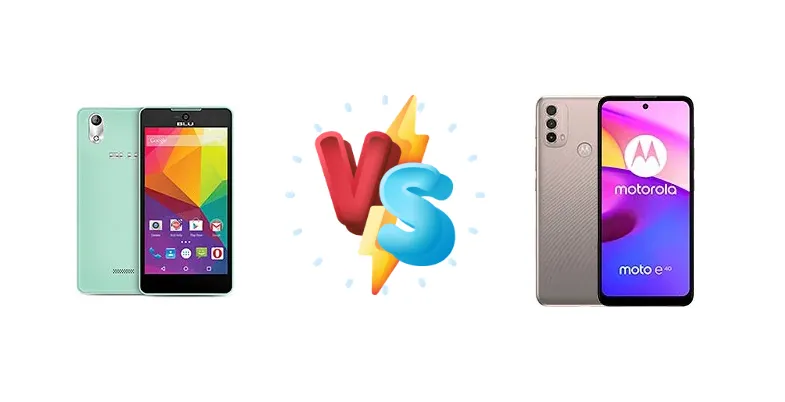
The sub-$150 smartphone market is fiercely competitive. The BLU Studio C 5 + 5 LTE represents an ultra-budget option relying on a tried-and-true, if aging, Qualcomm platform. The Motorola Moto E40, however, attempts to disrupt this space with a newer Unisoc chipset, promising improved performance. This comparison dissects the key differences to determine which device delivers the best value.
🏆 Quick Verdict
For the average user prioritizing responsiveness and multitasking, the Motorola Moto E40 is the clear winner. Its octa-core Unisoc T700 processor significantly outperforms the quad-core Snapdragon 210 in the BLU Studio C 5 + 5 LTE. While the BLU offers a potentially simpler software experience, the performance gap is too large to ignore.
| Network |
|---|
| 2G bands | GSM 850 / 900 / 1800 / 1900 - SIM 1 & SIM 2 | GSM 850 / 900 / 1800 / 1900 |
| 3G bands | HSDPA 850 / 1700(AWS) / 1900 / 2100 | HSDPA 850 / 900 / 1700(AWS) / 1900 / 2100 |
| 4G bands | 2, 4, 7, 17 | 1, 2, 3, 4, 5, 7, 8, 19, 28, 40, 66 - Brazil |
| Speed | HSPA 21.1/5.76 Mbps, LTE Cat4 150/50 Mbps | HSPA 42.2/5.76 Mbps, LTE Cat4 150/50 Mbps |
| Technology | GSM / HSPA / LTE | GSM / HSPA / LTE |
| Launch |
|---|
| Announced | 2015, July. Released 2015, August | 2021, October 07 |
| Status | Discontinued | Available. Released 2021, October 11 |
| Body |
|---|
| Build | - | Glass front, plastic frame, plastic back |
| Dimensions | 143 x 71.8 x 9 mm (5.63 x 2.83 x 0.35 in) | 165.1 x 75.7 x 9.1 mm (6.5 x 2.98 x 0.36 in) |
| SIM | Dual SIM (Mini-SIM/ Micro-SIM, dual stand-by) | · Nano-SIM· Nano-SIM + Nano-SIM |
| Weight | 157 g (5.54 oz) | 198 g (6.98 oz) |
| Display |
|---|
| Resolution | 480 x 854 pixels, 16:9 ratio (~196 ppi density) | 720 x 1600 pixels, 20:9 ratio (~270 ppi density) |
| Size | 5.0 inches, 68.9 cm2 (~67.1% screen-to-body ratio) | 6.5 inches, 102.0 cm2 (~81.6% screen-to-body ratio) |
| Type | IPS LCD | IPS LCD, 90Hz |
| Platform |
|---|
| CPU | Quad-core 1.1 GHz Cortex-A7 | Octa-core 1.8 GHz |
| Chipset | Qualcomm MSM8909 Snapdragon 210 (28 nm) | Unisoc T700 |
| GPU | Adreno 304 | Mali G52 |
| OS | Android 5.0 (Lollipop) | Android 11 |
| Memory |
|---|
| Card slot | microSDXC | microSDXC (dedicated slot) |
| Internal | 8GB 1GB RAM | 64GB 4GB RAM |
| | - | eMMC 5.1 |
| Main Camera |
|---|
| Features | LED flash | LED flash, HDR, panorama |
| Single | 5 MP, AF | - |
| Triple | - | 48 MP, f/2.0, 26mm (wide), PDAF
2 MP (macro)
Auxiliary lens |
| Video | 720p@30fps | 1080p@30fps |
| Selfie camera |
|---|
| Features | - | HDR |
| Single | 5 MP | 8 MP, f/2.0 |
| Video | - | 1080p@30fps |
| Sound |
|---|
| 3.5mm jack | - | Yes |
| 35mm jack | Yes | Yes |
| Loudspeaker | Yes | Yes |
| Comms |
|---|
| Bluetooth | 4.0, A2DP | 5.0, A2DP, LE |
| NFC | No | No |
| Positioning | GPS | GPS, GLONASS, GALILEO |
| Radio | Stereo FM radio | FM radio |
| USB | microUSB 2.0 | USB Type-C 2.0 |
| WLAN | Wi-Fi 802.11 b/g/n, Wi-Fi Direct, hotspot | Wi-Fi 802.11 b/g/n |
| Features |
|---|
| Sensors | Accelerometer, proximity, gravity | Fingerprint (rear-mounted), accelerometer, proximity |
| Battery |
|---|
| Charging | - | 10W wired |
| Stand-by | Up to 800 h (2G) / Up to 700 h (3G) | - |
| Talk time | Up to 22 h (2G) / Up to 12 h (3G) | - |
| Type | Li-Po 2000 mAh, removable | Li-Po 5000 mAh |
| Misc |
|---|
| Colors | Black, White, Gold | Carbon Gray, Pink Clay |
| Price | - | About 90 EUR |
BLU Studio C 5 + 5 LTE
- Potentially lower price point
- Simpler software experience (likely)
- More power-efficient chipset
- Significantly slower performance
- Outdated chipset architecture
- Limited multitasking capabilities
Motorola Moto E40
- Faster octa-core processor
- Improved multitasking and app performance
- 10W wired charging
- Potentially shorter battery life due to processor demands
- May be slightly more expensive
- Unisoc chipset may have less software support
Display Comparison
Neither device boasts a standout display. Given the context data, we can assume both utilize LCD panels, common in this price bracket. The key difference lies in processing power, not display fidelity. Expect similar resolutions and viewing angles. Bezels are likely substantial on both, maximizing screen real estate within a budget-friendly form factor. Color accuracy will likely be standard for the price point, leaning towards warmer tones.
Camera Comparison
Without detailed camera specifications, a direct comparison is difficult. However, given the price points, both devices likely feature basic camera setups. We can assume the Moto E40, being a slightly newer device, may benefit from improved image processing algorithms. The BLU Studio C 5 + 5 LTE likely relies on older, less sophisticated software. Sensor size is critical, but without data, we can only speculate. The presence of a 2MP macro lens on either device is largely marketing fluff and unlikely to deliver significant image quality improvements.
Performance
The Motorola Moto E40’s Unisoc T700 is the defining advantage here. Its octa-core configuration running at 1.8 GHz provides a substantial leap in processing power compared to the BLU’s quad-core 1.1 GHz Snapdragon 210. The Snapdragon 210, built on a 28nm process, is known for its efficiency but limited performance. The Unisoc T700, while not a powerhouse, offers a much smoother experience for multitasking and running modern apps. The older architecture of the Snapdragon 210 will struggle with demanding applications, leading to noticeable lag. The Moto E40’s performance will be noticeably quicker in everyday tasks.
Battery Life
Battery capacity is not specified for either device. However, the Moto E40’s 10W wired charging is a notable feature, suggesting a focus on usability. The Snapdragon 210 in the BLU Studio C 5 + 5 LTE is more power-efficient, potentially offsetting a smaller battery capacity. However, the increased processing demands of the Moto E40’s Unisoc T700 will likely negate any efficiency gains. Expect similar all-day battery life with moderate usage on both devices, but the Moto E40’s charging capability provides a convenience advantage.
Buying Guide
Buy the BLU Studio C 5 + 5 LTE if you absolutely need the lowest possible price point and prioritize simplicity over performance. It's suitable for basic communication – calls, texts, and light app usage. Buy the Motorola Moto E40 if you want a phone capable of handling more demanding tasks like social media browsing, streaming video, and occasional gaming, even if it means spending a little more.
Frequently Asked Questions
❓ Will the Motorola Moto E40 struggle with popular apps like Facebook or WhatsApp?
While not a flagship, the Unisoc T700 in the Moto E40 is capable of running apps like Facebook and WhatsApp smoothly. You may experience some slowdown with multiple apps open simultaneously, but it's a significant improvement over the Snapdragon 210 in the BLU Studio C 5 + 5 LTE.
❓ Is the BLU Studio C 5 + 5 LTE a good choice for someone who primarily makes calls and sends texts?
Yes, the BLU Studio C 5 + 5 LTE is perfectly adequate for basic communication. Its power-efficient Snapdragon 210 chipset will provide good battery life for calls and texts, and the simpler software experience may appeal to users who prefer a straightforward device.
❓ Can the Motorola Moto E40 handle light gaming?
The Moto E40 can handle some light gaming, but don't expect high frame rates or demanding graphics settings. Games like Candy Crush or simple puzzle games will run fine, but more intensive titles may experience lag or require reduced settings.