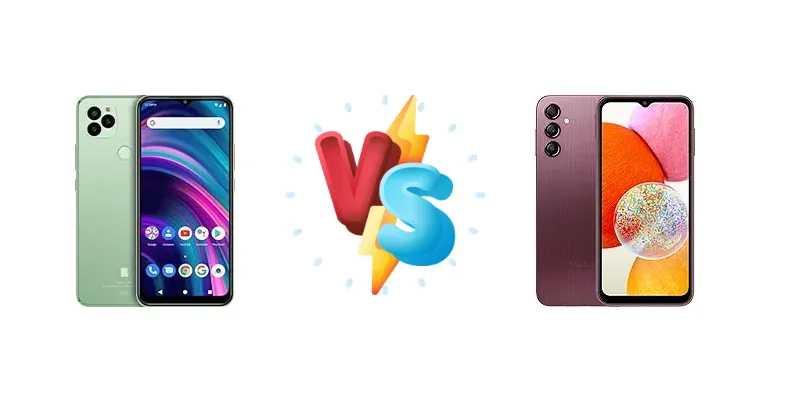
The BLU S91 and Samsung Galaxy A14 represent two approaches to the ultra-budget smartphone market. The BLU S91 aims for affordability above all else, while the Samsung Galaxy A14 attempts to balance cost with Samsung’s brand recognition and a more versatile chipset offering. This comparison dissects their key differences to determine which device delivers the best value.
🏆 Quick Verdict
For most users, the Samsung Galaxy A14 is the better choice. Its Mediatek Helio G80 chipset (or Exynos 850 variant) provides a noticeable performance uplift over the BLU S91’s Helio G25, translating to smoother multitasking and a more responsive user experience. While the BLU S91 is cheaper, the A14’s added processing power justifies the price difference.
| Network |
|---|
| 2G bands | GSM 850 / 900 / 1800 / 1900 | GSM 850 / 900 / 1800 / 1900 |
| 3G bands | HSDPA 850 / 900 / 1700 / 1900 / 2100 | HSDPA 850 / 900 / 2100 |
| 4G bands | 1, 2, 3, 4, 5, 7, 12, 13, 17, 28, 66 | 1, 3, 5, 7, 8, 20, 28, 38, 40, 41 |
| Speed | HSPA, LTE | HSPA, LTE |
| Technology | GSM / HSPA / LTE | GSM / HSPA / LTE |
| Launch |
|---|
| Announced | 2022, June 24 | 2023, February 28 |
| Status | Available. Released 2022, June 24 | Available. Released 2023, March 27 |
| Body |
|---|
| Build | - | Glass front, plastic back, plastic frame |
| Dimensions | 164.8 x 76.3 x 8.9 mm (6.49 x 3.00 x 0.35 in) | 167.7 x 78 x 9.1 mm (6.60 x 3.07 x 0.36 in) |
| SIM | Nano-SIM + Nano-SIM | · Nano-SIM· Nano-SIM + Nano-SIM |
| Weight | 202 g (7.13 oz) | 201 g (7.09 oz) |
| Display |
|---|
| Resolution | 720 x 1600 pixels, 20:9 ratio (~270 ppi density) | 1080 x 2408 pixels, 20:9 ratio (~400 ppi density) |
| Size | 6.5 inches, 102.0 cm2 (~81.1% screen-to-body ratio) | 6.6 inches, 104.9 cm2 (~80.2% screen-to-body ratio) |
| Type | IPS LCD | PLS LCD |
| Platform |
|---|
| CPU | Octa-core (4x2.0 GHz Cortex-A53 & 4x1.5 GHz Cortex-A53) | Octa-core (2x2.0 GHz Cortex-A75 & 6x1.8 GHz Cortex-A55) - Version AOcta-core (4x2.0 GHz Cortex-A55 & 4x2.0 GHz Cortex-A55) - Version B |
| Chipset | Mediatek MT6762G Helio G25 (12 nm) | Mediatek MT6769 Helio G80 (12 nm) - Version AExynos 850 (8 nm) - Version B |
| GPU | PowerVR GE8320 | Mali-G52 MC2 |
| OS | Android 11 | Android 13, upgradable to Android 15, One UI 7 |
| Memory |
|---|
| Card slot | microSDXC | microSDXC (dedicated slot) |
| Internal | 128GB 4GB RAM | 64GB 4GB RAM, 128GB 4GB RAM, 128GB 6GB RAM |
| Main Camera |
|---|
| Features | LED flash, HDR, panorama | LED flash, panorama, HDR |
| Single | 13 MP | 13 MP, f/2.0, (wide) |
| Triple | 13 MP, (wide), PDAF
0.3 MP (macro)
Auxiliary lens | 50 MP, f/1.8, 26mm (wide), 1/2.75", 0.64µm, PDAF
5 MP, f/2.2, 17mm (ultrawide), 1/5.0", 1.12µm
2 MP (macro) |
| Video | 1080p@30fps | 1080p@30fps |
| Selfie camera |
|---|
| Single | 13 MP | 13 MP, f/2.0, 26mm (wide), 1/3.1", 1.12µm |
| Video | 1080p@30fps | 1080p@30fps |
| Sound |
|---|
| 3.5mm jack | Yes | Yes |
| 35mm jack | Yes | Yes |
| Loudspeaker | Yes | Yes |
| Comms |
|---|
| Bluetooth | 5.0, A2DP, LE | 5.1 or 5.3, A2DP, LE |
| NFC | No | Yes (market/region dependent) |
| Positioning | GPS | GPS, GALILEO, GLONASS, BDS, QZSS |
| Radio | FM radio | Unspecified |
| USB | USB Type-C 2.0, OTG | USB Type-C 2.0 |
| WLAN | Wi-Fi 802.11 a/b/g/n, Wi-Fi Direct | Wi-Fi 802.11 a/b/g/n/ac, dual-band, Wi-Fi Direct |
| Features |
|---|
| Sensors | Fingerprint (rear-mounted), accelerometer, gyro, proximity, compass | Fingerprint (side-mounted), accelerometer, proximity, compass |
| Battery |
|---|
| Charging | - | 15W wired |
| Type | Li-Po 5000 mAh | Li-Po 5000 mAh |
| Misc |
|---|
| Colors | Black, Green | Black, Dark Red, Silver, Green |
| Models | - | SM-A145F, SM-A145F/DSN, SM-A145M, SM-A145M/DS, SM-A145P, SM-A145R |
| Price | About 170 EUR | € 85.76 / $ 147.60 / £ 79.95 |
| SAR EU | - | 0.46 W/kg (head) 1.37 W/kg (body) |
BLU S91
- Lower price point makes it accessible to budget-conscious buyers.
- Functional for basic smartphone tasks.
- Potentially longer battery life due to less powerful processor (depending on battery capacity).
- Significantly weaker performance compared to the Galaxy A14.
- Likely to struggle with multitasking and demanding apps.
- Camera quality is expected to be basic.
Samsung Galaxy A14
- Noticeably faster performance thanks to the Helio G80 or Exynos 850 chipset.
- Smoother multitasking and app responsiveness.
- Samsung’s brand reputation and software support.
- Higher price compared to the BLU S91.
- 15W charging is relatively slow.
- Camera performance, while potentially better, is still limited by the budget segment.
Display Comparison
Neither device boasts a standout display. Both utilize 12nm chipsets, suggesting a focus on cost reduction over premium display features. Specifics like panel type (IPS vs. TFT) and resolution are missing, but both are likely 720p+ displays. The Galaxy A14 benefits from Samsung’s display tuning, potentially offering slightly better color accuracy and viewing angles. Bezels are expected to be substantial on both devices, typical for this price bracket.
Camera Comparison
Camera performance is likely to be similar in real-world usage, given the focus on affordability. Both devices likely feature a primary camera around 13MP, but sensor size and lens aperture are unknown. The Galaxy A14’s image processing, leveraging Samsung’s software, may yield slightly more pleasing results. The presence of a 2MP macro camera on both devices is largely a marketing gimmick, offering limited practical benefit due to the low resolution and lack of optical image stabilization (OIS).
Performance
The performance gap is the most significant differentiator. The Samsung Galaxy A14, in its Helio G80 configuration, features a more modern CPU architecture with 2x Cortex-A75 cores alongside 6x Cortex-A55 cores, compared to the BLU S91’s 4x Cortex-A53 and 4x Cortex-A53 setup. The A75 cores provide a substantial boost in single-core performance, crucial for app launch speeds and general responsiveness. The Exynos 850 variant of the A14, built on an 8nm process, further enhances efficiency and sustained performance. The Helio G25 in the BLU S91 is adequate for basic tasks but will struggle with demanding applications or multitasking.
Battery Life
Battery capacity is not specified for the BLU S91, but given its focus on affordability, it’s likely comparable to the Galaxy A14’s. The Galaxy A14 supports 15W wired charging, which is relatively slow by today’s standards, but adequate for overnight charging. The efficiency gains of the Helio G80 (or Exynos 850) in the A14 may translate to slightly longer battery life despite similar capacity, due to lower power consumption during typical usage.
Buying Guide
Buy the BLU S91 if your primary need is a functional smartphone for basic tasks like calls, texts, and light social media, and you are operating on an extremely tight budget. Buy the Samsung Galaxy A14 if you prioritize a smoother user experience, occasional gaming, and the reliability of the Samsung ecosystem, even if it means spending a bit more.
Frequently Asked Questions
❓ Does the Exynos 850 chip in some Galaxy A14 models overheat during prolonged gaming sessions?
The Exynos 850, built on an 8nm process, is generally efficient and less prone to overheating than older or less refined chipsets. While it won't deliver flagship-level gaming performance, it should handle moderate gaming sessions without significant throttling. However, sustained, high-graphics gaming will likely lead to some heat buildup.
❓ Is the 2MP macro camera on either phone actually useful for taking detailed close-up photos?
Unfortunately, the 2MP macro cameras on both the BLU S91 and Samsung Galaxy A14 are largely marketing features. The low resolution and lack of autofocus result in images that are often soft, noisy, and lack detail. They are best avoided in favor of the main camera.
❓ Can the Samsung Galaxy A14 run PUBG Mobile at 60fps?
The Samsung Galaxy A14 with the Helio G80 chipset can likely run PUBG Mobile at balanced graphics settings and medium frame rates (around 40-50fps). Achieving a consistent 60fps may require lowering the graphics settings significantly, and performance will vary depending on the specific game mode and number of players.
❓ What kind of software updates can I expect on the BLU S91?
BLU devices historically have limited software update support. While the S91 will likely ship with a recent version of Android, don't expect frequent security patches or major Android version upgrades. Samsung, on the other hand, typically provides more consistent software support for its A-series devices.