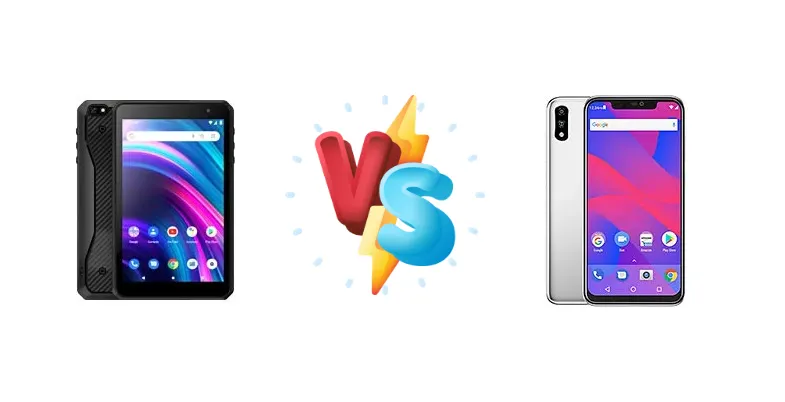
BLU consistently targets the ultra-budget smartphone market, but even within that segment, choices exist. The M8L represents a basic, cost-optimized option, while the Vivo XI+ attempts to elevate the experience with a more powerful chipset and the convenience of wireless charging. This comparison dissects the key differences to help you determine which BLU phone best suits your needs.
🏆 Quick Verdict
For most users, the BLU Vivo XI+ is the superior choice. Its Mediatek Helio P60 chipset, featuring Cortex-A73 cores, delivers significantly better performance than the M8L’s Cortex-A55 processor. The addition of Qi wireless charging further sweetens the deal, making it a more versatile and future-proof option despite a likely higher price.
| Network |
|---|
| 2G bands | GSM 850 / 900 / 1800 / 1900 | GSM 850 / 900 / 1800 / 1900 |
| 3G bands | HSDPA 850 / 900 / 1700 / 1900 / 2100 | HSDPA 850 / 900 / 1700(AWS) / 1900 / 2100 |
| 4G bands | 2, 3, 4, 5, 7, 12, 17, 28, 66 | 1, 2, 3, 4, 5, 7, 8, 12, 13, 17, 28, 66 |
| Speed | HSPA, LTE | HSPA 42.2/11.5 Mbps, LTE (2CA) Cat6 300/50 Mbps |
| Technology | GSM / HSPA / LTE | GSM / HSPA / LTE |
| Launch |
|---|
| Announced | 2020, August. Released 2020, August | 2018, August. Released 2018, August |
| Status | Discontinued | Discontinued |
| Body |
|---|
| Dimensions | 208 x 125 x 9 mm (8.19 x 4.92 x 0.35 in) | 155 x 75.5 x 7.8 mm (6.10 x 2.97 x 0.31 in) |
| SIM | Nano-SIM + Nano-SIM | Nano-SIM + Micro-SIM |
| Weight | 352 g (12.42 oz) | 199 g (7.02 oz) |
| Display |
|---|
| Protection | - | Corning Gorilla Glass 3 |
| Resolution | 800 x 1280 pixels, 16:10 ratio (~189 ppi density) | 1080 x 2246 pixels, 18.7:9 ratio (~402 ppi density) |
| Size | 8.0 inches, 185.6 cm2 (~71.4% screen-to-body ratio) | 6.2 inches, 96.9 cm2 (~82.8% screen-to-body ratio) |
| Type | IPS LCD | IPS LCD |
| Platform |
|---|
| CPU | Octa-core 1.6 GHz Cortex-A55 | Octa-core (4x2.0 GHz Cortex-A73 & 4x2.0 GHz Cortex-A53) |
| Chipset | - | Mediatek MT6771 Helio P60 (12 nm) |
| GPU | - | Mali-G72 MP3 |
| OS | Android 11 (Go edition) | Android 8.1 (Oreo), upgradable to Android 9.0 (Pie) |
| Memory |
|---|
| Card slot | microSDXC | microSDXC |
| Internal | 32GB 1GB RAM | 64GB 4GB RAM, 128GB 6GB RAM |
| | eMMC 5.1 | eMMC 5.1 |
| Main Camera |
|---|
| Dual | - | 16 MP, f/2.0, 1/3.0", 1.10µm, PDAF
Auxiliary lens |
| Features | LED flash | LED flash, HDR |
| Single | 8 MP | - |
| Video | 1080p@30fps | 1080p@30fps |
| Selfie camera |
|---|
| Features | - | LED flash |
| Single | 5 MP | 16 MP, f/2.2, 26mm (wide), 1/3.06", 1.0µm |
| Video | 720p@30fps | 720p@30fps |
| Sound |
|---|
| 3.5mm jack | Yes | No |
| 35mm jack | Yes | No |
| Loudspeaker | Yes | Yes |
| Comms |
|---|
| Bluetooth | 4.1, A2DP, LE | 4.1, A2DP, LE |
| NFC | No | No |
| Positioning | GPS | GPS |
| Radio | FM radio | FM radio |
| USB | USB Type-C 2.0 | USB Type-C 2.0 |
| WLAN | Wi-Fi 802.11 b/g/n, Wi-Fi Direct | Wi-Fi 802.11 a/b/g/n, Wi-Fi Direct |
| Features |
|---|
| Sensors | Accelerometer | Iris scanner, fingerprint (rear-mounted), accelerometer, gyro, proximity, compass |
| Battery |
|---|
| Charging | - | Wireless (Qi) |
| Stand-by | - | Up to 625 h (3G) |
| Talk time | - | Up to 21 h (3G) |
| Type | Li-Po 4000 mAh | Li-Po 3050 mAh, non-removable |
| Misc |
|---|
| Colors | Black | Black, Silver |
| Models | - | XI |
| Price | About 60 EUR | About 290 EUR |
BLU M8L
- Lowest possible price point
- Functional for basic tasks
- Potentially longer battery life due to less powerful processor (depending on battery capacity)
- Significantly slower performance
- Limited multitasking capabilities
- Likely lower resolution display
BLU Vivo XI+
- Much faster performance with Cortex-A73 cores
- Qi wireless charging support
- Potentially better camera image processing
- Higher price than the BLU M8L
- Battery life may be slightly shorter due to more powerful processor
- Still a budget device with inherent limitations
Display Comparison
Neither BLU provides detailed display specifications. However, given their price points, both likely utilize IPS LCD panels. The Vivo XI+’s chipset suggests a potentially higher resolution display to take advantage of the GPU. The M8L, with its less powerful processor, likely targets a 720p resolution to maintain acceptable performance. Bezels are expected to be substantial on both devices, reflecting their budget nature. Color accuracy is unlikely to be a strong point on either model, and neither is expected to feature high refresh rates.
Camera Comparison
Detailed camera specifications are lacking for both devices. However, it’s safe to assume both will feature a primary camera and potentially a secondary depth sensor. The Vivo XI+’s more powerful chipset allows for more sophisticated image processing, potentially resulting in better dynamic range and noise reduction. The M8L’s limited processing power will likely result in simpler image processing algorithms. The presence of a more capable GPU in the Vivo XI+ could also enable features like HDR video recording, which are unlikely to be available on the M8L. Avoid expectations of exceptional low-light performance from either device.
Performance
The performance gap is the most significant differentiator. The BLU M8L’s Octa-core 1.6 GHz Cortex-A55 CPU is designed for efficiency, not speed. In contrast, the BLU Vivo XI+ boasts the Mediatek MT6771 Helio P60, featuring a combination of 4x2.0 GHz Cortex-A73 and 4x2.0 GHz Cortex-A53 cores. The Cortex-A73 cores represent a substantial architectural improvement over the A55, offering significantly faster single-core and multi-core performance. This translates to snappier app launches, smoother multitasking, and a more enjoyable overall user experience. The Helio P60’s 12nm process node also contributes to better power efficiency compared to a potentially larger node used in the M8L’s processor. Users who play mobile games or frequently switch between apps will greatly benefit from the Vivo XI+’s superior processing power.
Battery Life
Battery capacity is not specified for either device. However, given the M8L’s focus on cost reduction, it likely features a smaller battery. The Vivo XI+’s Helio P60, while more powerful, is also relatively efficient. The key advantage of the Vivo XI+ is its support for Qi wireless charging. This provides a convenient alternative to traditional wired charging and adds a layer of future-proofing. While wired charging wattage is unknown for both, the Vivo XI+’s wireless charging capability suggests it may also support faster wired charging speeds.
Buying Guide
Buy the BLU M8L if you prioritize absolute affordability and only need a phone for basic tasks like calls, texts, and light social media. It’s a functional device for those on the tightest of budgets. Buy the BLU Vivo XI+ if you value smoother multitasking, occasional gaming, and the convenience of wireless charging. The performance uplift and added features justify the likely price premium for users who demand more from their smartphone.
Frequently Asked Questions
❓ Is the Mediatek Helio P60 in the BLU Vivo XI+ capable of running demanding games like PUBG Mobile?
The Helio P60 is capable of running PUBG Mobile, but likely at medium settings to maintain a stable frame rate. Don't expect the same performance as flagship devices; some stuttering may occur during intense firefights. The M8L would struggle significantly with PUBG Mobile.
❓ Does the BLU Vivo XI+ support fast wired charging, and how long does it take to fully charge?
While the exact wired charging wattage isn't specified, the inclusion of Qi wireless charging suggests the Vivo XI+ likely supports a faster wired charging standard than the M8L. A full charge via wired connection is estimated to take between 2-3 hours, while wireless charging will take considerably longer (4-6 hours).
❓ How much RAM does the BLU Vivo XI+ have, and is it sufficient for multitasking?
RAM specifications are not provided. However, given the chipset, it likely has 3GB or 4GB of RAM. 4GB would be preferable for smoother multitasking, allowing you to switch between apps without significant slowdown. The M8L likely has 2GB or 3GB, which will limit multitasking capabilities.