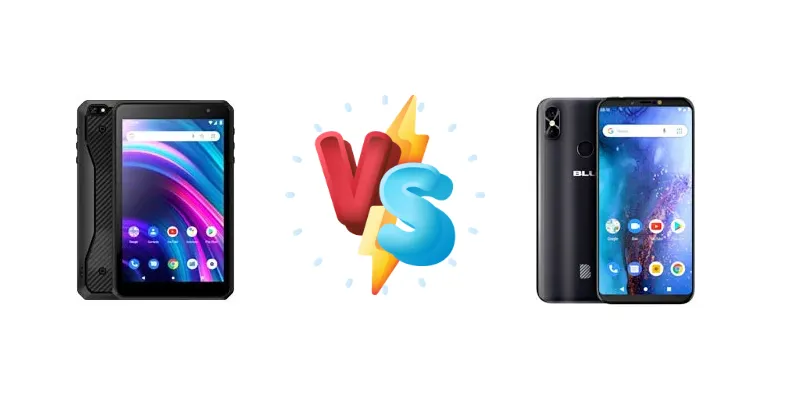
The BLU M8L and BLU Vivo Go represent the ultra-budget end of the smartphone spectrum. Both aim to deliver essential smartphone functionality at the lowest possible price point, but they achieve this with significantly different internal hardware. This comparison dissects those differences to help you determine which device best suits your needs.
🏆 Quick Verdict
For most users, the BLU M8L offers a more modern and capable experience. Its octa-core Cortex-A55 CPU provides a noticeable performance advantage over the Vivo Go’s quad-core Cortex-A53, making it better suited for multitasking and app responsiveness. While both are entry-level, the M8L represents a step forward.
| Network |
|---|
| 2G bands | GSM 850 / 900 / 1800 / 1900 | GSM 850 / 900 / 1800 / 1900 |
| 3G bands | HSDPA 850 / 900 / 1700 / 1900 / 2100 | HSDPA 850 / 900 / 1700(AWS) / 1900 / 2100 |
| 4G bands | 2, 3, 4, 5, 7, 12, 17, 28, 66 | 1, 2, 3, 4, 7, 12, 17, 28 |
| Speed | HSPA, LTE | HSPA 42.2/11.5 Mbps, LTE Cat4 150/50 Mbps |
| Technology | GSM / HSPA / LTE | GSM / HSPA / LTE |
| Launch |
|---|
| Announced | 2020, August. Released 2020, August | 2018, December. Released 2018, December |
| Status | Discontinued | Discontinued |
| Body |
|---|
| Dimensions | 208 x 125 x 9 mm (8.19 x 4.92 x 0.35 in) | 156.7 x 75.2 x 8.4 mm (6.17 x 2.96 x 0.33 in) |
| SIM | Nano-SIM + Nano-SIM | Nano-SIM + Nano-SIM |
| Weight | 352 g (12.42 oz) | 155 g (5.47 oz) |
| Display |
|---|
| Resolution | 800 x 1280 pixels, 16:10 ratio (~189 ppi density) | 720 x 1440 pixels, 18:9 ratio (~268 ppi density) |
| Size | 8.0 inches, 185.6 cm2 (~71.4% screen-to-body ratio) | 6.0 inches, 92.9 cm2 (~78.8% screen-to-body ratio) |
| Type | IPS LCD | IPS LCD |
| Platform |
|---|
| CPU | Octa-core 1.6 GHz Cortex-A55 | Quad-core 1.5 GHz Cortex-A53 |
| Chipset | - | Mediatek MT6739 (28 nm) |
| GPU | - | PowerVR GE8100 |
| OS | Android 11 (Go edition) | Android 9.0 Pie (Go edition) |
| Memory |
|---|
| Card slot | microSDXC | microSDXC |
| Internal | 32GB 1GB RAM | 16GB 1GB RAM |
| | eMMC 5.1 | eMMC 5.1 |
| Main Camera |
|---|
| Dual | - | 8 MP, AF
Auxiliary lens |
| Features | LED flash | LED flash |
| Single | 8 MP | - |
| Video | 1080p@30fps | 1080p@30fps |
| Selfie camera |
|---|
| Features | - | LED flash |
| Single | 5 MP | 5 MP |
| Video | 720p@30fps | 720p@30fps |
| Sound |
|---|
| 3.5mm jack | Yes | Yes |
| 35mm jack | Yes | Yes |
| Loudspeaker | Yes | Yes |
| Comms |
|---|
| Bluetooth | 4.1, A2DP, LE | 4.1, A2DP |
| NFC | No | No |
| Positioning | GPS | GPS |
| Radio | FM radio | FM radio |
| USB | USB Type-C 2.0 | microUSB 2.0 |
| WLAN | Wi-Fi 802.11 b/g/n, Wi-Fi Direct | Wi-Fi 802.11 b/g/n, Wi-Fi Direct |
| Features |
|---|
| Sensors | Accelerometer | Fingerprint (rear-mounted), accelerometer, proximity |
| Battery |
|---|
| Stand-by | - | Up to 600 h (2G) / Up to 550 h (3G) |
| Talk time | - | Up to 21 h (2G) / Up to 16 h (3G) |
| Type | Li-Po 4000 mAh | Li-Po 2600 mAh, non-removable |
| Misc |
|---|
| Colors | Black | Black |
| Price | About 60 EUR | About 70 EUR |
BLU M8L
- More powerful octa-core processor
- Modern Cortex-A55 architecture
- Potentially better multitasking performance
- Battery life may be slightly shorter
- Display specifications are unknown
BLU Vivo Go
- Potentially longer battery life due to less powerful processor
- Lower price point (likely)
- Simple and straightforward user experience
- Slower quad-core processor
- Older Cortex-A53 architecture
- Less responsive user interface
Display Comparison
Neither BLU provides detailed display specifications. However, given their price points, both likely utilize IPS LCD panels with 720p+ resolutions. The lack of information prevents a direct comparison of brightness or color accuracy. The Vivo Go’s older chipset suggests it may have a slightly less efficient display driver, potentially impacting battery life. Bezels are expected to be substantial on both devices, reflecting their budget nature.
Camera Comparison
Detailed camera specifications are unavailable for either device. However, budget phones in this segment typically feature basic camera setups. It’s safe to assume both phones include a primary rear camera and a front-facing camera for selfies. The presence of a 2MP macro camera on either device is unlikely to significantly enhance the photography experience. Image processing will likely be minimal, resulting in photos that are adequate in good lighting conditions but struggle in low light. The M8L’s more modern processor *could* offer slightly faster image processing speeds, but the impact will be minimal.
Performance
The core difference lies in the processors. The BLU M8L’s octa-core 1.6 GHz Cortex-A55 CPU represents a more modern architecture than the BLU Vivo Go’s MediaTek MT6739, featuring a quad-core 1.5 GHz Cortex-A53. The Cortex-A55 offers improved instructions per clock (IPC) compared to the A53, translating to faster performance at the same clock speed. The M8L’s eight cores further enhance multitasking capabilities. The MT6739, built on a 28nm process, is less power-efficient, potentially leading to more heat generation under load. While neither phone is a gaming powerhouse, the M8L will handle casual games and everyday tasks with greater ease.
Battery Life
Battery capacity is not specified for either device. However, the MT6739 in the Vivo Go, being a less efficient chipset, will likely consume more power than the M8L’s processor. This means the Vivo Go might require more frequent charging despite potentially having a similar battery capacity. The M8L’s Cortex-A55 architecture and octa-core design, while more powerful, are also more power-efficient, potentially offering longer battery life during moderate usage. Charging wattage is also unknown, but both are likely to support standard 5W charging.
Buying Guide
Buy the BLU M8L if you prioritize smoother app performance and a more responsive user experience, even if it means potentially sacrificing a small amount of battery life. This phone is ideal for users who frequently switch between apps or use social media. Buy the BLU Vivo Go if your primary needs are basic communication – calls, texts, and light web browsing – and you want to maximize battery longevity on a single charge, accepting a slower overall performance profile.
Frequently Asked Questions
❓ Will the BLU M8L handle popular social media apps like Facebook and Instagram smoothly?
Yes, the BLU M8L’s octa-core Cortex-A55 processor should provide a noticeably smoother experience when using social media apps compared to the Vivo Go. The increased processing power will reduce lag and improve app responsiveness, making scrolling and loading content faster.
❓ Is the MediaTek MT6739 chipset in the BLU Vivo Go sufficient for basic tasks like calling and texting?
Absolutely. The MT6739 is perfectly capable of handling basic communication tasks like making calls, sending texts, and checking email. However, it will struggle with more demanding applications or multitasking. If your primary use case is simple communication, the Vivo Go will suffice.
❓ Can either of these phones run modern mobile games like PUBG Mobile or Call of Duty Mobile?
While technically possible, neither phone is well-suited for playing demanding games like PUBG Mobile or Call of Duty Mobile. You’ll likely experience significant lag and low frame rates, even on the lowest settings. These phones are better suited for casual games that don’t require a lot of processing power.