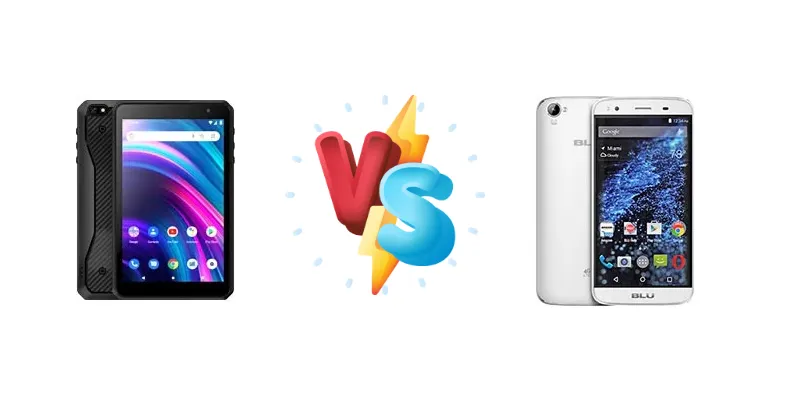
BLU offers compelling options in the ultra-budget smartphone space, but choosing between models like the M8L and Dash X Plus LTE requires understanding their core differences. While both aim for affordability, they take distinct approaches to processing power, impacting everyday usability and app performance. This comparison dissects the key specifications to reveal which device delivers the best experience for the price.
🏆 Quick Verdict
For most users, the BLU M8L emerges as the better choice. Its octa-core Cortex-A55 processor, while still budget-oriented, provides a noticeable performance advantage over the quad-core Cortex-A53 in the Dash X Plus LTE. This translates to smoother multitasking and a more responsive user experience, justifying the likely price difference.
| Network |
|---|
| 2G bands | GSM 850 / 900 / 1800 / 1900 | GSM 850 / 900 / 1800 / 1900 - SIM 1 & SIM 2 |
| 3G bands | HSDPA 850 / 900 / 1700 / 1900 / 2100 | HSDPA 850 / 1700(AWS) / 1900 / 2100 |
| 4G bands | 2, 3, 4, 5, 7, 12, 17, 28, 66 | 1, 2, 3, 4, 5, 7, 12, 17 |
| Speed | HSPA, LTE | HSPA 42.2/11.5 Mbps, LTE Cat4 150/50 Mbps |
| Technology | GSM / HSPA / LTE | GSM / HSPA / LTE |
| Launch |
|---|
| Announced | 2020, August. Released 2020, August | 2016, March. Released 2016, March |
| Status | Discontinued | Discontinued |
| Body |
|---|
| Dimensions | 208 x 125 x 9 mm (8.19 x 4.92 x 0.35 in) | 158.8 x 77.7 x 10.2 mm (6.25 x 3.06 x 0.40 in) |
| SIM | Nano-SIM + Nano-SIM | Dual SIM (Micro-SIM, dual stand-by) |
| Weight | 352 g (12.42 oz) | 190 g (6.70 oz) |
| Display |
|---|
| Resolution | 800 x 1280 pixels, 16:10 ratio (~189 ppi density) | 720 x 1280 pixels, 16:9 ratio (~267 ppi density) |
| Size | 8.0 inches, 185.6 cm2 (~71.4% screen-to-body ratio) | 5.5 inches, 83.4 cm2 (~67.6% screen-to-body ratio) |
| Type | IPS LCD | IPS LCD |
| Platform |
|---|
| CPU | Octa-core 1.6 GHz Cortex-A55 | Quad-core 1.0 GHz Cortex-A53 |
| Chipset | - | Mediatek MT6735 (28 nm) |
| GPU | - | Mali-T720MP2 |
| OS | Android 11 (Go edition) | Android 5.1 (Lollipop) |
| Memory |
|---|
| Card slot | microSDXC | microSDXC |
| Internal | 32GB 1GB RAM | 8GB 1GB RAM |
| | eMMC 5.1 | - |
| Main Camera |
|---|
| Features | LED flash | LED flash |
| Single | 8 MP | 8 MP, f/2.4, 1/3.2", AF |
| Video | 1080p@30fps | 1080p@30fps |
| Selfie camera |
|---|
| Features | - | LED flash |
| Single | 5 MP | 5 MP |
| Video | 720p@30fps | - |
| Sound |
|---|
| 3.5mm jack | Yes | Yes |
| 35mm jack | Yes | Yes |
| Loudspeaker | Yes | Yes |
| Comms |
|---|
| Bluetooth | 4.1, A2DP, LE | 4.0, A2DP |
| NFC | No | No |
| Positioning | GPS | GPS |
| Radio | FM radio | Stereo FM radio |
| USB | USB Type-C 2.0 | microUSB 2.0 |
| WLAN | Wi-Fi 802.11 b/g/n, Wi-Fi Direct | Wi-Fi 802.11 b/g/n, Wi-Fi Direct, hotspot |
| Features |
|---|
| Sensors | Accelerometer | Accelerometer, proximity |
| Battery |
|---|
| Stand-by | - | Up to 700 h (2G) / Up to 625 h (3G) |
| Talk time | - | Up to 25 h (2G) / Up to 16 h (3G) |
| Type | Li-Po 4000 mAh | Li-Po 2750 mAh, removable |
| Misc |
|---|
| Colors | Black | Black, Gold, White |
| Price | About 60 EUR | - |
BLU M8L
- More powerful octa-core processor for smoother performance
- Modern Cortex-A55 architecture offers better efficiency
- Likely better multitasking capabilities
- No detailed specifications available for display or camera
- Potential for slightly higher price compared to the Dash X Plus LTE
BLU Dash X Plus LTE
- Potentially lower price point
- Suitable for basic communication tasks
- MediaTek chipset is well-established
- Older and less efficient Cortex-A53 processor
- Quad-core CPU may struggle with multitasking
- 28nm process is less power efficient
Display Comparison
Neither BLU provides detailed display specifications in the provided data. However, given their price points, both likely utilize IPS LCD panels. The absence of information regarding resolution, brightness, or refresh rate suggests a focus on cost reduction. The user experience will likely be similar in terms of visual quality, with neither device expected to excel in outdoor visibility or color accuracy.
Camera Comparison
Without sensor size or aperture information, a detailed camera comparison is impossible. Both devices likely feature basic camera setups geared towards casual snapshots. The absence of any mention of Optical Image Stabilization (OIS) suggests neither phone will perform well in low-light conditions. Any camera differences will likely stem from software processing rather than hardware capabilities, making it difficult to predict a clear winner without sample images.
Performance
The core difference lies in the processors. The BLU M8L’s octa-core 1.6 GHz Cortex-A55 CPU represents a more modern architecture than the Dash X Plus LTE’s MediaTek MT6735, featuring a quad-core 1.0 GHz Cortex-A53. The Cortex-A55 offers improved instructions per clock cycle (IPC) compared to the A53, meaning it can accomplish more with each clock cycle. The MT6735, built on a 28nm process, is also older and less efficient. While core count isn’t everything, the combination of a newer architecture and higher clock speed gives the M8L a significant edge in multitasking and app loading times. The M8L will likely handle more demanding apps with greater ease.
Battery Life
Battery capacity and charging wattage are not specified for either device. Given the budget nature of these phones, battery life will likely be adequate for a full day of light use. The more efficient Cortex-A55 processor in the M8L *could* translate to slightly longer battery life, but this is speculative without concrete data. Charging speeds are also likely to be slow, potentially taking several hours to fully charge from 0%.
Buying Guide
Buy the BLU M8L if you prioritize a smoother, more responsive user experience, even with basic apps and multitasking. It's ideal for users who frequently switch between applications or engage in light social media browsing. Buy the BLU Dash X Plus LTE if your primary needs are basic communication – calls and texts – and you're looking for the absolute lowest possible price point, accepting a slower, less fluid experience.
Frequently Asked Questions
❓ Will the BLU Dash X Plus LTE struggle with popular social media apps like Facebook and Instagram?
The quad-core Cortex-A53 processor in the Dash X Plus LTE may exhibit noticeable lag when running multiple social media apps simultaneously. While it can handle basic browsing, expect slower loading times and occasional stuttering, especially with image and video-heavy content.
❓ Is the BLU M8L a good choice for playing mobile games?
The BLU M8L is suitable for *casual* mobile gaming. While the Cortex-A55 processor is an improvement over the Dash X Plus LTE, it's still a budget chip. Demanding games will likely require reduced graphics settings and may still experience occasional frame drops. It's not designed for intensive gaming sessions.
❓ Does the MT6735 chipset in the Dash X Plus LTE support VoLTE (Voice over LTE)?
The MediaTek MT6735 *can* support VoLTE, but compatibility depends on the carrier and software implementation by BLU. It's crucial to check with your mobile carrier to confirm VoLTE support before purchasing the Dash X Plus LTE if this feature is important to you.