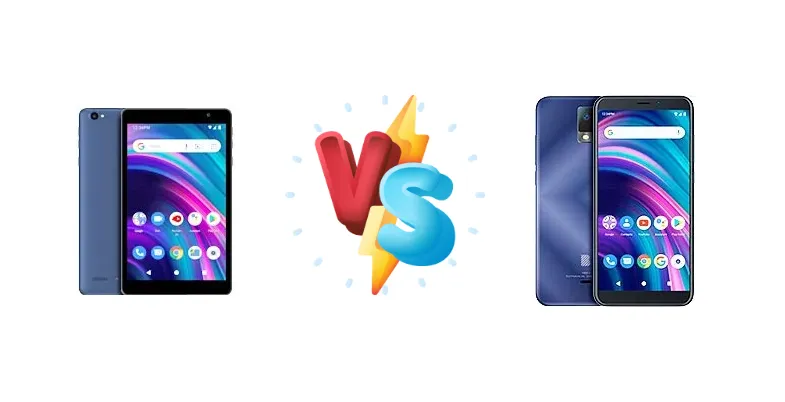
Looking for an affordable Android phone? BLU offers several options, and the M8L Plus and View 3 are two popular contenders. But which one delivers the best value? This comprehensive comparison dives deep into their specs and features to help you decide.
🏆 Quick Verdict
The BLU View 3 edges out the M8L Plus thanks to its slightly faster processor and more efficient 12nm manufacturing process. While both are budget phones, the View 3 offers a more responsive experience, making it the better overall choice for most users.
| Network |
|---|
| 2G bands | GSM 850 / 900 / 1800 / 1900 | GSM 850 / 900 / 1800 / 1900 |
| 3G bands | HSDPA 850 / 900 / 1700 / 1900 / 2100 | HSDPA 850 / 1700(AWS) / 1900 |
| 4G bands | 2, 3, 4, 5, 7, 12, 17, 28, 66 | 2, 4, 5, 12, 13, 25, 26, 41, 66, 71 |
| Speed | HSPA, LTE | HSPA 42.2/5.76 Mbps, LTE Cat6 300/50 Mbps |
| Technology | GSM / HSPA / LTE | GSM / HSPA / LTE |
| Launch |
|---|
| Announced | 2020, August. Released 2020, August | 2021, September. Released 2021, October |
| Status | Discontinued | Discontinued |
| Body |
|---|
| Dimensions | 208 x 123.7 x 10.5 mm (8.19 x 4.87 x 0.41 in) | 160.2 x 76.7 x 9 mm (6.31 x 3.02 x 0.35 in) |
| SIM | Nano-SIM | Nano-SIM |
| Weight | 383 g (13.51 oz) | 178 g (6.28 oz) |
| Display |
|---|
| Resolution | 800 x 1280 pixels, 16:10 ratio (~189 ppi density) | 720 x 1440 pixels, 18:9 ratio (~268 ppi density) |
| Size | 8.0 inches, 185.6 cm2 (~72.1% screen-to-body ratio) | 6.0 inches, 92.9 cm2 (~75.6% screen-to-body ratio) |
| Type | IPS LCD | IPS LCD |
| Platform |
|---|
| CPU | Octa-core 1.6 GHz Cortex-A55 | Octa-core 2.0 GHz Cortex-A53 |
| Chipset | - | Mediatek MT6762 Helio P22 (12 nm) |
| GPU | - | PowerVR GE8320 |
| OS | Android 11 (Go edition) | Android 11 |
| Memory |
|---|
| Card slot | microSDXC | microSDXC |
| Internal | 32GB 2GB RAM | 32GB 3GB RAM |
| | eMMC 5.1 | eMMC 5.1 |
| Main Camera |
|---|
| Features | LED flash | LED flash |
| Single | 8 MP | 13 MP |
| Video | 1080p@30fps | 1080p@30fps |
| Selfie camera |
|---|
| Single | 5 MP | 8 MP |
| Video | 720p@30fps | 720p@30fps |
| Sound |
|---|
| 3.5mm jack | Yes | Yes |
| 35mm jack | Yes | Yes |
| Loudspeaker | Yes | Yes |
| Comms |
|---|
| Bluetooth | 4.1, A2DP, LE | 5.1, A2DP, LE |
| NFC | No | No |
| Positioning | GPS | GPS |
| Radio | FM radio | FM radio |
| USB | microUSB 2.0 | USB Type-C 2.0 |
| WLAN | Wi-Fi 802.11 b/g/n, Wi-Fi Direct | Wi-Fi 802.11 b/g/n, Wi-Fi Direct |
| Features |
|---|
| Sensors | Accelerometer | Accelerometer, proximity |
| Battery |
|---|
| Type | Li-Po 4300 mAh | Li-Po 3400 mAh |
| Misc |
|---|
| Colors | Blue | Black |
| Price | About 60 EUR | About 50 EUR |
BLU M8L Plus
- Larger Display
- Potentially more RAM (variant dependent)
- Affordable Price
- Slower Processor
- Less Efficient Chipset
- Potentially Lower Battery Life
BLU View 3
- Faster Processor (Helio P22)
- More Efficient 12nm Chipset
- Slightly Better Battery Life
- More Responsive Performance
- Smaller Display
- Similar Camera Performance to M8L Plus
- Budget Build Quality
Display Comparison
The BLU M8L Plus typically features a larger display, often around 6.5 inches, compared to the View 3's roughly 6.0-inch screen. Both likely utilize IPS LCD panels with HD+ resolution. While the M8L Plus offers more screen real estate, the View 3's smaller size might be more comfortable for one-handed use. Color accuracy and brightness are likely comparable on both, typical for budget devices.
Camera Comparison
Camera performance on both phones is likely similar, with both featuring a combination of primary and secondary lenses (likely a 13MP main sensor and a 2MP depth sensor). Image quality will be adequate in good lighting conditions, but expect noise and limited detail in low light. The View 3's slightly more powerful processor *might* offer marginally better image processing, but the difference will be minimal.
Performance
Here's where the View 3 takes a lead. Its Mediatek Helio P22 chipset, built on a 12nm process, is generally more efficient and offers better performance than the M8L Plus's Octa-core 1.6 GHz Cortex-A55. The View 3's 2.0 GHz Cortex-A53 cores provide a noticeable boost in responsiveness for everyday tasks and light gaming. Expect smoother multitasking and faster app loading times on the View 3.
Battery Life
The BLU View 3's 12nm chipset contributes to better power efficiency. While both phones likely have batteries in the 3000-4000mAh range, the View 3 should offer slightly longer battery life on a single charge. Expect a full day of moderate use from either device.
Buying Guide
The BLU M8L Plus is a good option for users prioritizing a larger display and potentially more RAM (depending on the specific variant). The BLU View 3 is ideal for those seeking a smoother, more responsive experience and slightly better battery efficiency, even if it means a smaller screen.
Frequently Asked Questions
❓ What is the difference between the processors in these phones?
The BLU View 3 uses a Mediatek Helio P22, which is generally faster and more efficient than the Octa-core Cortex-A55 in the BLU M8L Plus. The Helio P22's 12nm process contributes to better performance and battery life.
❓ Which phone is better for gaming?
The BLU View 3 is the better choice for gaming due to its more powerful processor. While neither phone is a gaming powerhouse, the View 3 will handle games more smoothly.