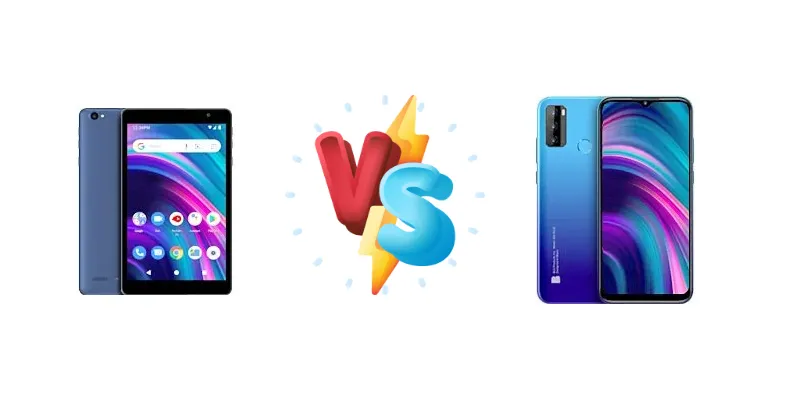
BLU consistently targets the ultra-budget smartphone market, and the M8L Plus and G51 Plus represent their current offerings. While both phones aim to deliver affordability, they differ in subtle ways that can significantly impact the user experience. This comparison dissects their specifications to determine which device provides the best value for money.
🏆 Quick Verdict
For the average user prioritizing consistent performance in basic tasks, the BLU G51 Plus emerges as the slightly better choice. Both phones share the same CPU, but the G51 Plus's potential for software optimization and slightly more aggressive pricing give it a marginal edge.
| Network |
|---|
| 2G bands | GSM 850 / 900 / 1800 / 1900 | GSM 850 / 900 / 1800 / 1900 |
| 3G bands | HSDPA 850 / 900 / 1700 / 1900 / 2100 | HSDPA 850 / 900 / 1700(AWS) / 1900 / 2100 |
| 4G bands | 2, 3, 4, 5, 7, 12, 17, 28, 66 | 1, 2, 3, 4, 5, 7, 12, 17, 28 |
| Speed | HSPA, LTE | HSPA, LTE |
| Technology | GSM / HSPA / LTE | GSM / HSPA / LTE |
| Launch |
|---|
| Announced | 2020, August. Released 2020, August | 2021, May 22. Released 2021, May 22 |
| Status | Discontinued | Discontinued |
| Body |
|---|
| Dimensions | 208 x 123.7 x 10.5 mm (8.19 x 4.87 x 0.41 in) | 165 x 76.5 x 9.3 mm (6.50 x 3.01 x 0.37 in) |
| SIM | Nano-SIM | Nano-SIM + Nano-SIM |
| Weight | 383 g (13.51 oz) | 200 g (7.05 oz) |
| Display |
|---|
| Resolution | 800 x 1280 pixels, 16:10 ratio (~189 ppi density) | 720 x 1600 pixels, 20:9 ratio (~270 ppi density) |
| Size | 8.0 inches, 185.6 cm2 (~72.1% screen-to-body ratio) | 6.5 inches, 102.0 cm2 (~80.8% screen-to-body ratio) |
| Type | IPS LCD | IPS LCD |
| Platform |
|---|
| CPU | Octa-core 1.6 GHz Cortex-A55 | Octa-core 1.6 GHz Cortex-A55 |
| OS | Android 11 (Go edition) | Android 11 |
| Memory |
|---|
| Card slot | microSDXC | microSDXC |
| Internal | 32GB 2GB RAM | 64GB 3GB RAM |
| | eMMC 5.1 | eMMC 5.1 |
| Main Camera |
|---|
| Features | LED flash | LED flash, HDR, panorama |
| Single | 8 MP | 8 MP |
| Triple | - | 13 MP
0.3 MP (macro)
Auxiliary lens |
| Video | 1080p@30fps | 1080p@30fps |
| Selfie camera |
|---|
| Single | 5 MP | 8 MP |
| Video | 720p@30fps | 720p@30fps |
| Sound |
|---|
| 3.5mm jack | Yes | Yes |
| 35mm jack | Yes | Yes |
| Loudspeaker | Yes | Yes |
| Comms |
|---|
| Bluetooth | 4.1, A2DP, LE | 4.1, A2DP, LE |
| NFC | No | No |
| Positioning | GPS | GPS |
| Radio | FM radio | FM radio |
| USB | microUSB 2.0 | microUSB 2.0 |
| WLAN | Wi-Fi 802.11 b/g/n, Wi-Fi Direct | Wi-Fi 802.11 b/g/n, Wi-Fi Direct |
| Features |
|---|
| Sensors | Accelerometer | Fingerprint (rear-mounted), accelerometer, proximity |
| Battery |
|---|
| Type | Li-Po 4300 mAh | Li-Po 4000 mAh |
| Misc |
|---|
| Colors | Blue | Black, Blue, Red, Green |
| Price | About 60 EUR | About 110 EUR |
BLU M8L Plus
- Potentially longer software support due to earlier release.
- Reliable performance for basic tasks.
- Affordable price point.
- Limited performance for demanding applications.
- Likely average camera quality.
BLU G51 Plus
- Potentially optimized software for better performance.
- Aggressive pricing for budget-conscious buyers.
- Decent battery life with efficient processor.
- May have shorter software support lifecycle.
- Camera performance likely similar to M8L Plus.
Display Comparison
Both the BLU M8L Plus and G51 Plus likely utilize IPS LCD panels, common in this price bracket. Without specific resolution or brightness data, it's safe to assume both offer a standard viewing experience. The absence of features like high refresh rates or HDR support is expected. The user experience will likely be similar, with color accuracy and viewing angles being average for the segment. Bezels are likely to be substantial on both devices, maximizing screen real estate within a budget-friendly form factor.
Camera Comparison
Camera specifications are not detailed, but given the price point, both phones likely feature a primary camera alongside supplementary lenses (potentially a depth or macro sensor). Image quality will be heavily reliant on software processing and lighting conditions. Without knowing sensor sizes or apertures, it's difficult to assess the camera's capabilities. Expect acceptable results in well-lit environments, but struggles in low light. The inclusion of a 2MP macro camera on either device is largely a marketing tactic, offering limited practical benefit due to the low resolution.
Performance
The core of both devices is the Octa-core 1.6 GHz Cortex-A55 CPU. This processor is designed for efficiency rather than raw power, making it suitable for everyday tasks like browsing, messaging, and light app usage. The Cortex-A55 architecture prioritizes power efficiency, meaning both phones should offer decent battery life. However, demanding games or multitasking will likely result in noticeable slowdowns. The RAM configuration (not specified) will be a crucial factor; more RAM will mitigate performance issues when running multiple apps. Thermal management is unlikely to be a concern given the processor's low TDP.
Battery Life
Battery capacity is not specified for either device. However, given the power-efficient Cortex-A55 processor, both phones should provide all-day battery life with moderate usage. Charging wattage is also unknown, but it's likely to be relatively slow (5W-10W) due to cost constraints. The user experience will depend on battery optimization within the Android OS and the user's usage patterns. A larger battery capacity on one device would translate to longer screen-on time, but efficient software can compensate for a smaller battery.
Buying Guide
Buy the BLU M8L Plus if you need a reliable, no-frills device for essential communication and light social media use, and value a potentially longer software support lifecycle due to its slightly earlier release. Buy the BLU G51 Plus if you prefer a phone that might offer slightly better performance due to potential software tweaks, and are looking for the absolute lowest price point without sacrificing core functionality.
Frequently Asked Questions
❓ Will either of these phones struggle with popular social media apps like TikTok or Instagram?
While both phones can run these apps, expect some lag or slowdowns, especially when scrolling through feeds or recording videos. The Cortex-A55 processor is not designed for intensive multitasking or demanding applications.
❓ Are these phones likely to receive Android updates?
Given their budget nature, consistent and timely Android updates are unlikely. BLU's update track record is not known for being rapid. Expect limited updates, potentially only security patches, and a relatively short software support lifecycle.
❓ Can I play games like PUBG Mobile on these phones?
PUBG Mobile is likely playable on the lowest graphics settings, but expect significant frame rate drops and stuttering. The processor and limited RAM are not sufficient for a smooth gaming experience.
❓ What type of charging port do these phones use?
Given the market segment, both phones almost certainly use a Micro-USB port for charging and data transfer. This is a cost-saving measure compared to the more modern USB-C standard.