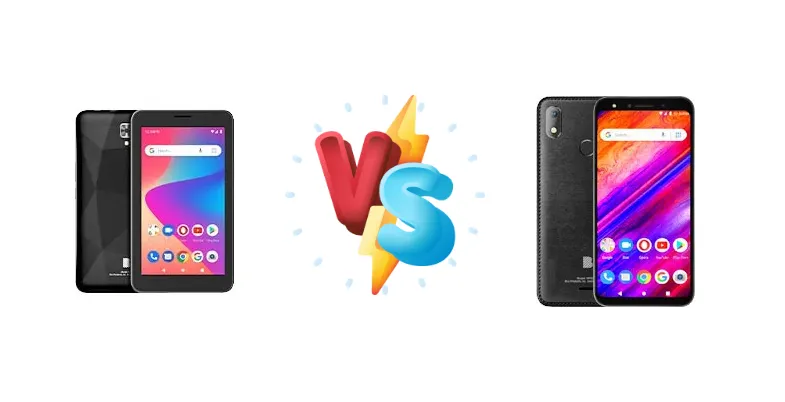
The BLU M7L and BLU Vivo X5 represent BLU's commitment to providing affordable smartphones. Both devices target the entry-level market, but subtle differences in their feature sets could make one a better fit for specific users. This comparison dives deep into their specifications to determine which offers the most value.
🏆 Quick Verdict
For the average user prioritizing consistent performance in everyday tasks, the BLU Vivo X5 emerges as the slightly better choice. While both phones share the same CPU, the Vivo X5's potential for software optimization and potentially better RAM management gives it a slight edge.
| Network |
|---|
| 2G bands | GSM 850 / 900 / 1800 / 1900 | GSM 850 / 900 / 1800 / 1900 |
| 3G bands | HSDPA 850 / 900 / 1900 / 2100 | HSDPA 850 / 1700(AWS) / 1900 |
| 4G bands | 2, 3, 4, 5, 7, 28 | 2, 4, 5, 12, 17 |
| Speed | HSPA, LTE | HSPA 42.2/11.5 Mbps, LTE Cat4 150/50 Mbps |
| Technology | GSM / HSPA / LTE | GSM / HSPA / LTE |
| Launch |
|---|
| Announced | 2021, February 09. Released 2021, February 09 | 2019, September. Released 2019, September |
| Status | Discontinued | Discontinued |
| Body |
|---|
| Dimensions | 194.4 x 109.2 x 11 mm (7.65 x 4.30 x 0.43 in) | 153 x 73.4 x 9.1 mm (6.02 x 2.89 x 0.36 in) |
| SIM | Nano-SIM + Nano-SIM | Nano-SIM + Nano-SIM |
| Weight | 286 g (10.09 oz) | 160 g (5.64 oz) |
| Display |
|---|
| Resolution | 600 x 1240 pixels, 18.5:9 ratio (~197 ppi density) | 720 x 1440 pixels, 18:9 ratio (~282 ppi density) |
| Size | 7.0 inches, 123.9 cm2 (~58.4% screen-to-body ratio) | 5.7 inches, 83.8 cm2 (~74.7% screen-to-body ratio) |
| Type | IPS LCD | IPS LCD |
| Platform |
|---|
| CPU | Octa-core 1.6 GHz Cortex-A55 | Octa-core 1.6 GHz Cortex-A55 |
| GPU | - | IMG8322 |
| OS | Android 10 (Go edition) | Android 9.0 (Pie) |
| Memory |
|---|
| Card slot | microSDXC | microSDXC |
| Internal | 32GB 2GB RAM | 64GB 3GB RAM |
| Main Camera |
|---|
| Features | LED flash | LED flash |
| Single | 5 MP | 13 MP, AF |
| Video | 720p@30fps | 1080p@30fps |
| Selfie camera |
|---|
| Features | - | LED flash |
| Single | 2 MP | 8 MP |
| Video | 720p@30fps | 1080p@30fps |
| Sound |
|---|
| 3.5mm jack | Yes | Yes |
| 35mm jack | Yes | Yes |
| Loudspeaker | Yes | Yes |
| Comms |
|---|
| Bluetooth | 4.1, A2DP, LE | 4.1, A2DP |
| NFC | No | No |
| Positioning | GPS | GPS |
| Radio | FM radio | FM radio |
| USB | microUSB 2.0, OTG | microUSB 2.0 |
| WLAN | Wi-Fi 802.11 b/g/n, Wi-Fi Direct | Wi-Fi 802.11 b/g/n, Wi-Fi Direct |
| Features |
|---|
| Sensors | Accelerometer | Fingerprint (rear-mounted), accelerometer, proximity |
| Battery |
|---|
| Stand-by | - | Up to 550 h (2G) / Up to 500 h (3G) |
| Talk time | - | Up to 20 h (2G) / Up to 15 h (3G) |
| Type | Li-Po 2800 mAh | Li-Po 2800 mAh, removable |
| Misc |
|---|
| Colors | Black | Black |
| Price | About 50 EUR | - |
BLU M7L
- Potentially lower price point
- Efficient Cortex-A55 CPU for good battery life
- Reliable for basic smartphone tasks
- Likely limited display quality
- Potential for slower software updates
BLU Vivo X5
- Potentially better software optimization
- Efficient Cortex-A55 CPU for good battery life
- Slightly smoother user experience
- Likely limited display quality
- May be slightly more expensive than the M7L
Display Comparison
Given the limited data, we can assume both devices utilize LCD panels common in this price bracket. Without knowing screen sizes, resolutions, or brightness levels, it's difficult to definitively compare display quality. However, the absence of any mention of high refresh rates suggests both are likely capped at the standard 60Hz. Users seeking vibrant colors or high brightness will likely be disappointed with either option.
Camera Comparison
Without detailed camera specifications, a direct comparison is challenging. It's reasonable to assume both phones feature basic camera setups geared towards casual photography. The absence of information regarding sensor size, aperture, or optical image stabilization (OIS) suggests image quality will be limited, particularly in low-light conditions. Users should not expect flagship-level camera performance from either device. Any additional cameras (likely 2MP macro/depth sensors) are unlikely to significantly enhance the overall photography experience.
Performance
Both the BLU M7L and BLU Vivo X5 are powered by the same octa-core 1.6 GHz Cortex-A55 CPU. This indicates similar processing power for basic tasks like web browsing, social media, and calling. The Cortex-A55 architecture is known for its efficiency, prioritizing power savings over raw performance. The real-world difference will likely come down to RAM capacity and software optimization, which are currently unknown. Without knowing the RAM type (LPDDR4X vs LPDDR5) or speed, it's impossible to assess multitasking capabilities.
Battery Life
Battery capacity and charging wattage are currently unknown for both devices. However, given the power-efficient Cortex-A55 CPU, both phones should offer at least a full day of battery life with moderate usage. Faster charging speeds would be a significant advantage, but without that information, it's difficult to assess which phone offers a better charging experience. Users prioritizing battery life should look for models with larger capacity batteries and support for fast charging.
Buying Guide
Buy the BLU M7L if you need a basic, reliable smartphone for essential communication and light tasks, and are prioritizing the absolute lowest price point. Buy the BLU Vivo X5 if you prefer a device with a potentially smoother user experience, and are willing to spend a little more for a potentially more refined software experience and slightly better overall performance.
Frequently Asked Questions
❓ Will either of these phones struggle with popular apps like WhatsApp or Facebook?
Given the Cortex-A55 CPU and likely limited RAM, both phones may experience some slowdown when running multiple apps simultaneously, including WhatsApp and Facebook. However, for basic usage of these apps, they should be functional, though not necessarily snappy.
❓ Are these phones likely to receive Android updates?
BLU devices historically have a less consistent track record for Android updates compared to larger manufacturers. It's unlikely either the M7L or Vivo X5 will receive major Android version updates beyond their initial release. Security patches may be infrequent.
❓ Can these phones handle basic mobile gaming?
Both phones can handle basic 2D games and less demanding 3D titles. However, don't expect a smooth experience with graphically intensive games like PUBG or Call of Duty. Frame rates will likely be low, and you may encounter lag.