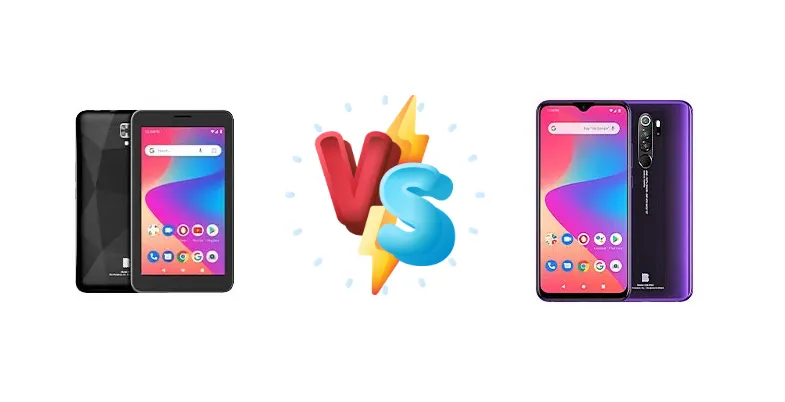
BLU offers two distinct Android experiences with the M7L and G90 Pro. The M7L represents a focus on affordability and basic functionality, while the G90 Pro aims to deliver a more robust experience, particularly for gaming, at a higher price point. This comparison dissects the key differences to determine which device best suits your needs.
🏆 Quick Verdict
For the average user prioritizing everyday tasks, the BLU M7L offers sufficient performance at a significantly lower cost. However, the BLU G90 Pro is the clear winner for gamers and power users, thanks to its significantly more powerful Mediatek Helio G90T chipset and added features like 18W wired and 10W wireless charging.
| Network |
|---|
| 2G bands | GSM 850 / 900 / 1800 / 1900 | GSM 850 / 900 / 1800 / 1900 |
| 3G bands | HSDPA 850 / 900 / 1900 / 2100 | HSDPA 850 / 900 / 1700(AWS) / 1900 / 2100 |
| 4G bands | 2, 3, 4, 5, 7, 28 | 1, 2, 3, 4, 5, 7, 8, 12, 13, 17, 28 |
| Speed | HSPA, LTE | HSPA 42.2/5.76 Mbps, LTE (2CA) Cat6 300/50 Mbps |
| Technology | GSM / HSPA / LTE | GSM / HSPA / LTE |
| Launch |
|---|
| Announced | 2021, February 09. Released 2021, February 09 | 2020, August 25. Released 2020, August 25 |
| Status | Discontinued | Discontinued |
| Body |
|---|
| Dimensions | 194.4 x 109.2 x 11 mm (7.65 x 4.30 x 0.43 in) | 162 x 77 x 10.1 mm (6.38 x 3.03 x 0.40 in) |
| SIM | Nano-SIM + Nano-SIM | Nano-SIM + Nano-SIM |
| Weight | 286 g (10.09 oz) | 215 g (7.58 oz) |
| Display |
|---|
| Protection | - | Corning Gorilla Glass |
| Resolution | 600 x 1240 pixels, 18.5:9 ratio (~197 ppi density) | 1080 x 2340 pixels, 19.5:9 ratio (~396 ppi density) |
| Size | 7.0 inches, 123.9 cm2 (~58.4% screen-to-body ratio) | 6.5 inches, 103.7 cm2 (~83.1% screen-to-body ratio) |
| Type | IPS LCD | IPS LCD |
| Platform |
|---|
| CPU | Octa-core 1.6 GHz Cortex-A55 | Octa-core (2x2.05 GHz Cortex-A76 & 6x2.0 GHz Cortex-A55) |
| Chipset | - | Mediatek MT6785 Helio G90T (12 nm) |
| GPU | - | Mali-G76 MC4 |
| OS | Android 10 (Go edition) | Android 10 |
| Memory |
|---|
| Card slot | microSDXC | microSDXC |
| Internal | 32GB 2GB RAM | 128GB 4GB RAM |
| | - | eMMC 5.1 |
| Main Camera |
|---|
| Features | LED flash | LED flash, panorama, HDR |
| Single | 5 MP | 3.15 MP |
| Triple | - | 48 MP, f/1.8, (wide), 1/2.0", 0.8µm, PDAF
8 MP, f/2.2, (ultrawide), 1/4.0", 1.12µm
2 MP (macro)
Auxiliary lens |
| Video | 720p@30fps | 4K@30fps |
| Selfie camera |
|---|
| Single | 2 MP | 32 MP, f/2.0, (wide), 1/2.8", 0.8µm |
| Video | 720p@30fps | 1080p@30fps |
| Sound |
|---|
| 3.5mm jack | Yes | Yes |
| 35mm jack | Yes | Yes |
| Loudspeaker | Yes | Yes |
| Comms |
|---|
| Bluetooth | 4.1, A2DP, LE | 4.1, A2DP, LE |
| NFC | No | No |
| Positioning | GPS | GPS |
| Radio | FM radio | FM radio |
| USB | microUSB 2.0, OTG | USB Type-C 2.0, OTG |
| WLAN | Wi-Fi 802.11 b/g/n, Wi-Fi Direct | Wi-Fi 802.11 a/b/g/n, Wi-Fi Direct |
| Features |
|---|
| Browser | - | HTML |
| Sensors | Accelerometer | Fingerprint (rear-mounted), accelerometer, gyro, proximity, compass |
| Battery |
|---|
| Charging | - | 18W wired
10W wireless (Qi) |
| Stand-by | - | Up to 560 h (2G) / Up to 445 h (3G) |
| Talk time | - | Up to 8 h 10 min (2G) / Up to 6 h 30 min (3G) |
| Type | Li-Po 2800 mAh | Li-Po 5100 mAh |
| Misc |
|---|
| Colors | Black | Purple Haze |
| Models | - | xt502 |
| Price | About 50 EUR | About 170 EUR |
| SAR | - | 1.16 W/kg (head) 0.59 W/kg (body) |
| SAR EU | - | 0.96 W/kg (head) |
BLU M7L
- More affordable price point
- Potentially longer battery life due to less powerful chipset
- Simpler, user-friendly experience
- Significantly slower performance
- Limited gaming capabilities
- Likely lacks fast or wireless charging
BLU G90 Pro
- Superior gaming performance with Helio G90T
- 18W wired and 10W wireless charging
- More responsive user experience
- Higher price tag
- Potentially shorter battery life under heavy load
- May experience more heat during prolonged gaming
Display Comparison
The context data lacks display specifications for both devices. Assuming typical BLU implementations at these price points, the M7L likely features a 720p LCD panel, prioritizing cost savings. The G90 Pro, positioned higher, may offer a 1080p LCD, resulting in a sharper image. The absence of details like refresh rate or peak brightness suggests neither device will excel in display quality compared to competitors. Bezels are likely to be substantial on both models, typical of budget-focused designs.
Camera Comparison
Without detailed camera specifications, a direct comparison is limited. However, given the G90 Pro’s positioning, it likely features a more capable main sensor and potentially additional lenses. The M7L likely relies on a simpler camera setup. The G90 Pro’s image processing capabilities, driven by the more powerful chipset, will likely result in better dynamic range and noise reduction. It's reasonable to assume the G90 Pro will offer a more versatile and higher-quality camera experience, even without knowing specific megapixel counts.
Performance
The core difference lies in the chipset. The BLU M7L’s Octa-core 1.6 GHz Cortex-A55 CPU is designed for efficiency, suitable for basic tasks. In contrast, the BLU G90 Pro’s Mediatek Helio G90T (12 nm) boasts a more sophisticated architecture: two high-performance 2.05 GHz Cortex-A76 cores paired with six efficiency-focused 2.0 GHz Cortex-A55 cores. This configuration provides a substantial performance uplift, particularly in demanding applications and games. The G90T’s 12nm process node also contributes to better thermal management under sustained load, reducing throttling compared to a potentially less optimized implementation in the M7L. This translates to smoother gameplay and faster app loading times for the G90 Pro.
Battery Life
Battery capacity isn’t specified for either device. However, the G90 Pro’s inclusion of 18W wired and 10W wireless (Qi) charging is a significant advantage. The M7L likely supports only standard wired charging. The faster charging speeds of the G90 Pro minimize downtime, allowing users to quickly replenish the battery. Wireless charging adds convenience, eliminating the need for cables. Even if the M7L has a slightly larger battery capacity, the G90 Pro’s charging capabilities provide a superior user experience.
Buying Guide
Buy the BLU M7L if you need a reliable, affordable smartphone for basic communication, social media, and light web browsing. It’s ideal for users on a tight budget or those seeking a secondary device. Buy the BLU G90 Pro if you prioritize gaming performance, faster charging speeds, and a more responsive user experience. This phone is geared towards users who demand more from their mobile device and are willing to pay a premium for it.
Frequently Asked Questions
❓ Is the Mediatek Helio G90T in the BLU G90 Pro prone to overheating during extended gaming sessions?
While the Helio G90T can generate heat under sustained load, the 12nm process node and BLU’s thermal design should mitigate significant throttling. However, expect some warmth during prolonged gaming. The M7L’s less powerful chipset will likely run cooler, but at the cost of performance.
❓ Does the BLU G90 Pro support fast charging with any charger other than the one included in the box?
The BLU G90 Pro supports the Power Delivery (PD) and Quick Charge (QC) standards, meaning it should work with many third-party 18W or higher USB-C chargers. However, optimal performance is guaranteed with a compatible charger.
❓ How does the CPU architecture of the BLU G90 Pro (Cortex-A76 & A55) compare to the BLU M7L (Cortex-A55)?
The G90 Pro’s inclusion of Cortex-A76 cores provides a substantial performance boost over the M7L’s all-Cortex-A55 configuration. A76 cores are significantly more powerful, handling demanding tasks and games with greater ease. The A55 cores in both phones are focused on efficiency, but the A76 cores in the G90 Pro elevate the overall performance considerably.