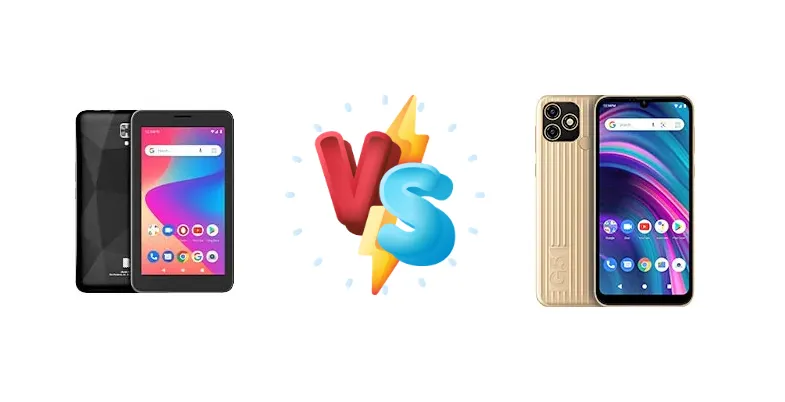
The BLU M7L and BLU G51 represent the ultra-budget end of the smartphone spectrum. While both aim to deliver essential smartphone functionality at a low price point, they take different approaches to achieving this. The M7L utilizes an octa-core Cortex-A55 CPU, while the G51 opts for the Mediatek Helio A22, a quad-core processor built on a more modern 12nm process. This comparison will dissect these differences to determine which device offers the best experience for everyday use.
🏆 Quick Verdict
For the average user prioritizing responsiveness in basic tasks, the BLU G51 emerges as the better choice. Its 2.0 GHz quad-core Cortex-A53 CPU, despite having fewer cores, offers a higher clock speed and a more efficient 12nm manufacturing process, resulting in snappier performance than the M7L’s 1.6 GHz Cortex-A55.
| Network |
|---|
| 2G bands | GSM 850 / 900 / 1800 / 1900 | GSM 850 / 900 / 1800 / 1900 |
| 3G bands | HSDPA 850 / 900 / 1900 / 2100 | HSDPA 850 / 900 / 1700(AWS) / 1900 / 2100 |
| 4G bands | 2, 3, 4, 5, 7, 28 | 2, 3, 4, 5, 7, 12, 17, 28, 66 |
| Speed | HSPA, LTE | HSPA, LTE |
| Technology | GSM / HSPA / LTE | GSM / HSPA / LTE |
| Launch |
|---|
| Announced | 2021, February 09. Released 2021, February 09 | 2022, June 03 |
| Status | Discontinued | Available. Released 2022, June 03 |
| Body |
|---|
| Dimensions | 194.4 x 109.2 x 11 mm (7.65 x 4.30 x 0.43 in) | 155.3 x 73.5 x 9.5 mm (6.11 x 2.89 x 0.37 in) |
| SIM | Nano-SIM + Nano-SIM | Nano-SIM + Nano-SIM |
| Weight | 286 g (10.09 oz) | 166 g (5.86 oz) |
| Display |
|---|
| Resolution | 600 x 1240 pixels, 18.5:9 ratio (~197 ppi density) | 720 x 1520 pixels, 19:9 ratio (~276 ppi density) |
| Size | 7.0 inches, 123.9 cm2 (~58.4% screen-to-body ratio) | 6.1 inches, 92.9 cm2 (~81.4% screen-to-body ratio) |
| Type | IPS LCD | IPS LCD |
| Platform |
|---|
| CPU | Octa-core 1.6 GHz Cortex-A55 | Quad-core 2.0 GHz Cortex-A53 |
| Chipset | - | Mediatek MT6761 Helio A22 (12 nm) |
| GPU | - | PowerVR GE8320 |
| OS | Android 10 (Go edition) | Android 11 (Go edition) |
| Memory |
|---|
| Card slot | microSDXC | microSDXC |
| Internal | 32GB 2GB RAM | 32GB 2GB RAM |
| | - | eMMC 5.1 |
| Main Camera |
|---|
| Dual | - | 8 MP
Auxiliary lens |
| Features | LED flash | LED flash, HDR, panorama |
| Single | 5 MP | 8 MP |
| Video | 720p@30fps | 1080p@30fps |
| Selfie camera |
|---|
| Single | 2 MP | 8 MP |
| Video | 720p@30fps | 720p@30fps |
| Sound |
|---|
| 3.5mm jack | Yes | Yes |
| 35mm jack | Yes | Yes |
| Loudspeaker | Yes | Yes |
| Comms |
|---|
| Bluetooth | 4.1, A2DP, LE | 4.2, A2DP, LE |
| NFC | No | No |
| Positioning | GPS | GPS |
| Radio | FM radio | FM radio |
| USB | microUSB 2.0, OTG | microUSB 2.0 |
| WLAN | Wi-Fi 802.11 b/g/n, Wi-Fi Direct | Wi-Fi 802.11 a/b/g/n, Wi-Fi Direct |
| Features |
|---|
| Sensors | Accelerometer | Fingerprint (rear-mounted), accelerometer, proximity |
| Battery |
|---|
| Type | Li-Po 2800 mAh | Li-Po 3000 mAh |
| Misc |
|---|
| Colors | Black | Black, Blue, Green, Silver, Gold |
| Price | About 50 EUR | - |
BLU M7L
- Potentially lower price point.
- Octa-core CPU may offer better multitasking in theory.
- May have wider availability in certain regions.
- Less efficient Cortex-A55 CPU.
- Likely slower performance than the G51.
- Older chipset architecture.
BLU G51
- More efficient 12nm Helio A22 chipset.
- Higher CPU clock speed for snappier responsiveness.
- Potentially better sustained performance.
- Fewer CPU cores than the M7L.
- May be slightly more expensive.
- Older Cortex-A53 architecture.
Display Comparison
Neither BLU provides detailed display specifications. Given their price point, it's safe to assume both utilize LCD panels with 720p+ resolutions. The lack of information prevents a direct comparison of brightness, color accuracy, or viewing angles. However, the G51’s chipset might support slightly better display drivers, potentially leading to marginally smoother scrolling.
Camera Comparison
Both devices likely feature basic camera setups. Without specific sensor details, it’s difficult to make a meaningful comparison. It’s reasonable to assume both phones include a primary camera and potentially a secondary depth or macro sensor. Image quality will likely be similar, limited by the sensor resolution and image processing capabilities of the respective chipsets. Expect adequate results in good lighting conditions, but poor performance in low light.
Performance
The core difference lies in the processors. The BLU M7L’s octa-core 1.6 GHz Cortex-A55 CPU offers more cores, but the BLU G51’s Mediatek Helio A22 (quad-core 2.0 GHz Cortex-A53) boasts a higher clock speed and is fabricated on a 12nm process. This smaller node generally translates to improved power efficiency and potentially better sustained performance. While the A53 architecture is older than the A55, the higher clock speed and process node advantage likely outweigh the core count difference for typical usage scenarios. The G51 will likely exhibit less throttling under sustained load.
Battery Life
Battery capacity is not specified for either device. However, the Helio A22’s 12nm process in the G51 suggests better power efficiency compared to the M7L’s Cortex-A55. This could translate to slightly longer battery life, even with similar battery capacities. Charging wattage is also unknown, so 0-100% charge times are difficult to estimate, but the G51’s efficiency could lead to faster overall charging.
Buying Guide
Buy the BLU M7L if you primarily need a phone for extremely light tasks like calls, texts, and occasional web browsing, and value a potentially lower price point. Buy the BLU G51 if you prefer a slightly more responsive experience for social media, basic gaming, and multitasking, and appreciate the benefits of a more modern chipset architecture.
Frequently Asked Questions
❓ Will the BLU G51 handle popular social media apps like Facebook and Instagram smoothly?
Yes, the BLU G51’s 2.0 GHz quad-core processor and 12nm process should provide a reasonably smooth experience for basic social media usage. While it won’t offer flagship-level performance, it should handle scrolling through feeds and viewing photos without significant lag.
❓ Is the difference in CPU cores between the M7L and G51 noticeable in everyday use?
While the M7L has more cores, the G51’s higher clock speed and more efficient chipset architecture are more impactful for typical tasks. The extra cores on the M7L won’t compensate for the slower clock speed and less efficient process, resulting in a less responsive user experience.
❓ Can the BLU G51 run basic games like Candy Crush or Subway Surfers?
Yes, the BLU G51 should be capable of running simple, less demanding games like Candy Crush or Subway Surfers. However, don’t expect high frame rates or the ability to play graphically intensive games.