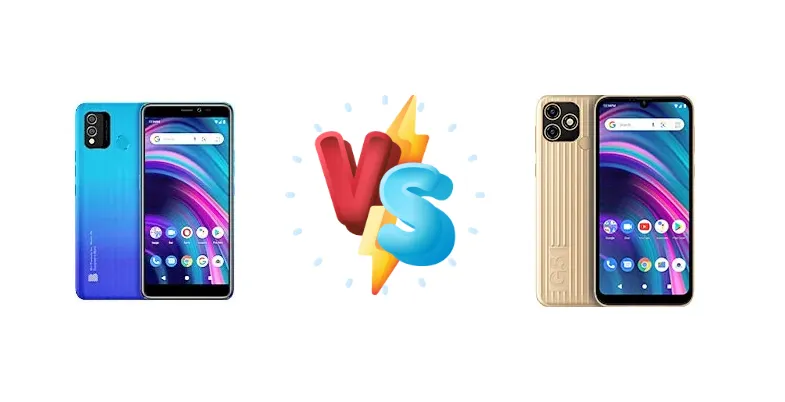
The BLU J9L and BLU G51 represent two distinct approaches to the ultra-budget smartphone market. The J9L utilizes an octa-core Cortex-A55 processor, while the G51 opts for the Mediatek Helio A22. This comparison dissects the architectural differences and real-world implications of these choices, helping you determine which device delivers the best value for your needs.
🏆 Quick Verdict
For the average user prioritizing multitasking and smoother app switching, the BLU J9L is the better choice. Its octa-core Cortex-A55 CPU, despite the lower clock speed, offers superior multi-core performance compared to the quad-core Helio A22 in the G51, resulting in a more responsive user experience.
| Network |
|---|
| 2G bands | GSM 850 / 900 / 1800 / 1900 | GSM 850 / 900 / 1800 / 1900 |
| 3G bands | HSDPA 850 / 900 / 1700(AWS) / 1900 / 2100 | HSDPA 850 / 900 / 1700(AWS) / 1900 / 2100 |
| 4G bands | 1, 2, 3, 4, 5, 7, 12, 17, 28 | 2, 3, 4, 5, 7, 12, 17, 28, 66 |
| Speed | HSPA, LTE | HSPA, LTE |
| Technology | GSM / HSPA / LTE | GSM / HSPA / LTE |
| Launch |
|---|
| Announced | 2021, June. Released 2021, June | 2022, June 03 |
| Status | Discontinued | Available. Released 2022, June 03 |
| Body |
|---|
| Dimensions | 161.6 x 76.9 x 9.7 mm (6.36 x 3.03 x 0.38 in) | 155.3 x 73.5 x 9.5 mm (6.11 x 2.89 x 0.37 in) |
| SIM | Nano-SIM + Nano-SIM | Nano-SIM + Nano-SIM |
| Weight | 191 g (6.74 oz) | 166 g (5.86 oz) |
| Display |
|---|
| Resolution | 480 x 960 pixels, 18:9 ratio (~179 ppi density) | 720 x 1520 pixels, 19:9 ratio (~276 ppi density) |
| Size | 6.0 inches, 92.9 cm2 (~74.8% screen-to-body ratio) | 6.1 inches, 92.9 cm2 (~81.4% screen-to-body ratio) |
| Type | IPS LCD | IPS LCD |
| Platform |
|---|
| CPU | Octa-core 1.6 GHz Cortex-A55 | Quad-core 2.0 GHz Cortex-A53 |
| Chipset | - | Mediatek MT6761 Helio A22 (12 nm) |
| GPU | - | PowerVR GE8320 |
| OS | Android 11 (Go edition) | Android 11 (Go edition) |
| Memory |
|---|
| Card slot | microSDXC | microSDXC |
| Internal | 32GB 1GB RAM | 32GB 2GB RAM |
| | eMMC 5.1 | eMMC 5.1 |
| Main Camera |
|---|
| Dual | 8 MP
Auxiliary lens | 8 MP
Auxiliary lens |
| Features | LED flash | LED flash, HDR, panorama |
| Single | 8 MP | 8 MP |
| Video | 1080p@30fps | 1080p@30fps |
| Selfie camera |
|---|
| Single | 8 MP | 8 MP |
| Video | 720p@30fps | 720p@30fps |
| Sound |
|---|
| 3.5mm jack | Yes | Yes |
| 35mm jack | Yes | Yes |
| Loudspeaker | Yes | Yes |
| Comms |
|---|
| Bluetooth | 4.0, A2DP | 4.2, A2DP, LE |
| NFC | No | No |
| Positioning | GPS | GPS |
| Radio | FM radio | FM radio |
| USB | microUSB 2.0 | microUSB 2.0 |
| WLAN | Wi-Fi 802.11 b/g/n, Wi-Fi Direct | Wi-Fi 802.11 a/b/g/n, Wi-Fi Direct |
| Features |
|---|
| Sensors | Fingerprint (rear-mounted), accelerometer | Fingerprint (rear-mounted), accelerometer, proximity |
| Battery |
|---|
| Type | Li-Ion 3000 mAh | Li-Po 3000 mAh |
| Misc |
|---|
| Colors | Blue, Black, Green, Red | Black, Blue, Green, Silver, Gold |
BLU J9L
- Octa-core CPU offers better multitasking
- Potentially smoother app switching
- More responsive user interface
- CPU clock speed is lower than the G51
- Battery life may be shorter than the G51
BLU G51
- More power-efficient 12nm process
- Potentially longer battery life
- Higher CPU clock speed
- Quad-core CPU struggles with multitasking
- Slower app loading times
- Less responsive user interface
Display Comparison
Neither BLU provides detailed display specifications. However, given their price points, both likely utilize IPS LCD panels. The absence of information regarding brightness nits, color gamut coverage, or refresh rates suggests a focus on cost reduction. Users should expect standard viewing experiences, adequate for indoor use but potentially washed out in direct sunlight. Bezels are likely to be substantial on both devices, reflecting their budget nature.
Camera Comparison
Both devices likely feature basic camera setups. Without specific sensor details, it’s difficult to make a definitive comparison. However, the inclusion of a 2MP macro camera on either device is largely a marketing tactic, offering limited practical benefit due to the small sensor size and lack of optical image stabilization. Image processing will likely be minimal on both, resulting in photos that are acceptable in good lighting conditions but struggle in low light. Expect significant noise and a lack of detail in challenging scenarios.
Performance
The core difference lies in the CPU architecture. The BLU J9L’s octa-core 1.6 GHz Cortex-A55 processor offers eight cores, enabling better parallel processing than the BLU G51’s quad-core 2.0 GHz Cortex-A53. While the A53 cores have a higher clock speed, the A55 architecture is more efficient and the sheer number of cores in the J9L provides a significant advantage in multi-threaded tasks. The G51’s Helio A22, built on a 12nm process, *should* offer better power efficiency, but the performance gap in CPU-intensive applications will be noticeable. The G51's GPU is integrated within the Helio A22, while the J9L's GPU details are unavailable, but it's likely a basic Mali-450 MP series GPU, sufficient for light gaming.
Battery Life
Battery capacity details are missing for both devices. However, the Mediatek Helio A22’s 12nm process node *suggests* potentially better power efficiency compared to the J9L’s processor. This could translate to slightly longer battery life for the G51, particularly during standby and light usage. Charging wattage is also unknown, meaning 0-100% charge times will likely be in the 2-3 hour range for both devices, assuming similar battery capacities.
Buying Guide
Buy the BLU J9L if you need a phone capable of handling multiple apps simultaneously, enjoy light multitasking, and value a more fluid user interface. Buy the BLU G51 if your primary use case is basic communication – calls, texts, and light web browsing – and you prioritize potentially longer battery life due to the more efficient 12nm process node of the Helio A22.
Frequently Asked Questions
❓ Will the BLU G51 struggle with popular social media apps like Facebook and Instagram?
The Helio A22 in the BLU G51 can handle basic social media usage, but you may experience occasional lag or slowdowns when scrolling through image-heavy feeds or using multiple apps simultaneously. The quad-core processor and limited RAM will be a bottleneck for more demanding tasks within these apps.
❓ Is the BLU J9L a good choice for playing mobile games?
The BLU J9L is suitable for very light gaming – simple 2D games or older titles. However, it will struggle with modern, graphically intensive games like PUBG or Call of Duty Mobile. Expect low frame rates and significant lag, even on the lowest settings. The G51 is even less suited for gaming.
❓ How much storage does each phone have, and can it be expanded?
Storage capacity details are not provided. However, given the price point, both devices likely offer 32GB of internal storage. It's highly probable that both phones support microSD card expansion, allowing you to increase storage capacity for photos, videos, and apps.