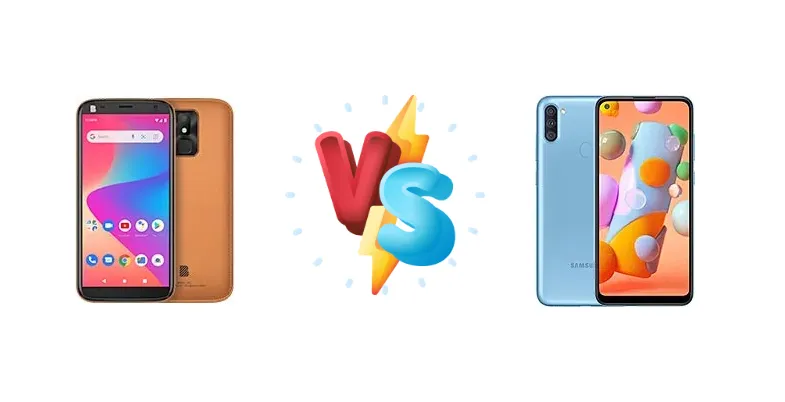
The BLU J7L and Samsung Galaxy A11 represent the lower end of the smartphone market, catering to users prioritizing affordability. However, a price difference doesn't always equate to a performance gap. This comparison dissects the key differences between these two devices, focusing on the impact of the Galaxy A11’s Qualcomm Snapdragon 450 chipset versus the J7L’s quad-core Cortex-A53 processor.
🏆 Quick Verdict
For the average user seeking a basic smartphone experience, the Samsung Galaxy A11 offers a noticeable performance advantage thanks to its octa-core Snapdragon 450. While the BLU J7L is cheaper, the A11’s smoother multitasking and faster app loading times justify the price difference for most.
| Network |
|---|
| 2G bands | GSM 850 / 900 / 1800 / 1900 | GSM 850 / 900 / 1800 / 1900 |
| 3G bands | HSDPA 850 / 900 / 1700(AWS) / 1900 / 2100 | HSDPA 850 / 900 / 1900 / 2100 |
| 4G bands | 1, 2, 3, 4, 5, 7, 12, 17, 28 | 1, 2, 3, 5, 7, 8, 20, 28, 38, 40, 41 |
| Speed | HSPA, LTE | HSPA 42.2/5.76 Mbps, LTE Cat4 150/50 Mbps |
| Technology | GSM / HSPA / LTE | GSM / HSPA / LTE |
| | - | 1, 2, 3, 4, 5, 7, 8, 12, 13, 17, 20, 25, 26, 28, 38, 39, 40, 41, 66, 71 - SM-A115U |
| Launch |
|---|
| Announced | 2020, October. Released 2020, October | 2020, March 13. Released 2020, May 01 |
| Status | Discontinued | Discontinued |
| Body |
|---|
| Build | - | Glass front, plastic back, plastic frame |
| Dimensions | 155 x 74.7 x 10.9 mm (6.10 x 2.94 x 0.43 in) | 161.4 x 76.3 x 8 mm (6.35 x 3.00 x 0.31 in) |
| SIM | Nano-SIM + Micro-SIM | · Nano-SIM· Nano-SIM + Nano-SIM |
| Weight | 173 g (6.10 oz) | 177 g (6.24 oz) |
| Display |
|---|
| Resolution | 720 x 1440 pixels, 18:9 ratio (~282 ppi density) | 720 x 1560 pixels, 19.5:9 ratio (~268 ppi density) |
| Size | 5.7 inches, 83.8 cm2 (~72.4% screen-to-body ratio) | 6.4 inches, 100.5 cm2 (~81.6% screen-to-body ratio) |
| Type | IPS LCD | PLS LCD |
| Platform |
|---|
| CPU | Quad-core 1.4 GHz Cortex-A53 | Octa-core 1.8 GHz Cortex-A53 |
| Chipset | - | Qualcomm SDM450 Snapdragon 450 (14 nm) |
| GPU | Mali-T820 | Adreno 506 |
| OS | Android 10 (Go edition) | Android 10, upgradable to Android 12, One UI Core 4.1 |
| Memory |
|---|
| Card slot | microSDXC | microSDXC (dedicated slot) |
| Internal | 32GB 1GB RAM | 32GB 2GB RAM, 32GB 3GB RAM, 64GB 3GB RAM, 64GB 4GB RAM |
| | eMMC 5.1 | eMMC 5.1 |
| Main Camera |
|---|
| Features | LED flash | LED flash, panorama, HDR |
| Single | 8 MP | - |
| Triple | - | 13 MP, f/1.8, 27mm (wide), AF
5 MP, f/2.2, 115˚ (ultrawide)
Auxiliary lens |
| Video | 1080p@30fps | 1080p@30fps |
| Selfie camera |
|---|
| Single | 8 MP | 8 MP, f/2.0 |
| Video | 720p@30fps | 1080p@30fps |
| Sound |
|---|
| 3.5mm jack | Yes | Yes |
| 35mm jack | Yes | Yes |
| Loudspeaker | Yes | Yes |
| Comms |
|---|
| Bluetooth | 4.0, A2DP | 4.2, A2DP, LE |
| NFC | No | No |
| Positioning | GPS | GPS, GLONASS, GALILEO, BDS |
| Radio | FM radio | FM radio |
| USB | microUSB 2.0 | USB Type-C 2.0 |
| WLAN | Wi-Fi 802.11 b/g/n, Wi-Fi Direct | Wi-Fi 802.11 b/g/n, Wi-Fi Direct |
| Features |
|---|
| Sensors | Fingerprint (rear-mounted), accelerometer | Fingerprint (rear-mounted), accelerometer, proximity |
| Battery |
|---|
| Charging | - | 15W wired |
| Type | Li-Ion 3000 mAh | Li-Po 4000 mAh |
| Misc |
|---|
| Colors | Blue, Black, Violet, Tan | Black, White, Blue, Red |
| Models | - | SM-A115F/DS, SM-A115F, SM-A115M, SM-A115M/DS, SM-A115U, SM-A115A, SM-A115AZ, SM-A115U1, SM-A115W, SM-A115AP, SM-S115DL |
| Price | About 60 EUR | About 160 EUR |
| SAR EU | - | 0.52 W/kg (head) 0.99 W/kg (body) |
BLU J7L
- Lower price point makes it highly accessible.
- Functional for basic smartphone tasks.
- Potentially longer battery life with conservative usage (depending on capacity).
- Significantly slower performance compared to the Galaxy A11.
- Likely limited software support and updates.
- Camera quality is likely subpar.
Samsung Galaxy A11
- Faster and more responsive performance thanks to the Snapdragon 450.
- 15W fast charging reduces downtime.
- Samsung’s brand recognition and potentially better software support.
- Higher price compared to the BLU J7L.
- Display quality is average for the price range.
- Camera performance is adequate but not exceptional.
Display Comparison
Neither device boasts a standout display. The context data lacks specifics on panel type or resolution for the BLU J7L, suggesting a standard LCD. The Samsung Galaxy A11 also utilizes an LCD, but its focus is on size (6.4 inches) rather than resolution. Both likely feature similar color accuracy and viewing angles, typical of this price bracket. The absence of high refresh rates or HDR support on either device means the display experience will be adequate but not immersive.
Camera Comparison
Camera performance is likely similar in real-world usage, given the lack of detailed sensor information. Both devices likely feature a primary camera and potentially additional sensors of limited utility. The A11’s image signal processor (ISP) within the Snapdragon 450 will likely offer slightly better image processing, resulting in marginally improved dynamic range and noise reduction. However, don't expect flagship-level image quality from either device. The absence of Optical Image Stabilization (OIS) on both phones means low-light photography will be challenging.
Performance
The core difference lies in the chipset. The Samsung Galaxy A11’s Qualcomm Snapdragon 450, built on a 14nm process, features an octa-core CPU clocked at 1.8 GHz, utilizing Cortex-A53 cores. This contrasts sharply with the BLU J7L’s quad-core 1.4 GHz Cortex-A53. The Snapdragon 450’s higher core count and clock speed translate to significantly better multitasking and app launch speeds. The 14nm process also contributes to improved power efficiency compared to an unspecified process for the J7L’s CPU. While both use the same Cortex-A53 architecture, the Snapdragon 450’s architecture is more efficient and capable. Users will notice a substantial difference in responsiveness when switching between apps or browsing the web on the A11.
Battery Life
Battery capacity is not specified for the BLU J7L, but given its price point, it’s likely comparable to or slightly smaller than the Galaxy A11’s. The Galaxy A11 supports 15W wired charging, a significant advantage over the J7L, which likely supports a slower charging rate. This means the A11 will reach a full charge considerably faster, reducing downtime. While the J7L might offer similar battery life under light usage, the A11’s faster charging provides a more convenient user experience.
Buying Guide
Buy the BLU J7L if you need a functional smartphone for extremely basic tasks like calls, texts, and light web browsing, and your budget is severely constrained. Buy the Samsung Galaxy A11 if you prefer a more responsive user experience, occasionally play casual games, or value the faster charging capabilities and brand recognition of Samsung.
Frequently Asked Questions
❓ Will the Samsung Galaxy A11 struggle with popular apps like Facebook or WhatsApp?
While the Snapdragon 450 isn't a powerhouse, it's capable of running apps like Facebook and WhatsApp smoothly. You might experience occasional slowdowns with multiple apps open simultaneously, but for typical social media usage, it should be sufficient. The BLU J7L will likely exhibit more noticeable lag.
❓ Is the difference in performance between the two phones noticeable for everyday tasks?
Yes, the difference is quite noticeable. The Galaxy A11’s octa-core processor and faster clock speed result in snappier app launches, smoother scrolling, and a more responsive overall experience. The BLU J7L will feel sluggish in comparison, especially when multitasking.
❓ How long will it take to fully charge the Samsung Galaxy A11 with the 15W charger?
With the included 15W charger, the Samsung Galaxy A11 should fully charge from 0% to 100% in approximately 2.5 to 3 hours, depending on usage during charging. The BLU J7L, lacking fast charging, will likely take considerably longer.